Banchan: Why a Korean Meal Arrives With a Table Full of Little Plates
Order one stew in Korea and the table fills with little plates. Here's why banchan come free, how refills work, and how to share them politely.
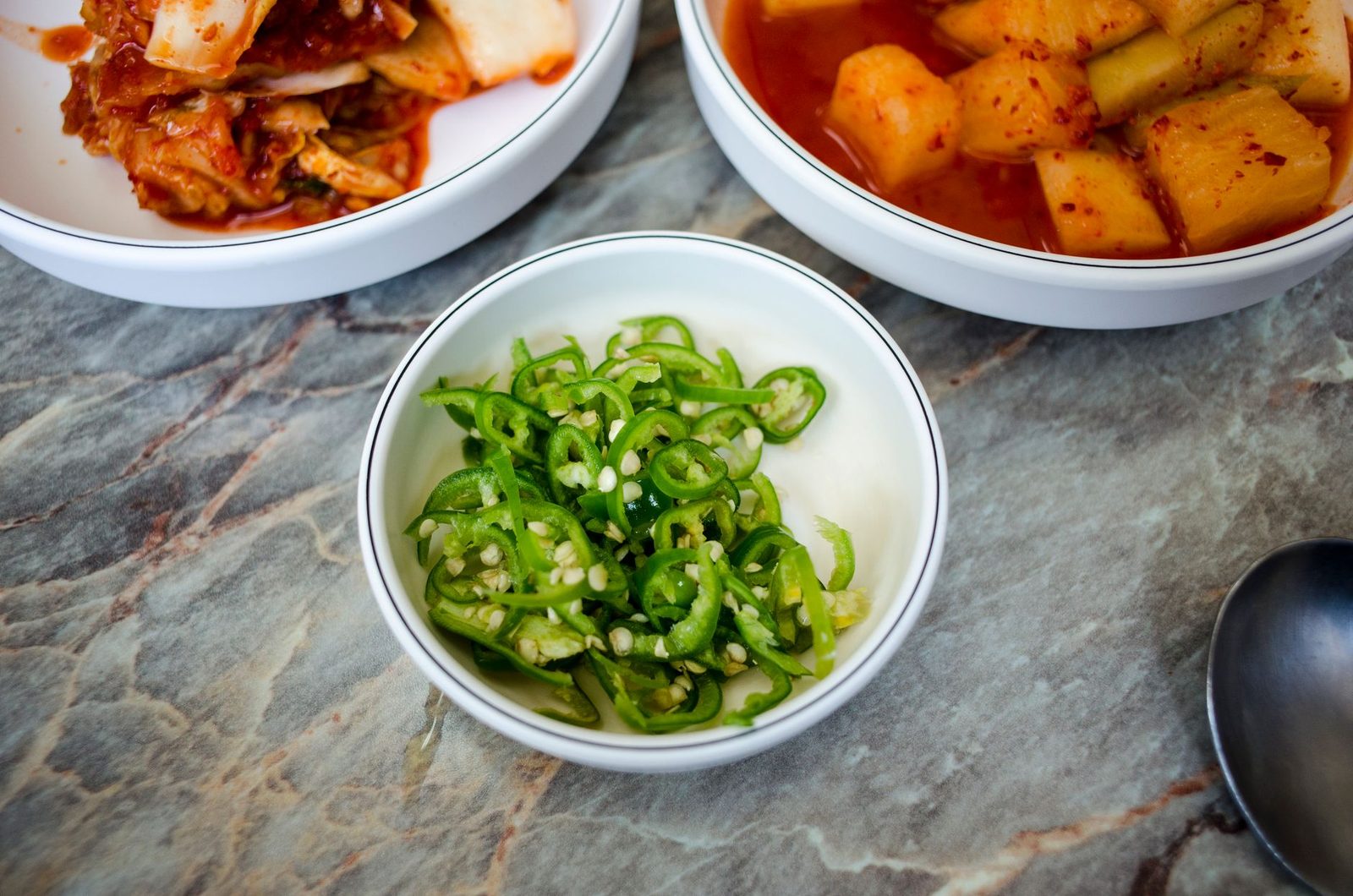
Order a single bowl of kimchi stew in Seoul and something curious happens before it even arrives: the table starts to fill. A little dish of kimchi. Seasoned bean sprouts. A few glossy braised potatoes. Maybe a slice or two of rolled omelet. You didn't order any of it, and nobody is going to add it to your bill.
These are 반찬 (banchan), the side dishes that come with rice, and in Korea they are not a bonus or a starter. They are part of what we mean by a meal. A Korean meal is rice plus the things you eat with rice, so the price of your main dish quietly covers the whole spread. That is also why, at most restaurants, when the kimchi runs out, you simply ask for more.
Made to go with rice
The word itself tells the story. Banchan is written 飯饌 in Chinese characters: the first means cooked rice, the second the dishes that keep it company. Traditional home meals were built around a setting called 반상 (bansang): rice and soup for each person, with banchan arranged around them. The Encyclopedia of Korean Culture explains that a bansang was ranked by 첩 (cheop), the number of small side-dish plates. Rice, soup, kimchi and sauces didn't count. An everyday table might be three cheop; five, seven and nine marked grander occasions, and a twelve-cheop spread is associated with the royal court.
Nobody counts plates at lunch today, but the logic survives. Banchan exist to keep plain rice exciting, bite after bite: salty, sour, spicy, nutty, crunchy, soft. A spoonful of rice, a pinch of something with your chopsticks, and repeat.
Why banchan are free (and refillable)
No law says side dishes must be free. It is a custom, and a strong one. Because banchan are seen as part of the meal rather than separate items, charging for each little plate would strike many Koreans as odd, a bit like paying extra for the bowl. Generosity plays a part, too. Koreans describe a lavish table as 상다리가 부러지게 (sangdari-ga bureojige), "so full the table legs might break," and a host who lets a guest leave hungry has failed at something that matters.
Refills follow the same logic. At most sit-down Korean restaurants, basic banchan such as kimchi and namul are topped up when you ask. Many casual places also have a self-serve station, often marked 셀프 (selpeu, "self"), where you refill your own little dishes: sometimes just kimchi and water, sometimes a whole row of side dishes.
The custom is not frozen in time. In early 2026, with lettuce about 41 percent pricier than a year before, The Korea Herald reported that restaurant owners were openly debating whether to charge for refills; in an informal online poll of self-employed owners, most still said no. Restaurants that mainly sell for delivery often already charge for extra side dishes. At the table, free banchan remain the norm, which makes them a kindness worth not abusing.
A field guide to the little plates
Banchan change with the season, the region and the cook, but a few families turn up again and again:
- 김치 (kimchi): fermented vegetables, present at nearly every meal. Napa cabbage kimchi, 배추김치 (baechu-kimchi), is the classic; cubed radish kimchi, 깍두기 (kkakdugi), often comes with beef soups.
- 나물 (namul): blanched or sautéed vegetables dressed with sesame oil, garlic and salt or soy sauce, such as 콩나물무침 (kongnamul-muchim, seasoned soybean sprouts) or 시금치나물 (sigeumchi-namul, spinach).
- 조림 (jorim): simmered in a soy-based sauce until glossy, like 감자조림 (gamja-jorim, braised potatoes) or 장조림 (jangjorim, soy-braised beef).
- 볶음 (bokkeum): stir-fried, like 멸치볶음 (myeolchi-bokkeum, crispy little anchovies) or 어묵볶음 (eomuk-bokkeum, fish cake).
- 전 (jeon): slices or patties dipped in flour and egg and pan-fried, such as 호박전 (hobak-jeon, zucchini).
- 장아찌 (jangajji) and 젓갈 (jeotgal): pickled vegetables and salted, fermented seafood, both bold enough that a little goes a long way.
Plenty of households keep the fridge stocked with 밑반찬 (mitbanchan), long-keeping side dishes such as soy-braised black beans, pickles and dried-fish dishes that can go straight from container to table. That is the secret behind a Korean home meal that appears in ten minutes: the rice is fresh, and the banchan were made earlier in the week.
One table, many chopsticks
Your rice and soup are yours alone, but banchan usually sit in the middle and everyone shares them. That turns every meal into a small exercise in consideration. Traditional table manners, as summarized by the Korea Heritage Service, begin with patience: when eating with elders or guests, wait for them to pick up their spoon first, then try to keep pace with them rather than racing ahead.
Shared dishes come with their own etiquette. Take the piece your chopsticks reach first instead of turning the dish over in search of the best one, and don't pick out the bits you dislike. At more formal meals, food is moved onto a small personal plate, an 앞접시 (apjeopsi), rather than eaten straight from the shared dish. Among friends, chopsticks often go directly into the common plates, but asking for an apjeopsi is never wrong. And the division of labor is simple: spoon for rice and soup, chopsticks for banchan.
If you visit Korea
- Do ask freely: 반찬 더 주세요 (banchan deo juseyo, "More side dishes, please"), or point and say 이거 더 주세요 (igeo deo juseyo, "More of this, please"). Calling out 저기요 (jeogiyo, "Excuse me") to catch a server's attention is perfectly normal.
- Do look for a self-serve station first. If you see a 셀프 sign, staff expect you to help yourself.
- Do take only what you will finish. Korea's food hygiene rules bar restaurants from reusing food that customers leave behind, so even untouched leftovers end up in the bin.
- Don't pack banchan from a self-serve bar into containers to take home. Stories of customers doing exactly that regularly make the Korean news, and owners are not amused.
- Don't assume everything refills. The main dish, and sometimes special sides, may not be included; when in doubt, ask.
- Do wait for the eldest at the table to start, and if someone is treating you, say 잘 먹겠습니다 (jal meokgetseumnida, "I will eat well") before you begin.
Quick answers
Are banchan free in Korea?
At most sit-down restaurants, yes. Side dishes are treated as part of the meal, and refills of the basic ones are usually free as well. Delivery orders and some restaurants may charge for extras.
Is it rude to ask for more banchan?
Not at all. Asking for more kimchi or namul is completely normal in Korea. Just ask for the amount you will actually eat.
Do you have to eat all the banchan?
No one expects every dish to be cleared. Trying a little of everything is a nice gesture, and taking only what you need, especially at self-serve bars, keeps waste down.
Sources
- 반상 (Bansang, the traditional rice-and-side-dish table) — Encyclopedia of Korean Culture
- 밑반찬 (Mitbanchan, long-keeping side dishes) — Encyclopedia of Korean Culture
- 한식 식사 예절의 재발견 (Rediscovering Korean table manners, 2024) — Korea Heritage Service
- Charging for banchan refills? Online poll among restaurateurs highlights growing pressure (Feb. 3, 2026) — The Korea Herald
- Administrative appeal ruling on reusing customers' leftover side dishes under the Food Sanitation Act — Korea Law Information Center