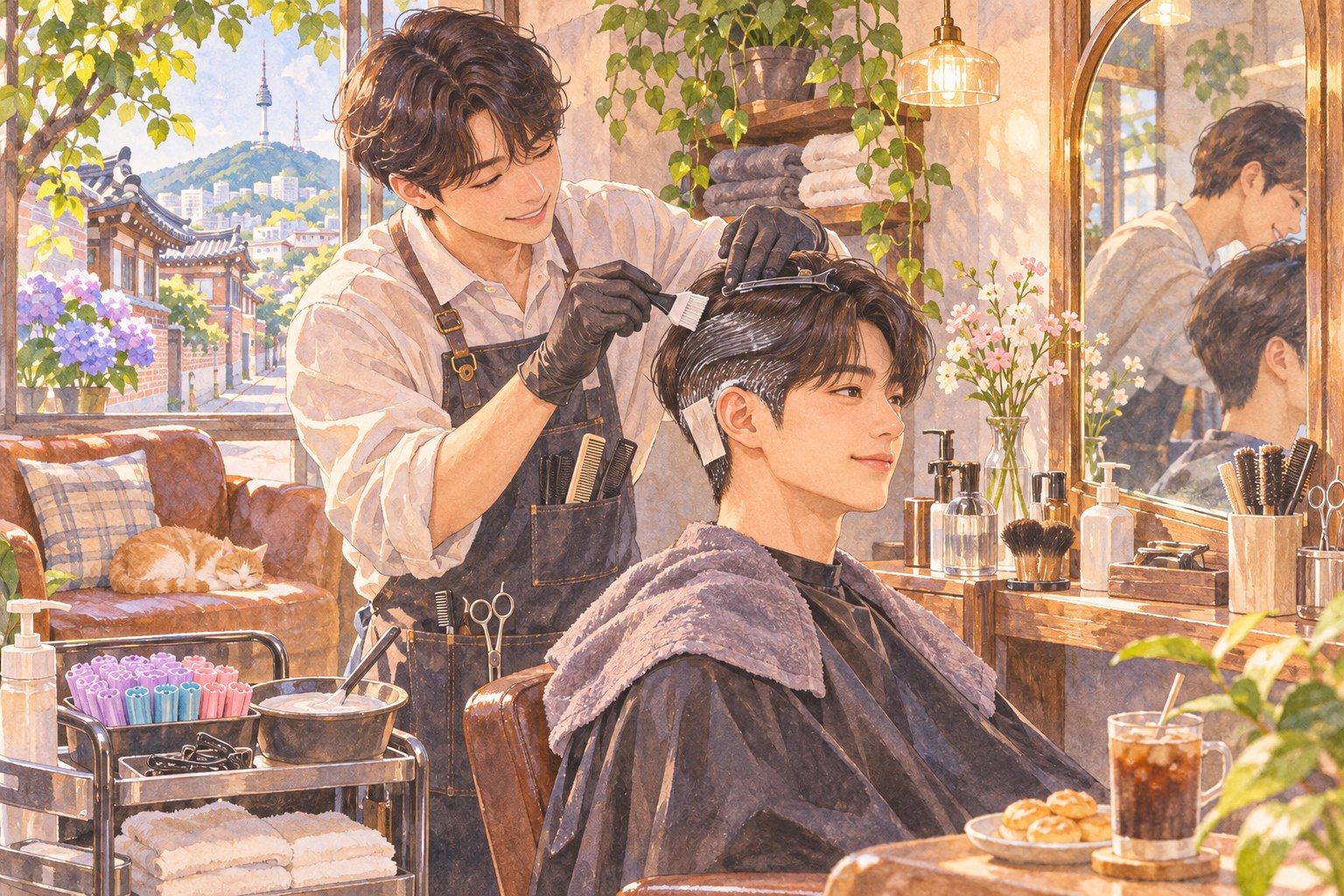
A Korean down perm (다운펌, daunpeom) is a men's perm that works in reverse. Instead of adding curl, it uses perm solution to set short side hair, and often the hair at the back, so it lies close to the head instead of sticking out above the ears. In Korea it is usually done in the same visit as a haircut, very often the short-sided two-block cut, and it is the fix barbers reach for when a man's sides refuse to lie flat.
Thick, straight hair cut short does not fall down. It stands out like the bristles of a brush, and the whole head starts to look puffy. A Marie Claire Korea editor, introduced in a February 2024 headline as 27 years into "a straight-hair life," wrote of a lifetime of side hair splaying out to the left and right. A down perm corrects the hair at the root, so the sides follow the shape of the head instead of pushing away from it.
What a Korean down perm does to men's side hair
The National Institute of Korean Language's open dictionary, Urimalsaem, defines a down perm as a hairstyle set to stay calmly settled without springing loose: a treatment done mostly for men, in which the hair rests against the head with a natural curve. That last part matters. A good down perm does not glue hair down like a helmet. It simply removes the outward push.
In a 2014 article in Sidae, a salon director explained that a down perm is usually done together with a cut, correcting the roots wherever the lines of the cut need it. The quickest version is simple: a guide posted by a Daegu salon owner describes brushing the solution on right after the cut, leaving it for about 15 minutes, then rinsing and drying. The same guide says the sides end up clinging to the head "like gim," the thin sheets of dried seaweed Koreans wrap rice in.
Why barbers pair it with the two-block cut
The 투블럭 (tubeulleok, two-block) cut, long at the front with the sides clipped short and close, is a basic of Korean men's hair. Urimalsaem notes that the standard spelling is 투 블록, though you will usually see 투블럭, and quotes a 2018 Ilgan Sports line putting the cut at the top of that year's men's hairstyle rankings.
Its weak spot is the growing-out stage, when clipped sides are just long enough to stand straight out. Another example sentence in the dictionary, from a 2012 Segye Ilbo article, warns that once short two-block sides lift, the whole head can look puffy, and advises pressing them down with a hair dryer. A down perm does that pressing for you, and a 2024 line from The Scoop, quoted in the down perm entry, names the payoff: no need to style it every time. The Daegu salon's guide is even titled, roughly, "If your straight hair won't behave after a two-block cut, a down perm is the answer."
How long it takes, and why it became a monthly habit
It depends on the method. The Daegu guide, posted in June 2026, gives the salon's own figures: about 40 to 50 minutes and roughly two weeks of hold for the quick, solution-only version; 1.5 to 2 hours and about a month when the hair is set with rods; and 2 to 2.5 hours and about two months for versions finished with a flat iron. Other salons will quote differently, but the trade-off is the same: more time in the chair, longer hold.
For one real menu, the online booking page of Hustlers Barbershop Hongdae in Seoul's Mapo district listed "Hair Cut & Down Perm" at 55,000 won in a two-hour slot when we checked on November 9, 2026, next to a plain "Hair Cut" at 35,000 won in a one-hour slot. Menus differ from shop to shop and change over time, so treat this as one shop's listing, not a going rate.
Why does it fade at all? Treated hair stays put, but new hair growing in at the root has not been treated, and every trim of short sides cuts away hair that was. Marie Claire Korea's editor put it plainly: because men's hair tends to be thick and strong, and the sides and back are cut short, keeping the effect is not easy. Add how often men already sit in the chair. A 2014 survey of 212 men living in Seoul, published in the Journal of Beauty Art Management, found they visited a salon at least once a month on average. Redo the sides at each visit and the down perm becomes a monthly habit, which is why menus often list the cut and the down perm as a single item.
Home down perm creams are sold in Korea too, but the same editor warned that doing it too often leaves hair as dry as a broom, and called a conditioning treatment afterward a must, not an option.
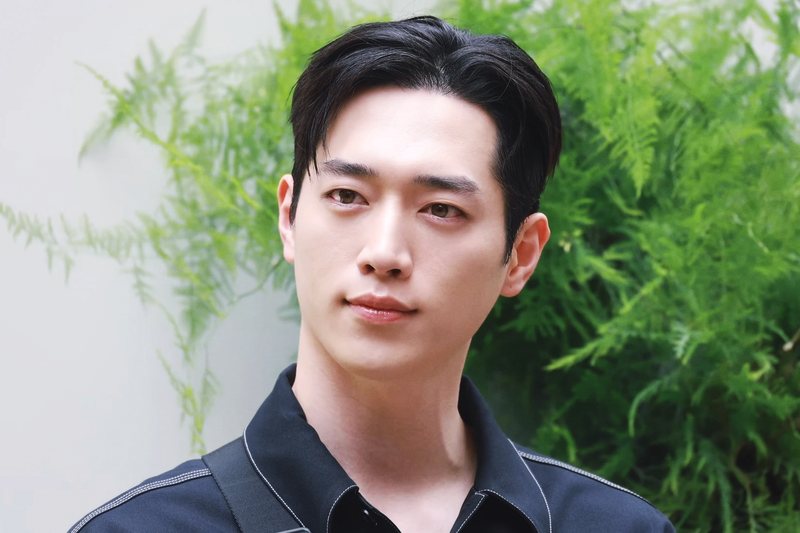
Parted perms and comma hair: the K-drama looks
A down perm handles the sides. The looks foreigners notice in K-dramas happen on top. The 가르마펌 (gareumapeom, parted perm; 가르마 is the parting line) gives the top hair lift and a soft fall away from a part. In July 2015, while Seo Kang-joon was appearing in the MBC drama Hwajeong, NewDaily quoted a salon stylist saying the actor often wore one, and that the style had moved on from short, pomade-like versions to softer 5:5 or 6:4 parts. During the Asian Cup in January 2024, Esquire Korea described footballer Lee Kang-in's parted perm as neatly pressed at the sides and back, with a 7:3 part: soft on top, flat at the sides.
The 쉼표 머리 (swimpyo meori, comma hair) is all about the fringe. Urimalsaem defines it as bangs shaped into a soft curve like a comma. In December 2015, Soompi called it the newest trend among male celebrities, naming EXO's D.O., Ryu Jun-yeol, Park Bo-gum, Yoo Seung-ho and Kang Dong-won. Under either look, the soft top usually sits on short, tidy sides, and that is where the down perm comes back in.
Why it counts as grooming, not vanity
To many Koreans, fixing puffy side hair is not vanity. The goal is to look 단정하다 (danjeonghada): neat, tidy and proper, a word used for clothes and manners alike. Sidae's 2014 piece pitched the down perm in exactly those terms, as a way to turn hair that lifts or sticks out into a 단정한 (danjeonghan) style. Job interviews, office life, meeting a partner's parents: Korean life is full of moments when looking tidy reads as respect for the people in front of you.
The same everyday logic explains why Koreans wear sunscreen to the office and why so many carry a cushion compact: care routines are treated as maintenance, not a statement. For men, the haircut is simply where that maintenance shows most.
Getting a down perm in Korea as a visitor
Many Korean salons and barbershops have a page on Naver Map (네이버 지도) with the menu, prices and, often, a booking button (예약, yeyak). Since June 2026, Naver lets visitors verify their identity with a passport issued abroad, with no Korean phone number needed, and then book and pay on Naver Map. A few phrases cover almost everything:
- 옆머리 다운펌 해 주세요 (yeommeori daunpeom hae juseyo): A down perm on the sides, please.
- 커트하고 다운펌 같이 해 주세요 (keoteuhago daunpeom gachi hae juseyo): A cut and a down perm together, please.
- 뒷머리도 해 주세요 (dwinmeorido hae juseyo): The back too, please.
- 너무 붙지 않게 해 주세요 (neomu butji anke hae juseyo): Not too flat, please.
Korean insider tip: Many salon menus split the down perm in two: the sides only (옆머리, yeommeori) or the sides and back (옆뒷머리, yeopdwinmeori). A price followed by a tilde (원~) means "from," so the final bill can be higher. Point to the one you want before the cape goes on, and ask 추가 요금 있어요? (chuga yogeum isseoyo?, "Is there an extra charge?"). Koreans ask this all the time; it is not rude.
Tipping is not expected. Under Korea's public hygiene rules, the price list a salon posts inside must already include VAT, materials and service charges, as Gwacheon City's summary of the rules spells out, so there is nothing to add at the counter (more in our story on tipping in Korea). And if you order three or more services, say a cut, a down perm and a color, the salon must give you each item's final price and the total before it starts, a rule announced by the Ministry of Health and Welfare that took effect on November 16, 2017.
Quick answers
Does a Korean down perm stop men's side hair from sticking out?
Yes, that is its whole job. It sets short side hair, and often the back, so it rests against the head instead of pushing outward. It is usually done in the same visit as a haircut, often a two-block cut.
How long does a Korean down perm last?
There is no fixed number. One Daegu salon quotes about two weeks for its quick version and about a month for a rod-set one. New growth is untreated and each trim removes treated hair, so many men simply redo it with every cut.
Do you tip at a Korean hair salon?
No. The posted price list must already include VAT, materials and service charges, so you just pay the menu price.