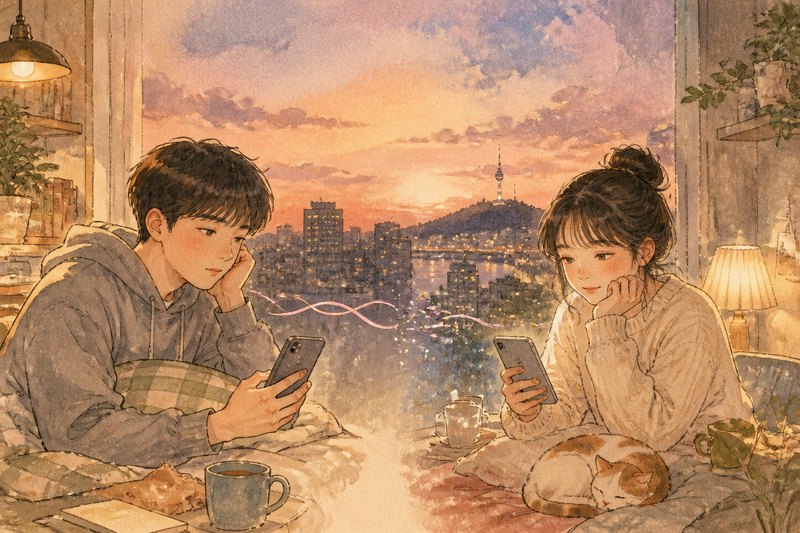
They message each other from good morning to good night. They have shared a few dinners, a movie and one very long walk home. Their friends have stopped asking “Are you two dating?” and started asking “So what are you?” Neither of them knows for sure. In Korea, this hazy in-between has a name: 썸 (sseom), usually written in English as “some.”
The word comes from the English “something,” as in “there’s something going on between them.” Urimalsaem, the open dictionary of the National Institute of Korean Language, defines sseom as a relationship between two people who are not a couple yet but stay close as if they were dating. It is the stage before officially dating: more than friends, not yet lovers. And it is not meant to last. Sseom usually ends one of two ways, with a confession or with a slow fade.

“Riding some,” and a pun on the number four
Koreans rarely say they “have” sseom. They say 썸 타다 (sseom tada), pairing the noun with 타다 (tada), a verb most learners first meet as “to ride.” So 우리 썸 타는 중이야 (uri sseom taneun jung-iya) means something like “we’re in the some stage right now.” The other person gets a title too: 썸남 (sseomnam, a “some” guy) or 썸녀 (sseomnyeo, a “some” girl). Urimalsaem lists the pair as well, for a man and a woman who are not a couple yet but act close, as if dating.
There is a joke version, too. The Korean verb for dating someone is 사귀다 (sagwida), and its first syllable sounds exactly like 사 (sa), the number four. Drop it to 삼 (sam, three) and you get 삼귀다 (samgwida): one number short of dating. Urimalsaem lists that one too.

The 2014 duet that put “some” on everyone’s lips
Young Koreans were already using the word by early 2013, when the Maeil Shinmun newspaper ran a trend piece on young people enjoying sseom. What carried it everywhere was a song. On February 7, 2014, Soyou of the girl group SISTAR and the singer Junggigo released a duet called simply 썸, known in English as “Some.” Its lyrics play on exactly this blurry line between friends and lovers.
A mellow R&B track was not supposed to rule a season of dance pop, but it did. According to OSEN, “Some” stayed at No. 1 on Korean music charts for 41 days in a row and finished as the top digital song of 2014 on the Gaon chart, and Soyou picked up the nickname 국민 썸녀 (gungmin sseomnyeo), “the nation’s some girl.” That March, The Korea Times noted the phrase popping up in webtoons, ads and text messages, and even in the hit drama My Love from the Star. Culture critics quoted in the piece saw a sign of the times in it: a generation facing uncertain jobs and futures had found a word for an uncertain kind of love.

How do you know you are in sseom?
There is no checklist, and that is the whole point. Sseom can start anywhere: in class, at work, or after a 소개팅 (sogaeting), the one-on-one blind date set up by a friend that we explain in our story on K-drama dating versus reality. Still, most Koreans would recognize the signs. KakaoTalk chats that open with good morning and close with good night. Coffee, meals or a movie with just the two of you, more than once. A casual “What are you doing this weekend?” that is clearly not about the weekend. A small pang when the other person mentions someone else.
Korean insider tip: Keep an eye on the small “1” next to your KakaoTalk message. It stays until the other person opens the chat, so Koreans in sseom notice when it vanishes and no reply follows. That is called 읽씹 (ikssip, “read and ignored”). Another milestone is speech level: if someone asks 말 놓을까요? (mal noeulkkayo?, “Shall we speak casually?”), saying yes moves you both from polite speech to banmal, the casual form, one step closer.
English speakers might call this the talking stage, and the two do overlap. The difference is that in Korea, sseom is understood as a waiting room, not a destination. Two people can go on many dates and still not be a couple, because in Korea a couple usually becomes a couple at one specific moment.

How sseom ends: the confession
That moment is the 고백 (gobaek), literally a “confession.” One person says it out loud, often with a simple 좋아해 (joahae, “I like you”) followed by 우리 사귈래? (uri sagwillae?, “Shall we go out?”). The Korea Herald, in a 2022 series on Korean dating quirks, put it plainly: only when one person confesses does the “some” stage end and the two become a couple. If the answer is yes, many couples count that day as day one, the start of the anniversary counting we unpack in our guide to Korean couple culture.
This is where foreigners are often caught off guard. In the same Korea Herald series, a Canadian woman married to a Korean man recalled that he asked her to be exclusive on their second date, which surprised her: where she grew up, she said, people usually drift into a relationship over several dates without any formal confession. A German student dating a Korean explained that back home, simply no longer seeing other people works as an indirect way of saying it. In Korea, people tend to want the words. If you are not sure where you stand, asking is not strange. It is the custom.
When sseom fizzles out
Not every sseom ends with a yes, or with a confession at all. Many simply fade. When the matchmaking company Gayeon asked 215 single adults how they could tell a sseom was ending, as reported by the Segye Ilbo in February 2023, the top answer was contact dropping off or the gaps between messages growing longer (51.6 percent), followed by a change in tone (24.7 percent). In a companion survey of 227 singles, the most popular ideal length for sseom was two to three weeks (47.6 percent), ahead of about a month (25.6 percent). Let it drag on, the thinking goes, and it tends to drift away.
Foreigners often ask a follow-up: can you be in sseom with more than one person? Since sseom is not a relationship, there is no official rule, and Korean lifestyle magazines have debated whether it counts as cheating. The language, though, leans one way. Treating several people at once as if you might date each of them is called 어장 관리 (eojang gwalli), literally “managing a fishing ground,” and it is not a compliment.

If you’re in sseom with a Korean
- Do take daily messages and repeated one-on-one plans as real interest, not just politeness.
- Don't assume you are a couple until someone has said so. In Korea, the label usually comes with words, not just time.
- Do speak up if you want more. A simple 좋아해 or 우리 사귈래? is perfectly normal, and either person can be the one to say it.
- Do ask 우리 무슨 사이야? (uri museun saiya?, “What are we?”) if it has gone on a while. It is a classic line for a reason.
- Do give a clear, kind answer if someone confesses to you, and take a no gracefully if you are the one asking.
- Don't keep several people on the hook at once. Even without an official rule, it can look like eojang gwalli.

Quick answers
What does “some” mean in Korean dating?
“Some” (썸, sseom) is the stage before officially dating, when two people are close, almost like a couple, but have not made it official. It comes from the English word “something.”
Is sseom the same as dating?
No. In Korea, two people usually become a couple only after a confession (gobaek), when one asks and the other says yes. Until then, it is sseom.
How long does sseom last?
There is no fixed rule. In a matchmaking company survey of Korean singles reported in 2023, two to three weeks was the most popular answer for the ideal length.