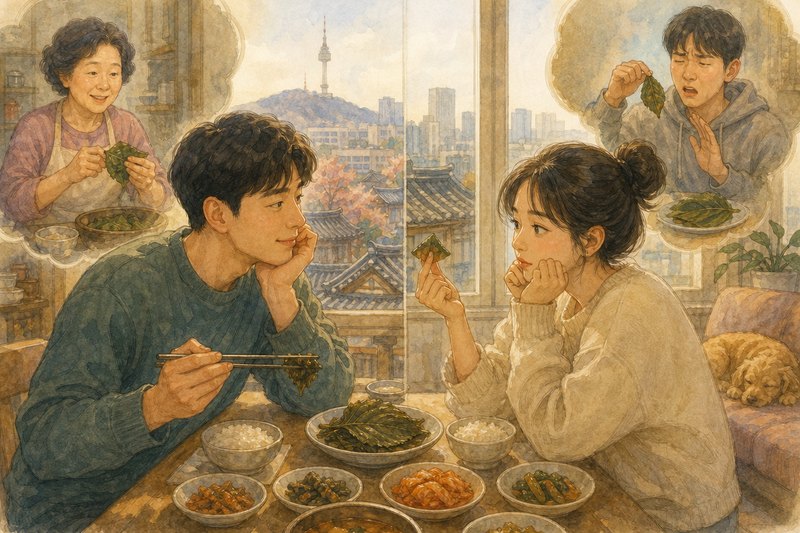
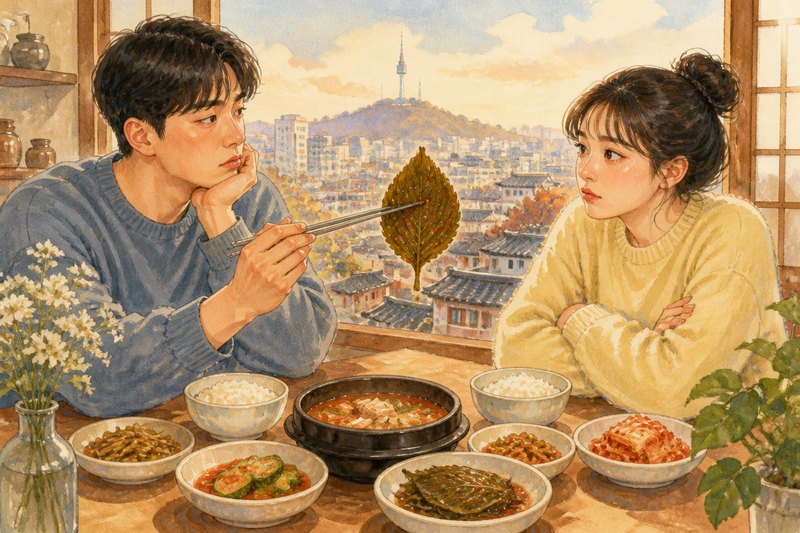
Picture a dinner for three: you, your partner and your friend. On the table sits a small dish of 깻잎장아찌 (kkaennip jangajji), perilla leaves marinated in soy sauce. Your friend tries to lift one leaf, but the whole stack comes up together. Your partner reaches over and holds the pile down with their chopsticks so your friend can peel off the top leaf. Good table manners? Or did your partner just cross the line?
That is the 깻잎 논쟁 (kkaennip nonjaeng), the perilla leaf debate, probably Korea's most famous dating dilemma. There is no right answer, and that is the point. Koreans have argued about it for years, and couples and friends use it as a quick, harmless way to see where the other person draws the line between kindness and something more.
Why one perilla leaf is so hard to pick up
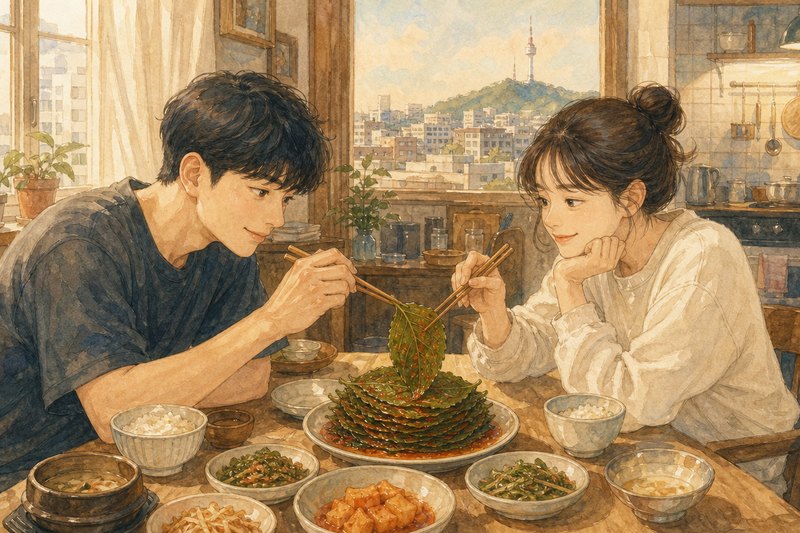
깻잎 (kkaennip) is the leaf of the perilla plant, 들깨 (deulkkae). It is often translated as “sesame leaf,” but perilla is not the plant that gives us sesame seeds. Koreans eat it fresh as a wrap at Korean barbecue and marinate it as a side dish. As a feature from Korea's Ministry of Culture, Sports and Tourism explains, the sauce and fermentation glue the leaves together, so peeling off just one with chopsticks takes real skill. At home the fix is teamwork: one person pins the stack, the other lifts the top leaf.
Korean insider tip: You can sidestep the dilemma by doing it yourself. Press the stack down with your spoon, since Korean tables set a spoon beside the chopsticks, and lift the top leaf by its stem. Lay it on a spoonful of rice, fold it over and eat it in one bite; the salty leaf is meant to season the rice. If the dish runs out, ask for more: most Korean restaurants refill banchan at no charge.
And at a Korean table, banchan sit in the middle for everyone to share. Helping each other is part of the meal: someone grills the meat for the table, someone passes the dish you can't reach. Holding down a leaf for someone is that same everyday courtesy. The debate only asks whether it feels different when the helper is your partner, and the person being helped is someone your partner might, at least in theory, find attractive.
Where the perilla leaf debate started
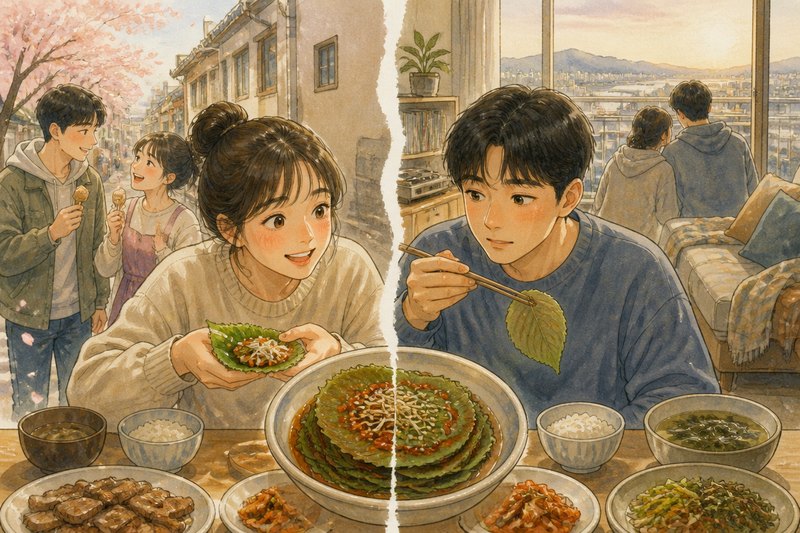
The scene comes from a real story. In mid-2018, singer Noh Sa-yeon described on SBS radio and TV a meal where her husband, singer Lee Moo-song, held down a woman's stuck perilla leaves with his chopsticks so she could take one. When it came up on SBS's My Little Old Boy (미운 우리 새끼) that August, the studio split, as a report on the episode noted: some of the mothers on the panel said to let him help, since those leaves never come apart anyway, while others said it was simply not OK. Noh said what hurt was not the leaf but the attention, because he had been watching another woman instead of looking at her. She also joked that her husband now won't even look at perilla leaves.
The question then took on a life of its own as a favorite 밸런스 게임 (baelleonseu geim, “balance game,” the Korean name for either-or questions) on variety shows, YouTube and social media. By early 2022 celebrities were fielding it in press interviews, and GQ Korea later named it the biggest debate of 2022. Even BTS argued about it in a 2022 video on their official YouTube channel, and the members didn't agree either, Star News reported.
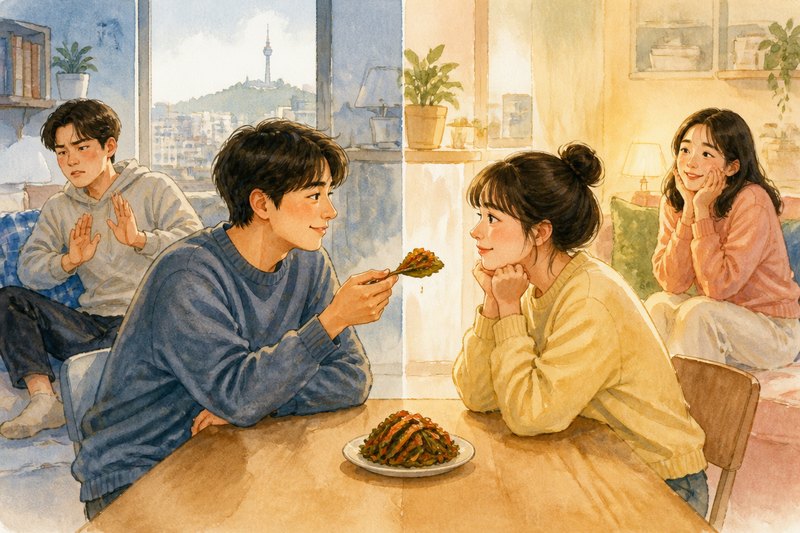
Kind or crossing the line? What each side says
The “it's fine” side keeps it simple: it's a leaf. Helping someone who is struggling is basic manners, and ignoring your friend would be ruder. For many it is also about trust: if you trust your partner, a pair of chopsticks on a side dish changes nothing.
The “not OK” side says it was never about the leaf. Your friend has chopsticks too. What stings is the attention: your partner noticed someone else's small struggle and stepped in, right in front of you.
Most people land somewhere in between, with conditions. Who is the friend? Was it casual, or did your partner make a moment of it? Would they do the same for anyone at the table? Nor does the verdict split neatly by gender or age: in that 2018 TV studio, people of the same generation ended up on opposite sides.
A gesture this small touches a nerve because friendships with the opposite sex are a real topic for Korean couples. In a late-2021 survey of 223 single adults by the marriage agency Gayeon, cited by The Korea Herald, 33.6 percent named friends of the opposite sex as a major cause of conflict between couples, the most common answer.
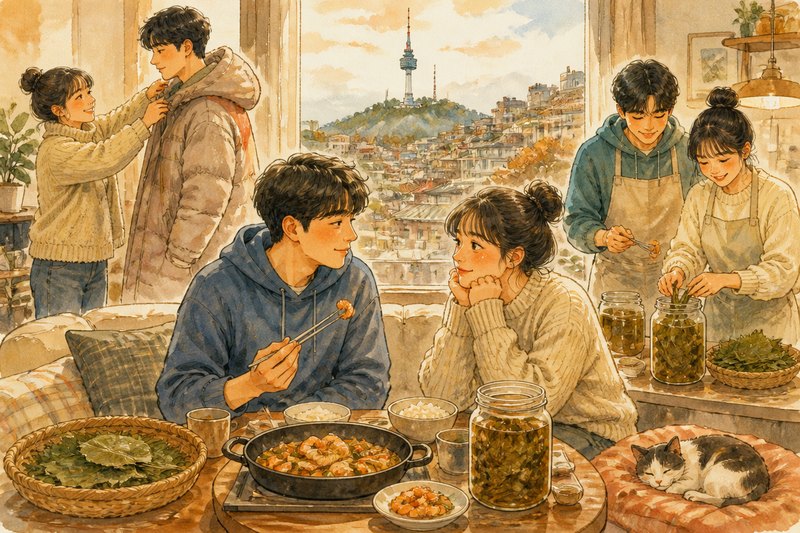
The shrimp, the padded coat and other spin-offs
Korea soon wrote sequels, each raising the stakes a little. GQ Korea and the Ministry of Culture feature both name these two:
- The shrimp debate: your partner peels shrimp for your friend. It takes longer and means handling someone else's food, so it feels like a bigger favor.
- The padded coat debate: your friend can't zip up their 롱패딩 (rong-paeding, the long padded coat that fills Korean streets every winter), so your partner does it for them. Some people who are fine with the leaf, and even the shrimp, draw the line here.
Each one is the same question in a new outfit: how much kindness can your partner show someone else, right in front of you, before it feels like too much?
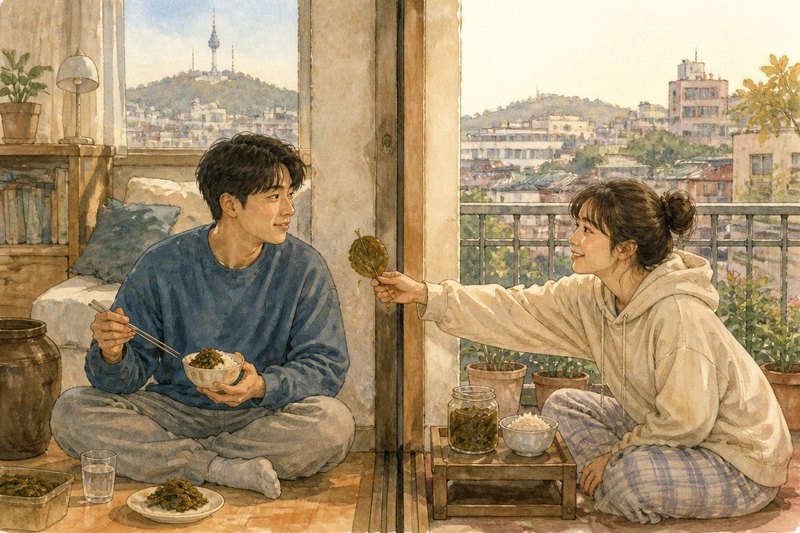
Namsachin, yeosachin and “crossing the line”
Two bits of slang run through every round of the debate. 남사친 (namsachin) and 여사친 (yeosachin) are short for 남자 사람 친구 (namja saram chingu, “male person friend”) and 여자 사람 친구 (yeoja saram chingu, “female person friend”). The word in the middle, 사람 (saram, person), does the work: 남자친구 (namja chingu) on its own means boyfriend, so adding “person” marks someone as a friend and nothing more.
The other is 선을 넘다 (seoneul neomda, “to cross the line”), often heard as 선 넘네 (seon neomne, “OK, now that's crossing the line”). Koreans use it for anything from a too-personal question to a joke that goes too far, usually with a laugh. The perilla leaf debate is really an argument about where that line sits.
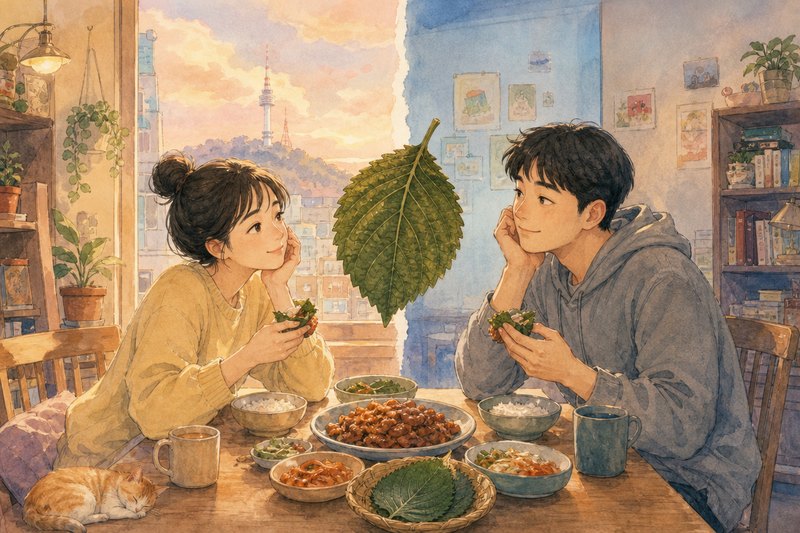
What the perilla leaf debate says about couples
It lasts because it is safe. Nobody is cheating and it is only a leaf, so couples can talk about jealousy and boundaries without a real fight. GQ Korea compared it to MBTI as a quick read on someone's values, and it often comes up early in a relationship, half as a joke.
It also fits a dating culture that likes to make the relationship visible, with anniversaries and matching items, as our guide to Korean couple culture explains. Agreeing on “what's OK with friends” comes from the same instinct. And if you know Korean romance mostly from TV, the debate is a reminder that real dating here runs on small, everyday moments, as we show in K-drama dating vs. reality.
If you date a Korean
- Expect the question. It is usually a playful test of your values, not an accusation.
- Give a reason. Your “yes” or “no” matters less than the why, so ask for their answer too.
- Agree with each other, not with the internet. Some couples are fine with leaves, shrimp and zippers; others with none of them. Neither is wrong.
Quick answers
What is the perilla leaf debate in Korea?
It's a dating dilemma: while you, your partner and your friend eat, your partner holds down stuck marinated perilla leaves so your friend can take one. Koreans argue over whether that is simple kindness or crossing the line.
Is helping with a perilla leaf considered cheating in Korea?
Not literally. It is a hypothetical, discussed half for laughs, about how much attention to someone else feels OK to you. The answer differs from couple to couple.
Why are marinated perilla leaves so hard to separate?
The thin leaves are stacked in a soy-based marinade that makes them cling, so lifting just one with chopsticks is tricky.