The Birthday Soup That Is Really a Thank-You to Mom
Every Korean birthday starts with the same humble bowl. Its story involves new mothers, a birth spirit and an old tale about whales.
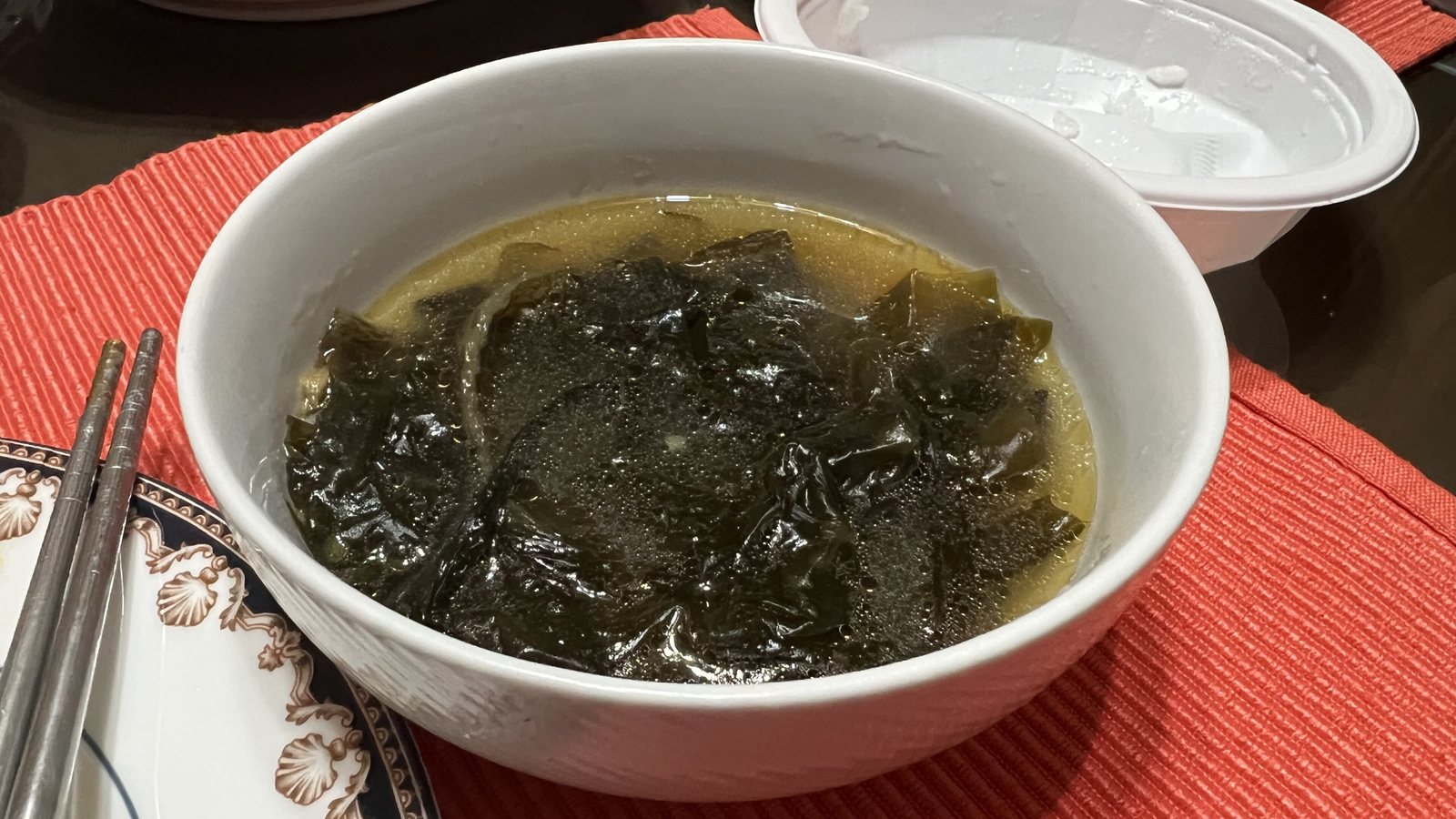
On a birthday morning in Korea, the celebration often starts before the cake and the candles, with a bowl of dark green soup. It is 미역국 (miyeok-guk, seaweed soup): soft ribbons of seaweed in a light, savory broth, usually with a little beef. Ask a Korean why it is on the table and you will hear some version of the same answer: "Because my mom ate it when I was born."
That is the heart of it. In Korea, seaweed soup is traditionally the first meal a mother eats after giving birth, and many new mothers keep eating it through the weeks of recovery that follow. Eating the same soup on your own birthday is widely understood as a way to remember that day, and the person who did the hard work on it. It is a quiet thank-you, served hot.
The first meal after birth
Traditional Korean childbirth customs gave seaweed a special place. Families prayed to 삼신 (Samsin), the spirit believed to grant children and to watch over mothers and newborns, often called Samsin Halmeoni, "Grandmother Samsin." A small offering table, the 삼신상 (samsin-sang), was set for her with rice, seaweed and a bowl of clean water. According to the Encyclopedia of Korean Culture, the rice and seaweed from that table were then cooked into the new mother's first meal after delivery.
That meal had its own name: 첫국밥 (cheot-gukbap, "first soup and rice"), white rice with seaweed soup. The seaweed bought for a birth was meant to stay long and unbroken, and folk belief held that snapping it could bring a difficult labor.
Why seaweed? Miyeok is rich in iodine and calcium, and Koreans have long believed it helps mothers recover and supports breast milk. An old story adds a touch of legend. An 8th-century Chinese encyclopedia from the Tang dynasty, the Chuxueji, is often quoted as saying that people of an ancient Korean kingdom, usually identified as Goguryeo, saw whales eating seaweed after giving birth and began feeding it to new mothers. Whether the whales were really experts in postpartum care is anyone's guess, but the tale is still told today.
From a mother's recovery to your birthday
Seaweed soup moved from the birth room to the birthday table long ago. Records compiled by the National Institute of Korean History describe how a birthday was traditionally marked in the morning, with white rice and seaweed soup for the person celebrating and their family, while guests were treated to noodle soup later, at lunch.
That is why the soup still feels most at home at breakfast. In many families a parent cooks it before the birthday child heads off to school, and some grown children flip the custom and make it for their mother instead. Either way, the meaning holds: the soup ties your birthday back to the day you were born.
It has also become a kind of shorthand. Asking a friend 미역국 먹었어? (miyeok-guk meogeosseo?, "Did you have your seaweed soup?") is a warm, casual way of asking whether anyone made a fuss over them today.
What goes in the pot
Miyeok is the same brown seaweed known in Japan as wakame. It is sold dried and swells dramatically in water, so a small handful is plenty for a family pot. The most common version starts by soaking the seaweed, then sautéing it with beef in a little sesame oil with garlic and 국간장 (guk-ganjang, soup soy sauce) before adding water and letting everything simmer. According to the Encyclopedia of Korean Culture, sautéing first gives a milky broth, while boiling without sautéing keeps it clear.
Beyond beef, there are plenty of variations:
- Seafood: mussels (홍합, honghap), clams (조개, jogae) or white fish such as sea bream.
- Perilla seeds: ground 들깨 (deulkkae) makes a nutty, creamy version.
- Jeju style: on Jeju Island, sea urchin roe goes into 성게미역국 (seongge miyeok-guk), a well-loved local dish.
Most cooks agree the soup gets better the longer it simmers, and many swear it tastes even better the next day.
The one day to skip it: exam day
For all its good associations, seaweed soup carries one awkward meaning. In Korean, 미역국을 먹다 (miyeok-guk-eul meokda, literally "to eat seaweed soup") is an idiom for failing an exam, and it can also mean being let go from a position. So on test days, plenty of students steer clear of it.
The popular explanation is texture: seaweed is slippery, and failing an exam is casually described as "slipping" (미끄러지다, mikkeureojida). Another widely told theory goes back to 1907, when the army of the Korean Empire was forcibly disbanded. The word for disbanding, 해산 (haesan), sounds exactly like the word for giving birth, so "ate seaweed soup" may have become a veiled way of saying someone had been dismissed. It is a good story, though not a settled one.
The opposite logic explains what Koreans do eat before big exams. Passing a test is 붙다 (butda), which also means "to stick," so sticky treats like 엿 (yeot, a chewy taffy) and 찹쌀떡 (chapssal-tteok, glutinous rice cakes) are classic good-luck gifts before the national college entrance exam.
If you visit Korea
- Do ask a Korean friend 미역국 먹었어? on their birthday. It shows you know the custom, and it usually earns a smile.
- Do try it at an everyday Korean restaurant. Seaweed soup often comes as the side soup with set meals, and some places make it the star of the menu.
- Do consider cooking it if you are celebrating a Korean friend's birthday. A homemade bowl means more than you might expect.
- Don't serve it, or joke about it, right before someone's exam, job interview or driving test.
- Don't overdo the dried seaweed if you cook at home. It expands many times over.
Quick answers
Why do Koreans eat seaweed soup on their birthday?
Because it is the soup Korean mothers traditionally eat after giving birth. Eating it on your birthday is a way to remember the day you were born and to thank your mother.
Why don't Koreans eat seaweed soup before an exam?
"Eating seaweed soup" is Korean slang for failing an exam, and slippery seaweed is linked to "slipping" on a test. Many students skip it on exam day, just in case.
Do Koreans only eat seaweed soup on birthdays?
No. It is an everyday home-style soup and a staple of meals for new mothers. The birthday bowl is simply the most meaningful one of the year.
Sources
- 미역국 (Seaweed soup) — Encyclopedia of Korean Culture
- 삼신상 (Samsin offering table) — Encyclopedia of Korean Culture
- 해마다 맞는 생일, 생일상 (Birthday tables) — National Institute of Korean History, Uri Yeoksa Net
- How seaweed soup became Korea's traditional birthday dish — Korea.net
- 실패의 상징 '미역국 먹었다', 구한말 군대 강제해산 자조적 표현에서 유래 — Yeongnam Ilbo