It tends to come right after names and ages have been traded: at the first meeting of a university club, on a blind date in a Seoul café, over a new team's welcome dinner. Someone leans in and asks, MBTI가 어떻게 되세요? (embiti-ai-ga eotteoke doeseyo?, "What's your MBTI?"). Four letters later, the table has a new topic: who plans everything, who is always late, who is quietly exhausted by all this socializing.
So why do Koreans ask your MBTI when they first meet you? Mostly because it is a quick, low-risk way to read a stranger. Korean social life rewards reading people well, and a four-letter type offers a shortcut: a ready-made topic, a hint about how to treat you, and a way to talk about personality without touching anything private. Since around 2020, when a free online version of the test swept the country during the pandemic, the question has become ordinary small talk. It is rarely a test you can fail. It is an invitation to talk about yourself.
The blood-type years
The habit is older than the letters. A generation ago, the question was 혈액형이 뭐예요? (hyeoraekhyeong-i mwoyeyo?, "What's your blood type?"). The belief that blood type shapes personality reached Korea from Japan, and many South Koreans embraced it in the early 2000s, including as a guide to romantic compatibility, CNN noted. Type A was supposedly considerate but shy, B creative but whimsical, O sociable and outgoing, AB rational but hard to read. The idea filled comics and dating advice, and in 2005 it got its own romantic comedy, My Boyfriend Is Type B (B형 남자친구), built on the stereotype that B-type men make charming but exhausting partners.
Blood type had an obvious weakness: there are only four of them, and as the Korea JoongAng Daily pointed out in 2022, there has never been solid scientific evidence behind the link. The paper placed both fads in a longer Korean habit of sorting people, alongside the twelve zodiac animals (띠, tti), saju fortune-telling (사주, saju) and face reading. What the country seemed ready for was a system with more boxes and a more modern feel.
That system arrived online. According to the JoongAng Daily, Korea's MBTI craze took off when 16Personalities, a free website whose 60-question quiz is modeled on the MBTI, caught on with young Koreans; it takes about 12 minutes. A Dankook University psychology professor told CNN in 2022 that the rise of the MBTI over the previous two or three years had coincided with the Covid-19 pandemic, and the JoongAng Daily linked the boom to the anxiety of those years, when personality tests gave young people a way to make sense of themselves. Meeting new people mostly through screens, a generation found it could introduce itself in four letters.
Why Koreans ask your MBTI so soon
To see why the question stuck, think about what a first meeting in Korea involves. People often ask your age early, not to pry but to work out which level of speech to use, as we explain in our story on how Korean age works. Much of the rest runs on 눈치 (nunchi), the knack of reading a room and sensing what someone wants before they say it. In a culture that prefers to avoid open friction, especially with someone you have just met, a wrong guess about a person can feel costly.
MBTI slots neatly into that work. Asking someone's type is far less personal than asking about their family or salary, yet the answer seems to tell you something useful. An I (introvert) might prefer a quieter seat and an early night; a J (judging) might want the plan fixed in advance rather than changed at the last minute. Whether or not the letters are accurate, they give both people a polite way to say things that might otherwise feel awkward: "I need some alone time after this," or "Could you send me the meeting place a day ahead?" The JoongAng Daily also pointed to Korea's strongly group-minded culture, in which belonging to a category can feel reassuring rather than limiting.
Once it caught on, it showed up everywhere at once. K-pop idols talk about their types on camera, and BTS even filmed "MBTI Lab" videos for their official YouTube channel, one of which drifted into Korea's famous perilla leaf debate. CNN reported in 2022 that about a third of profiles on Korean dating apps included a type, and that some young people used the letters to rule out partners before a first date. Brands followed, printing the 16 type codes on beer cans and offering holiday ideas by type.
The letters even became a punchline. In a 2023 sketch on the YouTube comedy channel Mimgorithm (밈고리즘), one woman snaps 언니 T야? (eonni ti-ya?, "Sis, are you a T?") at a friend whose blunt reply spoils the mood, and the line spread across the country. T stands for "thinking," the logical half of the T-versus-F pair, so 너 T야? (neo ti-ya?, "Are you a T?") is now a playful jab at anyone who answers feelings with facts. The Korea Herald reported in 2024 that the meme had even reached an ice cream menu, as an Earl Grey flavor called "Are You Tea?" It may say something about who is doing the teasing, too: in 2021 data from NERIS Analytics, the company behind 16Personalities, covering about 70,000 Korean test-takers, F types outnumbered T types roughly two to one, the paper noted.
When the letters went to work
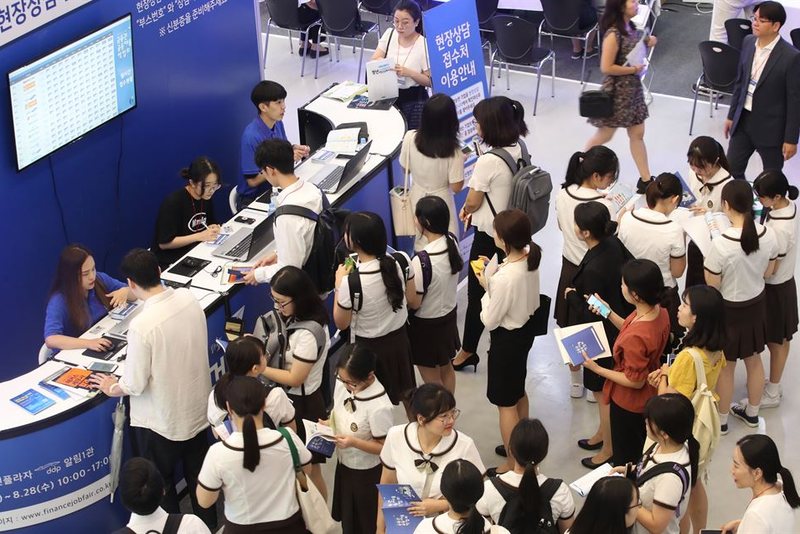
By the early 2020s the fad had walked into the job market, and that is where many Koreans started to push back. CNN found dozens of listings on a Korean job site seeking particular types, including a marketing role that wanted an ENFP, and the JoongAng Daily reported that some companies asked for applicants' MBTI on forms or in interviews. To job seekers, a personality quiz was turning into one more credential to fake. The head researcher of the Korea MBTI Institute warned that applicants would simply act out whatever type a company seemed to want, and argued that MBTI should have no place in hiring at all.
The numbers suggest the alarm was bigger than the practice. When the Ministry of Employment and Labor surveyed hiring managers at 752 companies in the spring of 2022, only 23 of them, or 3.1 percent, said they used MBTI in hiring, and just seven said it actually affected their decisions, Kyunghyang Shinmun reported.
Psychologists have long been cautious about the test itself. CNN cited a 1993 paper by psychology professor David Pittenger arguing that the data do not show 16 distinct personality types, and even the test's publisher, The Myers-Briggs Company, told CNN it would not be appropriate to use the test to pick a partner. In Korea, Ajou University psychology professor Kim Kyung-il has suggested that the results may reflect a social role, the face people show others, more than a fixed type, according to the Korea Herald.
There is a quieter catch as well. The quiz most Koreans took is not, strictly speaking, the MBTI; the Korea Herald notes that the free NERIS test differs from the original. The official Korean edition is published by Assesta, and it is not a free quiz anyone can open on a phone. On Assesta's official testing site, a Form M test sheet with its interpretation material is listed at 9,300 won a copy, and only buyers who hold an MBTI practitioner qualification can order it. The real thing, in other words, is meant to be given and explained by a trained practitioner, not compared over a second round of drinks.
What the four letters really ask
None of this has stopped the question, and most people asking it are not running a diagnosis. For many Koreans it is half a game, closer to trading star signs than sitting an exam, and the person asking usually just wants a way into the conversation. Answer with your four letters and one sentence about yourself, and you have given them exactly that.
Korean insider tip: When someone asks MBTI가 어떻게 되세요?, give your four letters and then one line about yourself, such as being an I who needs quiet after a party. That second line is what people are really fishing for. If you have never taken it, just say so; the free online quiz that started the craze takes about 12 minutes. And skip the "it's pseudoscience" speech on a first meeting. It sounds like you are refusing the small talk, not the test.
In Korea today, the four letters work less like a verdict and more like a polite opening move. They let a new coworker admit they need quiet, a date confess they hate surprises, and old friends tease each other for being "such a T." The science may not hold up, and most companies never used it to hire. But the question survives because it does what Korean small talk has always tried to do: work out how to be considerate to someone before you really know them. These days, that often starts with four letters.