Fewer Wrist Grabs, More Blind Dates: How Dating in Korea Really Works
The wrist grabs and chaebol heirs stay on screen. Real dating in Korea runs on friends' setups, busy schedules and a habit of counting days.

In a K-drama, love has its own choreography. Someone storms off, and a hand shoots out to catch their wrist. A night of soju ends with a piggyback ride home under the streetlights. The quietest person in the office turns out to be dating the heir to a chaebol, one of Korea's giant family-run business groups. And the first real kiss can take what feels like half the series to arrive.
Real dating in Korea is more down to earth, and in some ways more interesting. Many couples are introduced by friends or meet at school or work. Long working hours and living with parents shape when and where dates happen. And once two people become a couple, they start counting the days, a habit the dramas get exactly right. People are different everywhere, Korea included, so read what follows as common customs, not a rulebook. This is the first story in our Dating in Korea series.
What K-dramas get wrong, and what they get right
The famous tropes are storytelling shorthand, much like the last-minute dash through the airport in a Hollywood romance. Each squeezes a whole confession into one gesture, and they are fun precisely because they are bigger than life. Off screen, grabbing someone's wrist to stop them from leaving comes across as pushy, not romantic. Chaebol heirs are a tiny slice of the population. And a piggyback ride is sweet in a drama, but it is not a dating milestone anyone is waiting for.
Some details, though, come straight from real life: a friend arranging a blind date, the nervous moment when someone finally says how they feel, a couple celebrating 100 days together, matching outfits on a weekend outing.

How people actually meet: the sogaeting
The classic route is the 소개팅 (sogaeting), a blind date. The word joins 소개 (sogae, introduction) with “-ting,” borrowed from the English “meeting,” and the Standard Korean Language Dictionary describes it as a one-on-one meeting arranged by someone else. Usually that someone is a mutual friend who thinks two people might click, passes along a phone number, and then waits for the report.
A recent survey still puts it on top. In a February 2025 poll by the Daehak Naeil 20s Research Institute of 500 people aged 19 to 39 who were in a relationship, 25.8 percent said they first met their current partner on a sogaeting, followed by school (21.4 percent) and work (16.4 percent). Among respondents in their 30s, dating apps ranked third, at about 10 percent. And nearly half said three dates is the minimum before officially becoming a couple.
There are other routes, too. University students know the 미팅 (miting), a group get-together where young men and women meet to socialize. And there is the 맞선 (matseon), a formal introduction between two people who meet with marriage in mind, sometimes arranged through family or a matchmaking company. Dramas love an awkward matseon scene; in real life it is simply one option for people who feel ready to marry.
From “some” to day one
Before two people are officially together, they are often in the 썸 (sseom) stage, from the English word “something.” Urimalsaem, the open dictionary of the National Institute of Korean Language, defines 썸 타다 (sseom tada) as being close as if dating without yet being a couple. Expect lots of messages and lots of guessing.
What usually ends the guessing is a 고백 (gobaek), a confession. One person says it out loud, perhaps with a simple 우리 사귈래? (uri sagwillae?, “Shall we go out?”), and if the answer is yes, that day becomes day one. Many couples keep a running count of their days together on their phones, and the 100th day is the first big celebration, often with flowers, a gift or a nice dinner, followed by the 200th, the 300th and beyond. Matching outfits for a day out and couple rings are popular ways to show you are taken. On this point, the dramas are practically documentaries.
Real life gets in the way: work, schedules and living at home
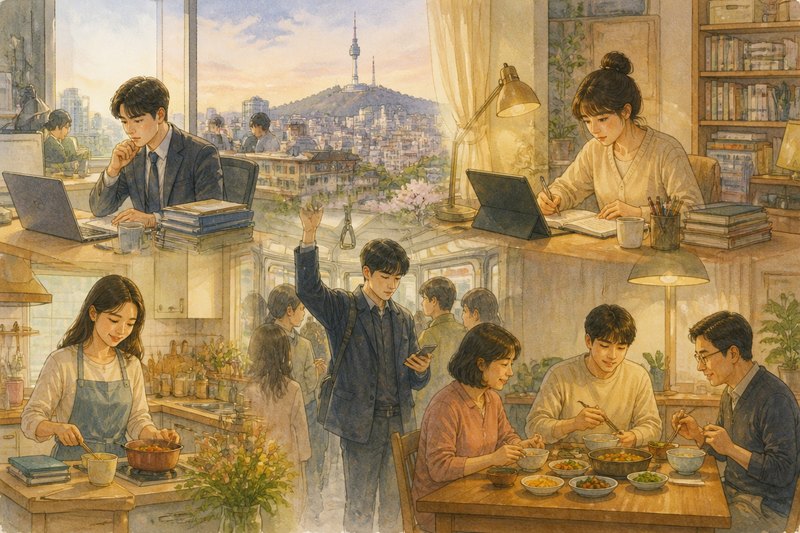
Drama characters seem to have endless free evenings. Real schedules are tighter. According to OECD figures reported by The Korea Herald, the average Korean worker put in 1,833 hours in 2025, 97 more than the OECD average, even after years of decline. Add commutes, classes and the famous speed of everyday life (see our story on ppalli-ppalli culture), and many dates get squeezed into weeknight dinners and weekends.
Home life matters, too. In the government's 2024 Youth Life Survey, published in March 2025, 54.4 percent of Koreans aged 19 to 34 lived with their parents, and the most common view was that it makes sense to move out once you have built up some assets. So a date usually ends with each person heading to their own home, and cafés, restaurants, parks and riverside paths do much of the work that apartments do elsewhere.
Living together before marriage has long been frowned upon in Korea, but views are shifting quickly. In Statistics Korea's 2024 Social Survey, 67.4 percent agreed that a man and a woman can live together without being married, up from 45.9 percent in 2012. Marriage, on average, comes in the early thirties: in 2024 the average age at first marriage was 33.9 for men and 31.6 for women.
Holding hands, texting and who pays
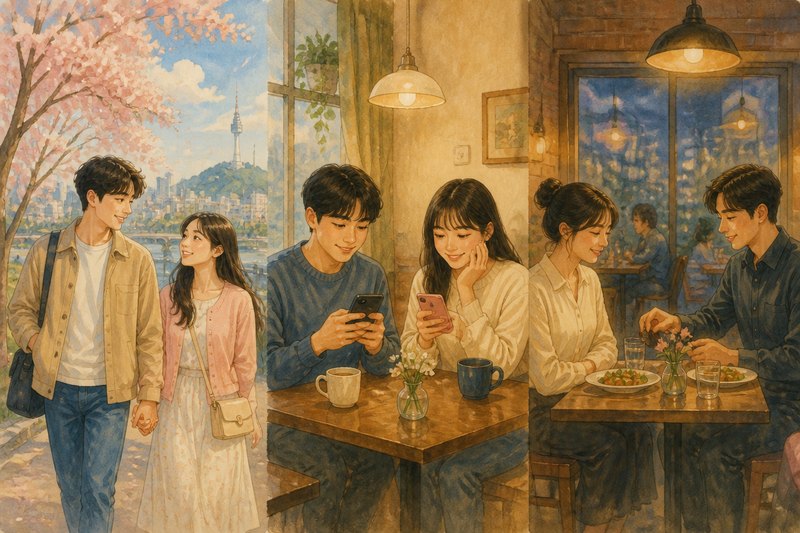
Public affection in Korea tends to be gentle. Holding hands, walking arm in arm and a quick hug are everyday sights; a long, passionate kiss on a crowded subway is more likely to draw looks, especially from older passengers. Norms have relaxed, and comfort levels still vary from person to person.
Many couples also stay in close touch through the day, trading messages about where they are and what they had for lunch. As for the bill, there is no single rule. Couples split it, take turns, or keep a shared 데이트 통장 (deiteu tongjang, “date account”) that both partners top up every month. In the 2025 Daehak Naeil survey, respondents reported spending an average of about 354,000 won a month on dates.
If you visit Korea
- Do say yes if a friend offers to set you up on a sogaeting. A café or a casual meal is a typical first meeting, and polite speech is normal until you both agree to switch to casual talk.
- Do keep affection low-key on subways and buses, and at temples, palaces and other quiet places.
- Do learn the day count if you are dating someone in Korea. Remembering the 100th day is a small gesture that means a lot.
- Do check how words like oppa are really used before you try them; our guide to what oppa means explains.
- Don't copy the wrist grab or any drama move that ignores what the other person wants. Respect and consent matter in Korea as much as anywhere.
- Don't expect anyone to act like a drama character, or to fit a type, because of where they are from. Get to know the person in front of you.
Quick answers
Is dating in Korea like in K-dramas?
Not really. The grand gestures are fiction. Many real couples meet on a blind date set up by a friend, at school or at work, though some customs on screen, like confessions and 100-day anniversaries, are very real.
What is a sogaeting in Korea?
A one-on-one blind date set up by someone you both know, usually a friend. In a 2025 survey of people in relationships, it was the most common way couples had first met.
Why do Korean couples celebrate 100 days?
Couples count the days from the day they officially got together, and the 100th day is the first big milestone. Many keep celebrating every 100 days after that.