Dinner on You, Coffee on Me: How Korean Couples Split the Bill
The old script said the man pays. Today many Korean couples take turns, go Dutch or share a “date account.” Here's how money works on a date in Korea.

Dinner is over, and one of you is already heading to the counter by the door, where the bill is usually paid in Korean restaurants. A few minutes later, at the café next door, the other one steps up first and says 커피는 내가 살게 (keopineun naega salge, “Coffee's on me”). Nobody pulled out a calculator, and nobody kept score out loud. For many Korean couples, that small exchange is how the money side of a date works today.
So who pays on a date in Korea? There is no single rule. For a long time, the expected script was that the man paid for most dates. Today many couples take turns, split the bill or pay into a shared “date account,” and each couple works out its own way. Read what follows as common customs, not a rulebook: people in Korea differ as much as people anywhere. This story is part of our Dating in Korea series, which began with how real dating compares with K-dramas.
The old script: one wallet for two
For decades the pattern was simple: on a date, the man reached for the bill. Writing in 2012, The Korea Times described how, in a male-dominated society, the money usually came out of the man's wallet no matter who had asked whom out, and how paying was seen as a kind of chivalry. A 2023 Korea Herald report summed it up the same way: men were traditionally expected to cover most dating costs.
That expectation grew out of a wider habit. In Korea, a shared meal has long been something one person pays for, not something divided item by item. There is even a word for it, 한턱내다 (hanteok naeda, to treat everyone), and among friends and coworkers the one treating was traditionally the older or more senior person. Dating followed a similar logic in an era when men were more often the main earners. A 2025 Korea JoongAng Daily report contrasted that older model with today's couples, who tend to share spending more equally.
Some of the old script lingers. Some people still like to treat on a first date, and a few feel strongly about it either way. But the idea that one person should always pay has been losing ground, especially among younger couples who see a date as something two people share.
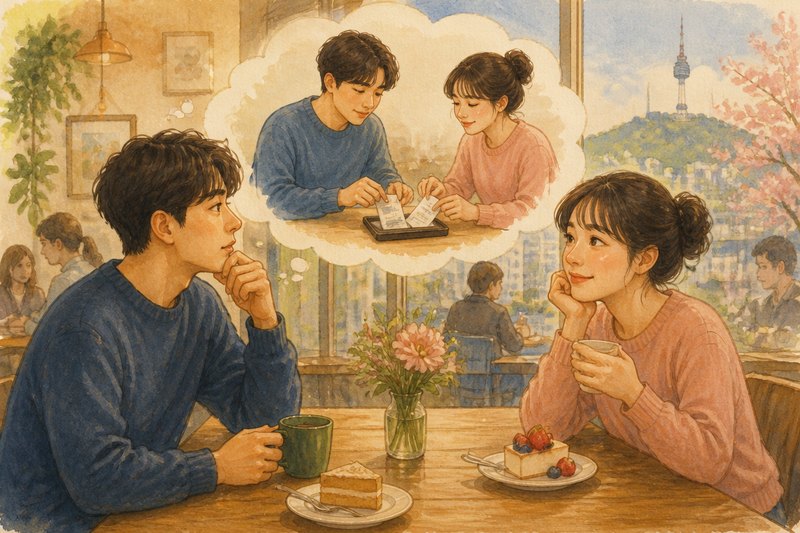
“Dutch pay”: the Korean word that sounds English
When Koreans split a bill, they call it 더치페이 (deochi pei, “Dutch pay”). It looks like English but is really Konglish, a Korean twist on the English phrase “going Dutch.” The Standard Korean Language Dictionary defines it simply as each person paying their own costs. The National Institute of Korean Language has suggested a native alternative, 각자내기 (gakja naegi, “each one pays”), but “Dutch pay” is the word that stuck. Its close cousin is N빵 (en-ppang), slang for dividing the total by N, the number of people at the table.
Among friends and coworkers, splitting is everyday life in Korea. With a partner, it is less automatic. In a 2022 Hankook Research survey reported by Financial News, 82 percent of respondents said they often or sometimes go Dutch with friends and 72 percent with coworkers, but only 37 percent with a boyfriend or girlfriend. Asked what is fair when one person is better off, 52 percent said that person should pay more, while 46 percent preferred splitting. Many Koreans, in other words, happily split with friends but handle money with a partner in a looser, more personal way.

Dinner on you, coffee on me
If one habit sums up dating money in Korea today, it is taking turns. A typical date is a chain of stops, often planned as a “date course”: a meal, a café, maybe a movie or a walk along the river. That makes alternating easy. One person pays for dinner, the other covers coffee, and next time you swap.
Surveys back this up. In a 2026 survey of 1,485 people in their 20s and 30s by the company behind the dating app Wippy, reported by The Korea Herald, the most common answer among women (40.8 percent) was that the couple takes turns paying, and another 31.5 percent said it depends on the situation. Among men, 40 percent said it depends on the situation and 32.1 percent said they take turns.
Taking turns does not always mean exactly equal. In a 2026 survey of 506 unmarried people aged 25 to 39 by the matchmaking agency Gayeon, reported by the Korea JoongAng Daily in September, the average date cost 115,000 won. Men said they spent 145,800 won per date on average and women 84,000 won, and respondents on average put a fair split at roughly 60 to 40, with the man paying a little more. More than half (55.7 percent) said they had never argued about dating costs, while 17.8 percent had. Surveys by dating companies are not national statistics, but they point the same way: Korean couples negotiate rather than follow one fixed rule.

The date account: one card for two
Some couples skip the turn-taking and pool their money instead. A 데이트 통장 (deiteu tongjang, “date account”) is a shared bank account just for dates. Usually one partner opens a group account in a banking app and invites the other, both put in a set amount each month, and meals, movie tickets and café bills come out of it. Every payment pings both phones, so nobody has to remember who paid last time.
It is a growing habit, not a universal one. At KakaoBank, one of Korea's biggest mobile banks, date accounts rose from about 360,000 at the end of 2021 to about 570,000 by the end of May 2025, the Korea JoongAng Daily reported, and nearly nine in ten users were in their 20s or 30s. Yet when the paper informally asked about a dozen people in that age group, only one couple had ever used one. Like couple rings and 100-day anniversaries (see our story on Korean couple culture), it is a custom some couples love and others skip.
Fans like the transparency and the end of awkward moments at the counter. The downsides are real, too. The Korea Herald reported in 2023 that one partner often ends up putting in more, deposit days get forgotten, and breakups can get messy because the account is usually in one person's name. Other couples skip the account altogether: one person pays, and the other sends their share by mobile transfer.
If you date someone in Korea
- Do offer to pay your share, or to cover the next stop. Even if your date insists on treating you this time, the offer is noticed.
- Do say thank you when someone treats you: 잘 먹었습니다 (jal meogeotseumnida, “I ate well,” meaning “thank you for the meal”), or the casual 잘 먹었어 (jal meogeosseo) with a partner. Our story on the “Have you eaten?” greeting explains why food talk carries so much warmth in Korea.
- Do take your turn. 다음엔 내가 살게 (daeumen naega salge, “Next time is on me”) keeps things balanced without turning a date into bookkeeping.
- Do talk about it once things get serious. Taking turns, splitting, a date account: none is more “Korean” than the others. What matters is that both of you feel it is fair.
- Don't assume anything because of someone's gender or nationality. Some Koreans love to treat, some prefer to split every time, and many fall somewhere in between.
Quick answers
Do men always pay on dates in Korea?
No. The man paying for most dates was the traditional expectation, and some people still like to treat, especially on a first date. Today many couples take turns, split the bill or share a date account, and it varies from couple to couple.
What is a date account in Korea?
A 데이트 통장 (deiteu tongjang) is a shared bank account that both partners pay into each month to cover dates. It has been growing among people in their 20s and 30s, but it is still far from the norm.
What does “Dutch pay” mean in Korean?
더치페이 (deochi pei) is the Korean word for splitting the bill so each person pays their own share. It is Konglish, based on the English “going Dutch.”