Day 1, Day 100, Day 1,000: Inside Korea's Couple Culture
Matching rings, goodnight texts and a couple's holiday almost every month. Here is how dating works in Korea, and why no two couples do it the same way.
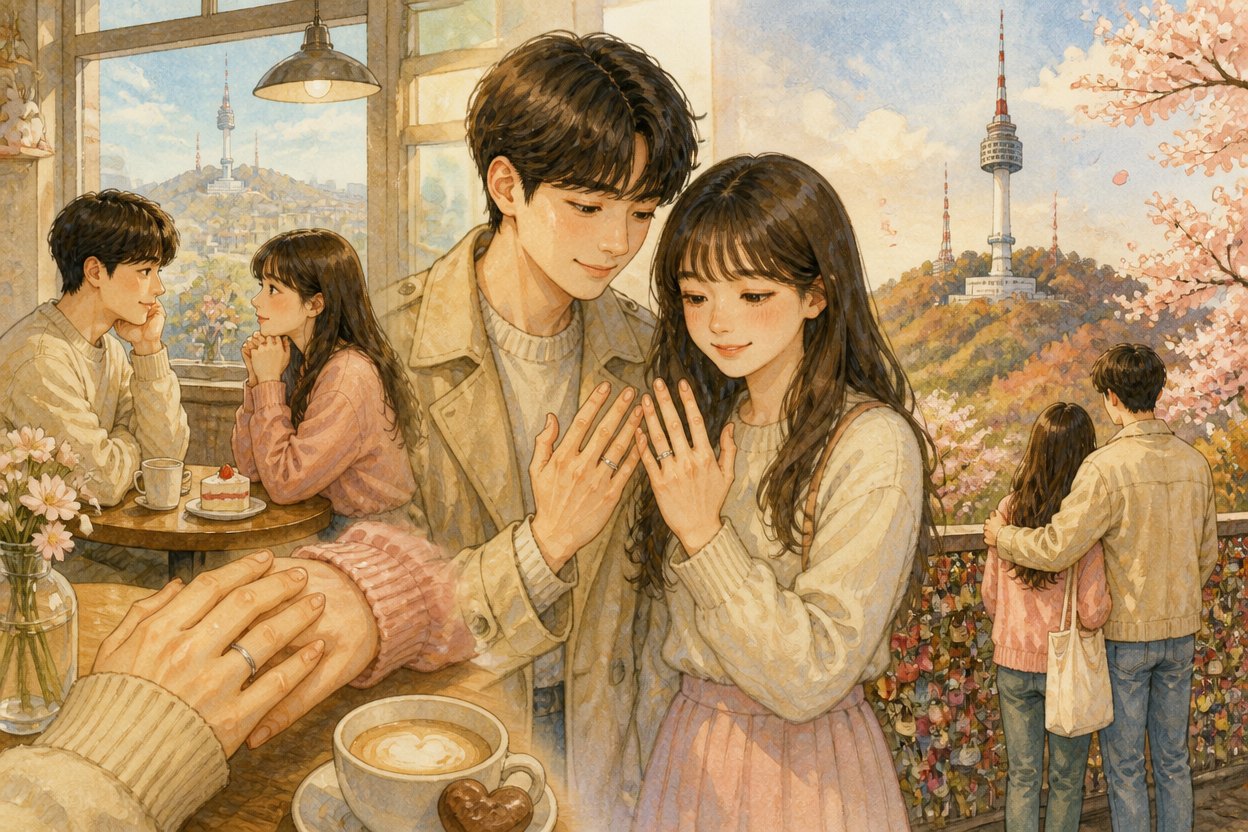
On many phones in Korea, a small number quietly keeps count: D+87, D+212, D+364. It is not counting down to anything. It is the number of days a couple has been together, and when it reaches 100, there will probably be flowers, a nice dinner, maybe even matching rings.
That little counter says a lot about dating in Korea. Relationships here often have a clear starting line and clear milestones, and many couples celebrate them out loud: an anniversary every 100 days, couple rings and outfits, messages from morning to night, and a calendar dotted with days for lovers (and one for singles). None of it is a rulebook. Some couples mark every milestone, others shrug at all of it, and people in Korea differ as much as people anywhere. But the customs are widely known, and knowing them makes a lot of Korean life, and a lot of Korean TV, easier to read.
It starts with a confession
Before a relationship there is often 썸 (sseom), from the English word "something." It is the hazy stage when two people are clearly interested in each other but have not defined anything. Urimalsaem, the open dictionary of the National Institute of Korean Language, describes 썸 타다 (sseom tada) as being close as if dating, without yet being a couple.
What usually ends the sseom stage is a 고백 (gobaek), literally a "confession": one person says how they feel and asks the other to go out with them. In its 2022 series on dating in Korea, the Korea Herald described this as the step that turns two people into a couple. If the answer is yes, a cheerful way to put it is 오늘부터 1일 (oneulbuteo iril): "From today, it's day one."

Counting from day one
That "day one" is meant literally. Korean couples usually count the day they got together as day 1, not day 0, so the 100th day falls 99 days later. There is even a playful, unofficial "confession day" on September 17: start dating that day, and your 100th day lands right on Christmas.
The 100th day, 백일 (baegil), is the first big milestone, followed by 200 and 300 days, the first anniversary and, for the truly dedicated, 1,000 days. According to the Korea Herald, couples typically mark these days by exchanging flowers and gifts, going out for a nice meal or taking a short trip together. Couple apps and phone widgets do the math, so nobody has to count on their fingers.
The number 100 already had a long history in Korea. Baegil is also the name of a baby's 100th-day celebration, one of the oldest family milestones. The Encyclopedia of Korean Culture explains that the custom grew out of an age when many infants did not survive their first months, so reaching day 100 was something to celebrate. When couples toast their own 100 days, the number already sounds like a party.
Couple items: love you can wear
On a weekend in a busy Seoul neighborhood, you may spot pairs in matching hoodies or identical sneakers. This is the 커플룩 (keopeulluk, "couple look"). The Korea Herald noted in 2022 that the Korean hashtag for it had more than 3.3 million posts on Instagram, and that couples wear it both to show the world they are together and simply to feel close.
The classic couple item is the 커플링 (keopeulling, couple ring). It is not an engagement ring, only a sign that two people are a couple, and some exchange one to mark a milestone such as their 100th day. Others keep it subtle with matching phone cases or pajamas, or coordinate colors instead of wearing identical clothes. And plenty of Koreans find full matching outfits a little too much and skip them. In Korea, a couple look is a choice, not a requirement.
Good morning, good night: staying in touch
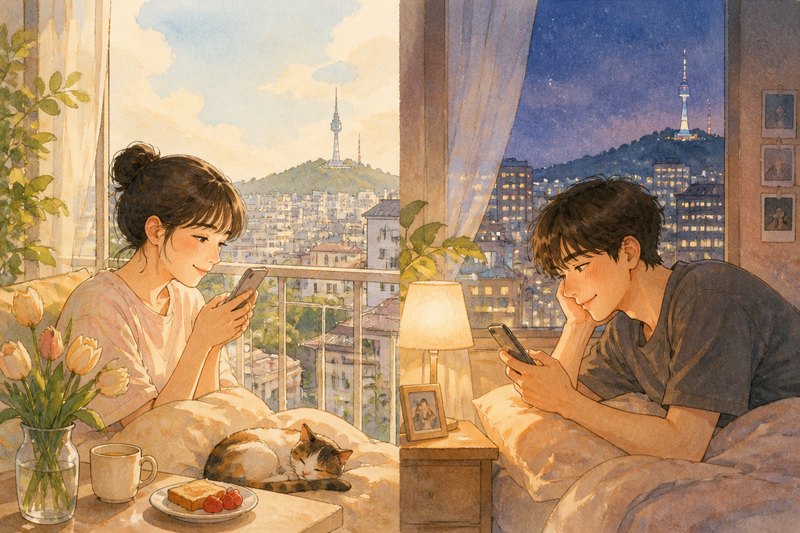
One thing that often surprises foreigners dating in Korea is how much couples stay in touch. In the Korea Herald's series, foreign partners described calls and messages that run throughout the day: where are you, what are you doing, what are you eating. For many couples, a morning hello and a goodnight message are simply part of the routine.
Most of this happens on KakaoTalk, the messaging app used by the vast majority of people in Korea. It shows a small "1" next to a message until the other person opens it, which has given "read, but no reply yet" its own small place among relationship worries. Many check-ins come down to 밥 먹었어? (bap meogeosseo?, "Did you eat?"), the everyday Korean way of saying "I care," which we unpack in our story on the "have you eaten" greeting.
How much contact feels right varies from couple to couple. If you are dating someone in Korea, it is worth talking about it openly rather than guessing.
A calendar full of couple days
Korea has turned the 14th of the month into a loose calendar of love. Two of the dates will look familiar, with a twist. On Valentine's Day (February 14), the traditional script is that women give chocolate to men. A month later, on White Day (March 14), men return the favor, often with candy.
Then comes Black Day (April 14), for anyone who received nothing on either day. Singles get together, sometimes dressed in black, to eat 짜장면 (jjajangmyeon, noodles in black bean sauce) and laugh about it. Lists name a "day" for every other 14th too, from Rose Day in May to Hug Day in December, but few people keep track of them all.
Pepero Day (November 11) is named after a thin chocolate-dipped biscuit stick that looks like the number 1. According to the Korea Times, it began in the mid-1990s among teenage girls in Korea's southeast, who swapped the sticks wishing each other to stay slim, and the snack's maker started promoting the day only in 1997. Today friends, coworkers, family and couples all join in. The same date is also Farmers' Day, and since 2006 the agriculture ministry has promoted it as 가래떡데이 (garaetteok-dei), a day to share long sticks of rice cake instead.
And then there is Christmas. It is a public holiday in Korea, and for many couples Christmas Eve is one of the biggest date nights of the year. The Korea Herald points to a bit of history: from 1945 to 1982 the country had a midnight curfew, and Christmas Eve was one of the few nights it was lifted.

Date courses, cafes and who pays
Koreans often plan a 데이트 코스 (deiteu koseu, "date course"): a route for the day, such as a meal, a cafe, a walk and maybe a movie. Cafes are a staple, and so are instant photo booths. The Korea Herald reported in 2023 that these self-photo studios had boomed, with most customers in their teens and 20s.
Who pays has been changing. The Korea Herald noted that the old idea that men should cover most dating costs no longer holds for many couples who value fairness, and some now use a 데이트 통장 (deiteu tongjang, "date account"), a shared bank account both partners pay into. It is still far from the mainstream, but it is growing: the Korea JoongAng Daily reported in 2025 that date accounts at one of Korea's biggest mobile banks rose from about 360,000 at the end of 2021 to about 570,000 by May 2025.
If you visit Korea
- Do ask a partner which anniversaries matter to them. Some couples mark every 100 days; others keep it to birthdays and the first anniversary. Neither is wrong.
- Do count the first day as day 1 if you want your 100th day to match a Korean partner's calendar.
- Do learn the pet names. Couples often call each other 자기야 (jagiya, "honey"), and some women call a boyfriend who is older than them 오빠 (oppa), a word we explain in our guide to oppa, unnie, hyung and noona.
- Do join in on Pepero Day or Black Day with friends. Both are lighthearted and not only for couples.
- Don't treat K-drama romance as a manual. Real couples in Korea are as varied as anywhere else, and no single picture fits all Korean men or all Korean women.
- Don't read a couple ring as an engagement. It usually just means "we're together."
Quick answers
Why do Korean couples celebrate 100 days?
The 100th day is the first big milestone of a relationship in Korea, and many couples celebrate every 100 days after that. The number also echoes baegil, the traditional 100th-day celebration for babies.
Do Korean couples count the first day as day 1?
Yes, usually. The day you get together is day 1, so your 100th day falls 99 days later.
What is Black Day in Korea?
April 14 is an unofficial day for singles who received nothing on Valentine's Day or White Day. Many get together to eat jjajangmyeon, black bean noodles, and turn being single into a joke they share.