The last box comes off the truck, and the new apartment turns into a maze of cardboard and packing tape. Nobody knows which box holds the pots, the gas may not be connected yet, and there is nowhere to sit but the floor. Then someone pulls out a phone and says the line that ends countless Korean moving days: 짜장면 시켜 먹자 (jjajangmyeon sikyeo meokja, “let's order jjajangmyeon”). So why do Koreans eat jjajangmyeon when moving? Mostly because it is the fastest, simplest way to feed everyone in a home that is not unpacked yet. It arrives quickly, fills up people who have spent the morning carrying furniture, and leaves almost nothing to wash.
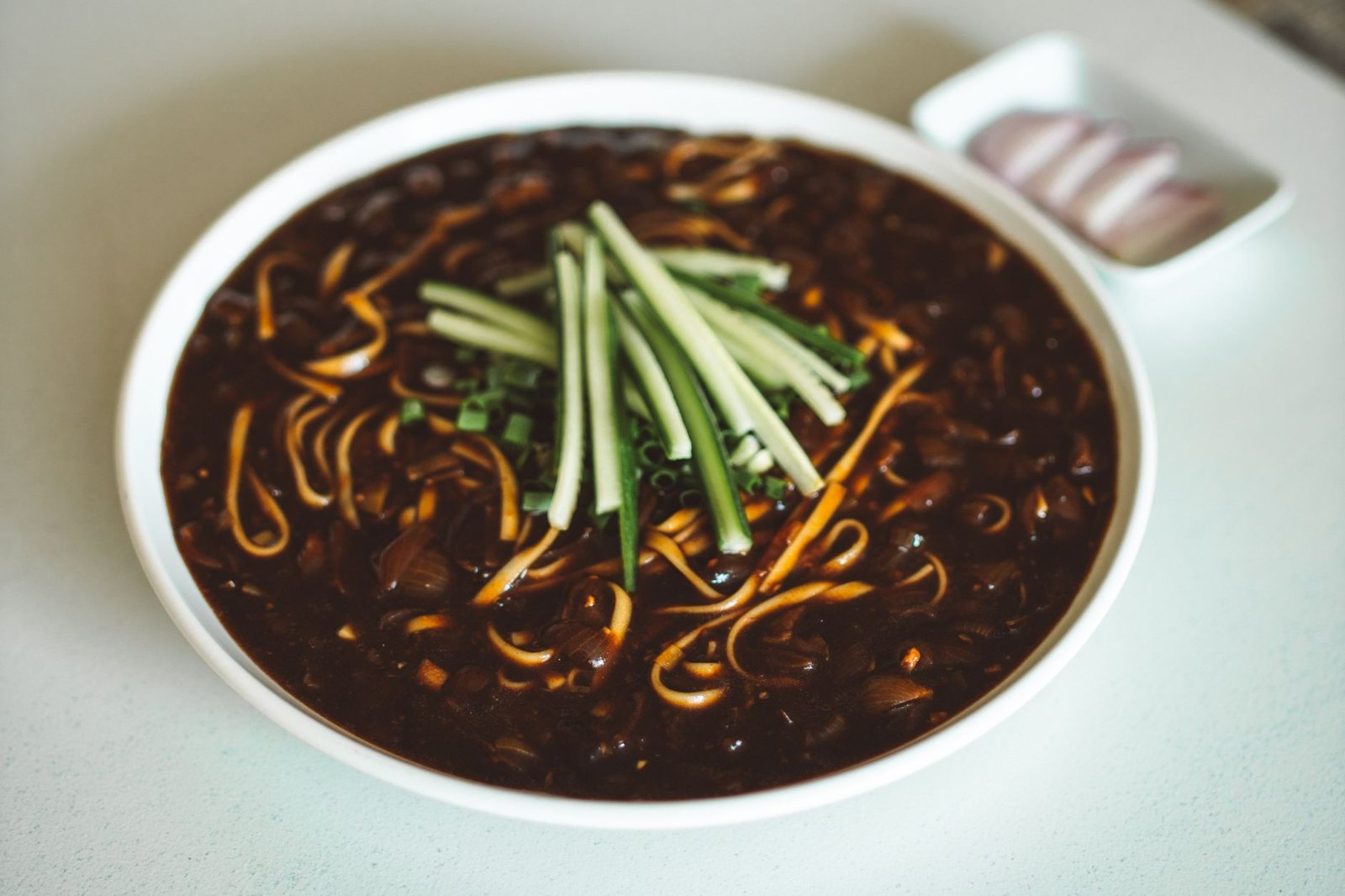
There is no superstition behind it and no promise of luck for the new house. 짜장면 (jjajangmyeon) is wheat noodles under a glossy black sauce of fermented soybean paste fried with pork, onion and other vegetables, and for decades it was the dish the neighborhood Chinese restaurant would bring straight to your door. Korea JoongAng Daily notes that the dish is now most famous as easy delivery food, above all on moving day, and filling enough to restore energy after hours of hauling heavy things. Convenience is only half the answer, though. For much of the last century, jjajangmyeon was also what Korean families ate on the days that opened a new chapter, and a new home is one of those days.
A noodle from the Incheon docks
The story starts at a port. After Incheon opened to foreign trade in 1883, Chinese merchants and laborers, many from Shandong province across the Yellow Sea, settled near the harbor in what is now Incheon Chinatown. With them came a Shandong home dish, zhajiangmian, “fried-sauce noodles.” According to Korea's government news service, Chinese merchants at the port turned it into cheap food that dock workers could eat in a hurry, adding the onions and carrots Korea grew in abundance, and it reached restaurant menus during the Japanese colonial period.
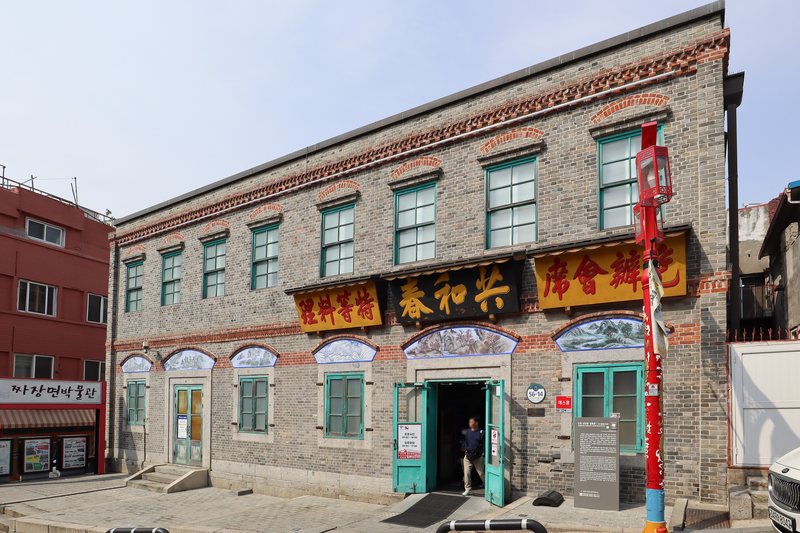
The restaurant most closely tied to that story is 공화춘 (Gonghwachun). According to Kyeongin Ilbo, a daily covering Gyeonggi and Incheon, a Shandong-born merchant arrived in 1907, opened a lodging house for traders and renamed it Gonghwachun in 1912 to celebrate the new Republic of China; the name means roughly “spring of the republic.” Korea's government news service dates the red-brick building to around 1908, so treat the exact years as the best-known version. Two things are settled: it grew into one of Chinatown's grand restaurants and stayed open until 1983, and the Korea Tourism Organization calls it the official birthplace of jjajangmyeon. Kyeongin Ilbo adds a fair caveat: Gonghwachun's first bowls were probably not quite today's dish, whose modern form is usually dated to the 1950s or later.
The real change happened in the sauce. In Shandong, the paste was brewed more like Korean doenjang than like today's black paste. In Korea, after liberation in 1945, caramel was mixed in, creating 춘장 (chunjang), the sweet, nearly black paste behind the dish's color. The Chinese original was saltier. Even the name went local. For years the only standard spelling was 자장면 (jajangmyeon), though almost everyone said it with a hard “jj,” until the National Institute of Korean Language accepted 짜장면 as a standard spelling in 2011. That is why menus abroad use both.
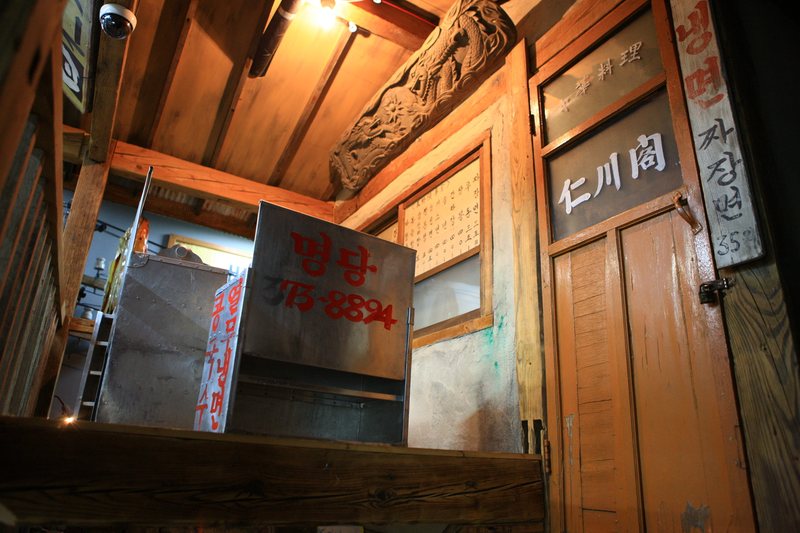
Gonghwachun's restored building, now a registered national heritage site, reopened on April 28, 2012 as the Jjajangmyeon Museum, the first in Korea devoted to the dish. Its six permanent rooms move from the Chinese dockside to a 1930s reception hall, a 1960s kitchen and the noodles' golden age, and one display traces how the metal delivery box changed over the decades. Exact subway exits, hours, fees and a taxi card are in the Getting there guide at the end.
The taste of a big day
For much of the 20th century, jjajangmyeon was not everyday food. Flour was scarce, and Korea JoongAng Daily notes that the dish stayed a luxury not everyone could get until years after the Korean War (1950–53). Then the flour came. Free American wheat aid began in the 1950s, and from 1964 to 1977 the government pushed a campaign for mixed grains and flour foods to save rice. Prices show a treat turning ordinary: using the museum's records, Kyeongin Ilbo traces a bowl from 15 won in the early 1960s, when an 80-kilogram sack of rice cost 3,010 won, to 35 won in 1964, 140 won in the mid-1970s, 350 won in the 1980s and 1,300 won in the early 1990s.
Cheap enough for most families yet still a step up from home cooking, it became the meal of milestones. From the 1970s into the 1990s, when eating out was rare, many families marked a graduation by walking to the neighborhood Chinese restaurant after the ceremony. The museum's golden-age room recreates exactly that scene: a 1970s restaurant where a family celebrates a graduation over bowls of black noodles. The 1992 cartoon Black Rubber Shoes (검정고무신), which looks back on the 1960s, shows the same dish as the food of a special day such as graduation.
By the 1980s and 1990s, Korea JoongAng Daily says, the noodles had become a quick, cheap way to fill up, popular with people grabbing a break at billiard halls and video arcades, and restaurants were bringing it to the door. Yet the special-day glow never fully wore off. Kyeongin Ilbo notes that many Koreans grew up going to a Chinese restaurant or ordering jjajangmyeon on graduation days, on moving days and whenever something good happened to the family. A move is one of those thresholds, and Korea already had a dish for them.
Why Koreans eat jjajangmyeon when moving: the box at the door
Long before delivery apps, the neighborhood Chinese restaurant was the delivery service most Koreans knew. A rider would arrive with a dented aluminum case, the 철가방 (cheolgabang, “iron bag”), holding real bowls sealed in plastic wrap. When you finished, you left the empty bowls outside the door and the restaurant came back for them. Speed mattered, because jjajangmyeon noodles soak up the sauce and swell if they sit. Koreans call this 불다 (bulda), and a bowl that has “bloated” on the way is a small tragedy. A country famous for wanting everything done quickly was always going to love a dish that rewards eating fast.
Now picture a Korean moving day. Families once moved with relatives and friends hauling boxes; today many hire a 포장이사 (pojang isa, “packing move”), where a crew packs, carries and unpacks everything. Either way, lunch has to appear in the middle of the chaos for a whole group, with no table, no clean dishes and perhaps no working stove. Jjajangmyeon solves all of it at once: one phone call, the same dish for everyone, fast to arrive and fast to clear away. Newspaper spread on the floor stands in for a tablecloth, because there is no table yet and black bean sauce stains whatever it splashes. Nobody recorded the first moving-day bowl; the habit grew out of plain logic, not ritual. Today the bowls are often disposable, the order goes through an app, and plenty of families pick fried chicken instead. Still, jjajangmyeon is the meal most Koreans picture when they think of moving day.
Korean insider tip: Peel off the plastic wrap and mix right away, working the sauce through the noodles with chopsticks before anyone takes a bite, or they soon swell and clump. Whoever carried the heaviest boxes can ask for 곱빼기 (gopbaegi), a double portion. And if the order arrives in real bowls instead of disposable ones, give them a quick rinse, stack them back in the bag and set them outside your door; the restaurant will come back for them.
Black noodles for singles, and a choice with no right answer
The dish of new beginnings has a funnier, lonelier side too. Korea loves its couple days: on February 14, women traditionally give chocolate, and on March 14, White Day, men return the favor. For anyone who received nothing on either day there is April 14, Black Day, when singles gather over bowls of black noodles, some of them dressed in black. Korea JoongAng Daily explains the joke: their hearts are said to have burnt black after missing out on the sweets. It is unofficial and half-ironic, a shared shrug more than a holiday, and it makes more sense once you see how crowded Korea's calendar of couple days is.
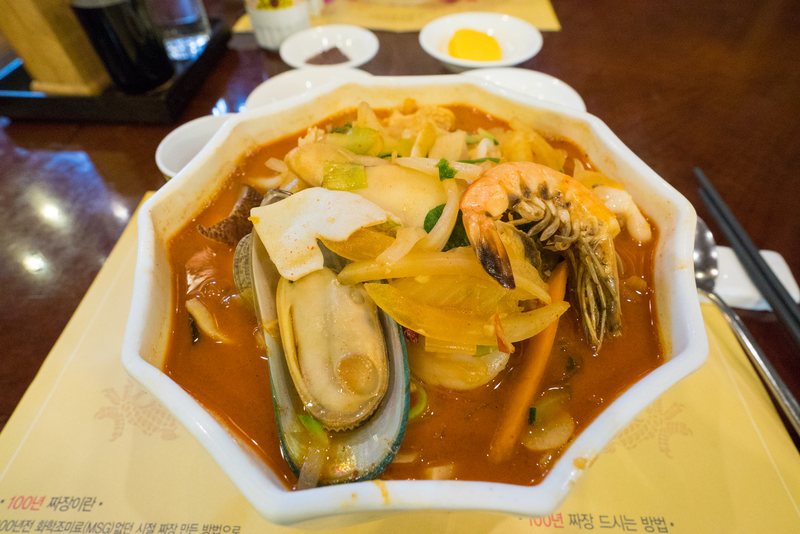
Then comes the question every Korean faces when a Chinese-restaurant menu appears: 짜장 or 짬뽕? Jjamppong, the other pillar of Korean-Chinese food, is a fiery red noodle soup full of seafood and vegetables. One is sweet and soothing, the other spicy and brothy, and agonizing between them is a national joke about indecision. Restaurants brokered a peace deal: 짬짜면 (jjamjjamyeon), one bowl with a divider down the middle, half of each. Visiting a Chinatown restaurant, a Kyeongin Ilbo reporter saw another fix: diners set a jjamppong beside a jjajangmyeon in the middle of the table and shared, so everyone tasted the black noodles.
In Incheon, the dish has come full circle. The city has named jjajangmyeon part of its local heritage, and in November 2025 it hosted its first city-run 1883 Incheon Jjajangmyeon Festival, named for the year the port opened. Everywhere else the meaning is quieter. Jjajangmyeon is no longer anyone's idea of luxury, yet Koreans still reach for it when life shifts: a graduation, a spring evening for the uncoupled, the first afternoon in a new home. A dish that began as fast food for dock workers has become the taste of starting over, and when the last box comes through a door somewhere in Korea, someone will still say it: let's order jjajangmyeon.
Getting there
Jjajangmyeon Museum (Incheon Chinatown) 짜장면박물관
- Subway
- Line 1 or Suin-Bundang Line, Incheon Station, Exit 1 (about 4 min walk)
- Bus
- es 2, 15, 26 or 45 to Incheon Station, then about 4 min on foot
- Hours
- Tue–Sun 09:00–18:00 (last entry 17:30); closed Mondays (the next day if Monday is a public holiday), January 1, and on Seollal and Chuseok days
- Admission
- Adults 1,000 won, teenagers 700 won; free for children 12 and under and visitors 65+. Combined ticket for five old-port museums: adults 3,400 won
- Tip
- No parking of its own; use the Chinatown public car park. Museum phone: +82-32-773-9812. Korean-Chinese restaurants are a few steps away in Chinatown
Checked on November 20, 2026; confirm on the official site before you go.