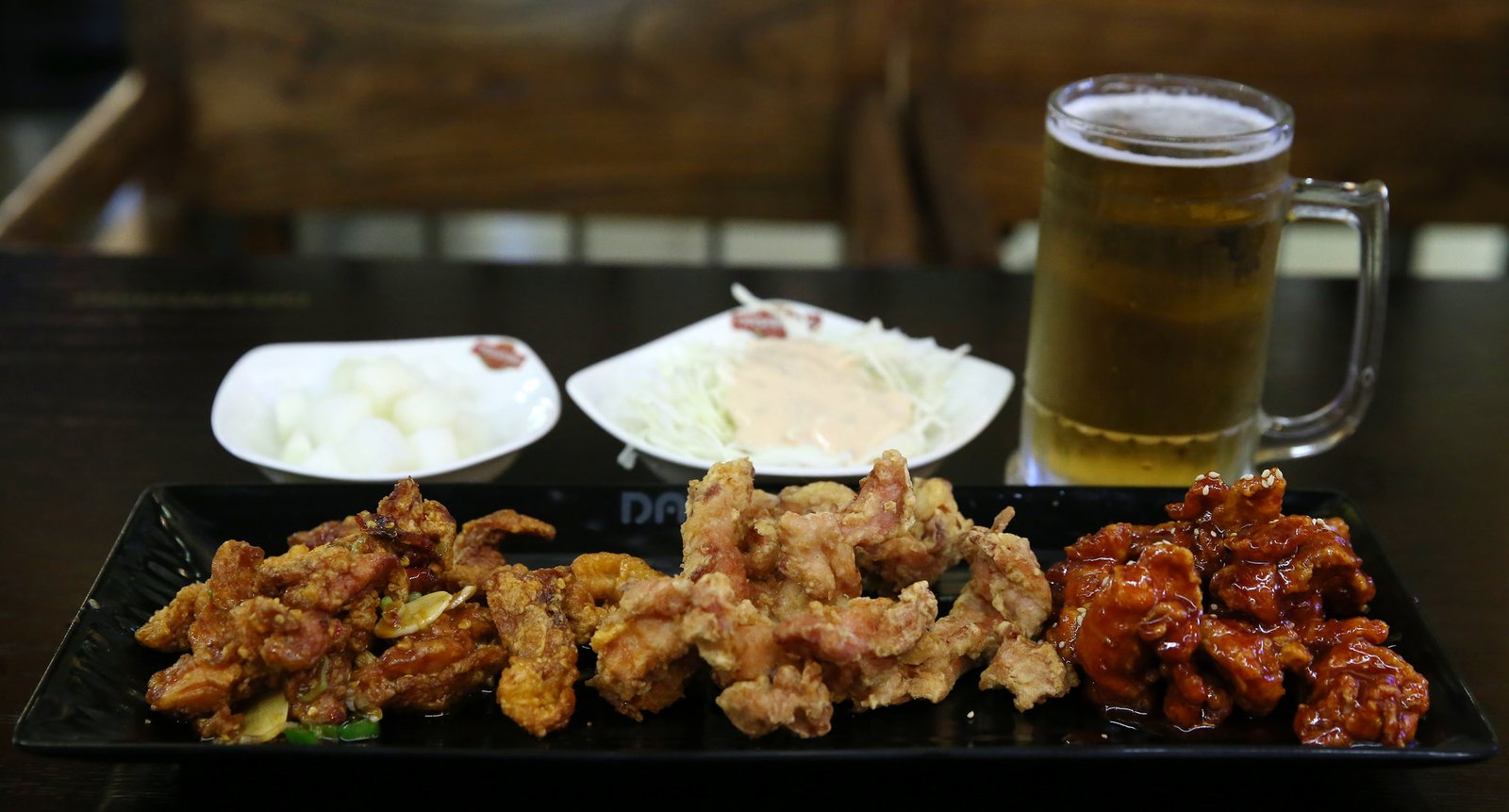
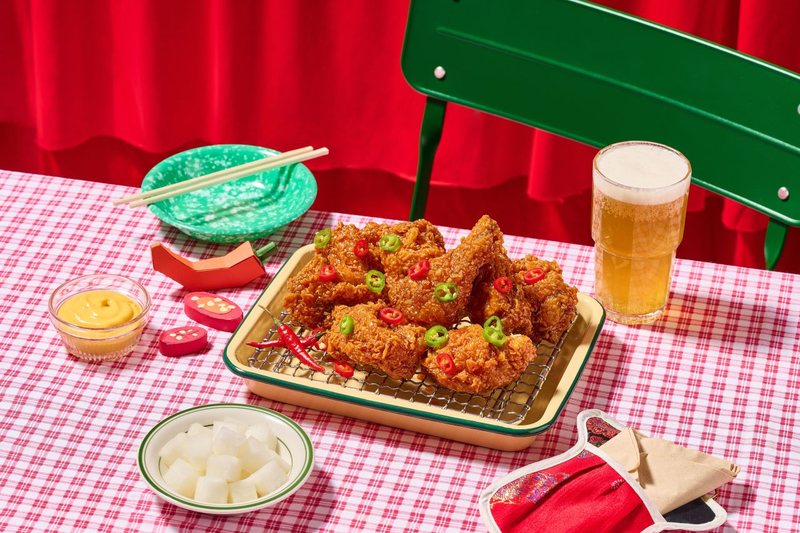
It is Friday night in a Seoul apartment. The doorbell rings, a delivery rider hands over a warm box, and inside are two kinds of fried chicken, a small tub of pickled radish and often a pair of plastic gloves. Someone pulls cold beer from the fridge. This is 치맥 (chimaek), short for 치킨 (chikin, fried chicken) and 맥주 (maekju, beer), and for many Koreans it is the default answer to “What should we eat tonight?”
So why do Koreans pair fried chicken with beer? Because the two grew up together. Fried chicken spread through Korea in the 1970s and ’80s, at the same time as casual pubs pouring draft beer, and hot, salty, crunchy chicken with a light, ice-cold lager simply works. Then came the shared moments that turned a snack into a ritual: the 2002 World Cup, late-night delivery, picnics by the Han River and, eventually, one K-drama line that had fans abroad lining up for Korean chicken.
In Korean, “chicken” is not the bird
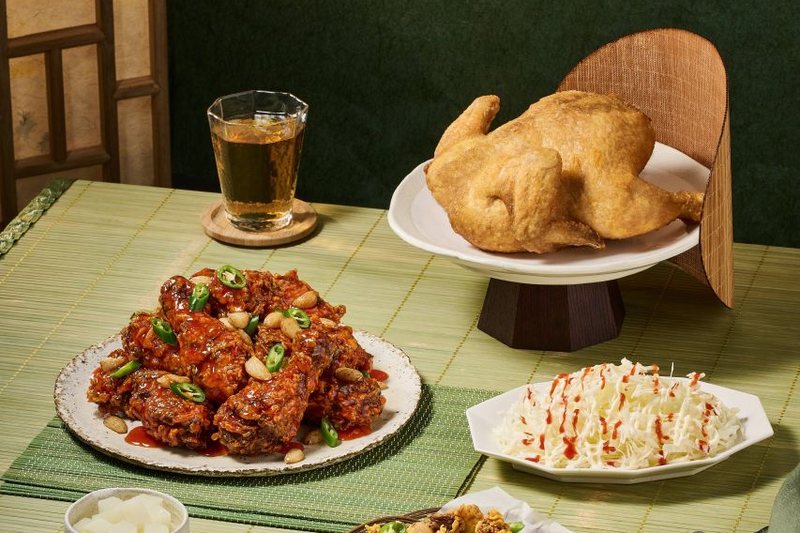
The first surprise for visitors: when Koreans say 치킨 (chikin), they do not mean the animal. The bird and its meat are 닭 (dak). Korea's standard dictionary defines chikin as chicken coated in flour or batter and fried, or sometimes roasted. In other words, it is the dish, and “Let's get chicken” means only one thing.
Plain fried chicken comes with a spelling quirk. Korea's official rules for loanwords turn an English f into ㅍ (p), so the dictionary form of “fried” is 프라이드 (peuraideu). Yet most menus write 후라이드 (huraideu), and that is the word you will hear when people order.
You also order by the bird, not by the piece. One 마리 (mari) is a whole chicken, chopped up, fried and packed into one box. Korean chickens are small, about 1.5 kilograms against roughly 2.5 kilograms for an average American bird, according to Korea JoongAng Daily. That is why one mari is often shared by two, and why the boast 1인 1닭 (irin ildak, “one person, one chicken”) exists. The same report says Koreans largely prefer leg meat, so at a family table, who gets the two drumsticks is a serious negotiation.
So what does a box cost? As of late October 2026, the recommended prices for the big chains' flagship orders were 23,000 won each for BBQ's Golden Olive Chicken and Kyochon's Honey Combo and 21,000 won for bhc's Bburinkle, with boneless versions costing more, the Seoul Economic Daily reported. Delivery adds a fee of around 3,000 won, the same report says.
Korean insider tip: If the shop is only a short walk away, choose 포장 (pojang, pickup) instead of delivery in the app and carry the box home yourself. You skip the delivery fee, and some shops even take a little off for pickup. For leftovers, Koreans reheat cold chicken in an air fryer for a few minutes instead of the microwave, which brings the crunch back.
Huraideu, yangnyeom or half-half?
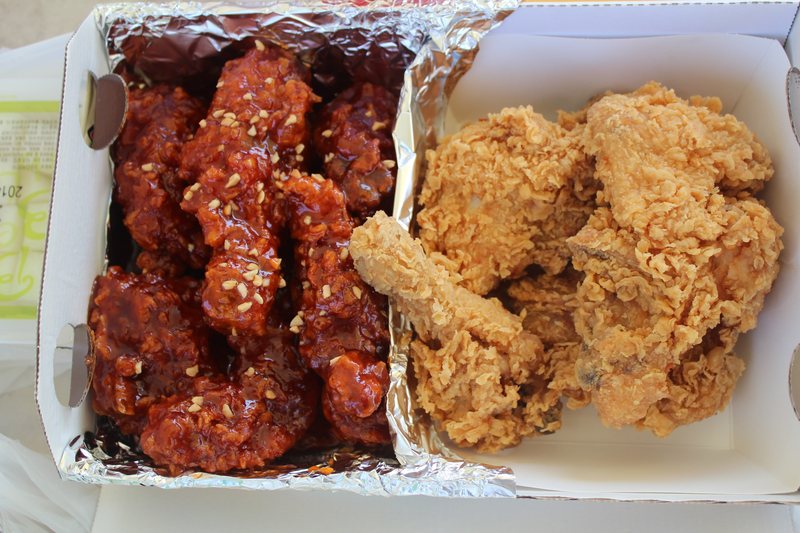
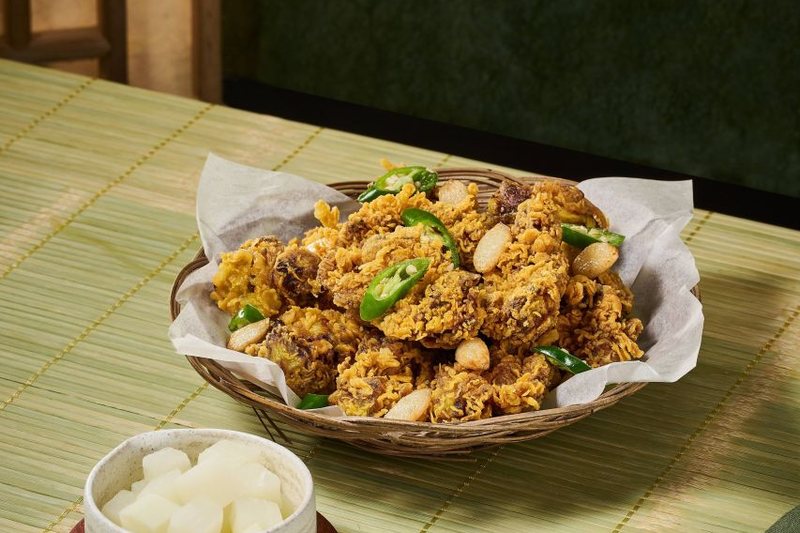
Huraideu is the base: chicken pieces in a thin coating, fried until crackly. Korean shops usually fry it at least twice, which The Korea Herald credits for its extra crunch compared with the thicker, well-seasoned crust of American fried chicken. A little dish of salt often comes on the side.
Yangnyeom (양념, “seasoning”) is fried chicken tossed in a glossy, sticky, sweet-and-spicy red sauce. It took off in the late 1970s and early 1980s, and who invented it is a friendly feud: chains from Daejeon and Daegu both claim to have been first, and Korean newspapers have printed both stories. Since then, shops have added coatings from 간장 (ganjang, soy-garlic) to hot pepper and cheese.
Can't decide? That is what 반반 (banban, “half-half”) is for: half huraideu and half yangnyeom in one box. The last choice is 뼈 (ppyeo, bone-in) or 순살 (sunsal, boneless).
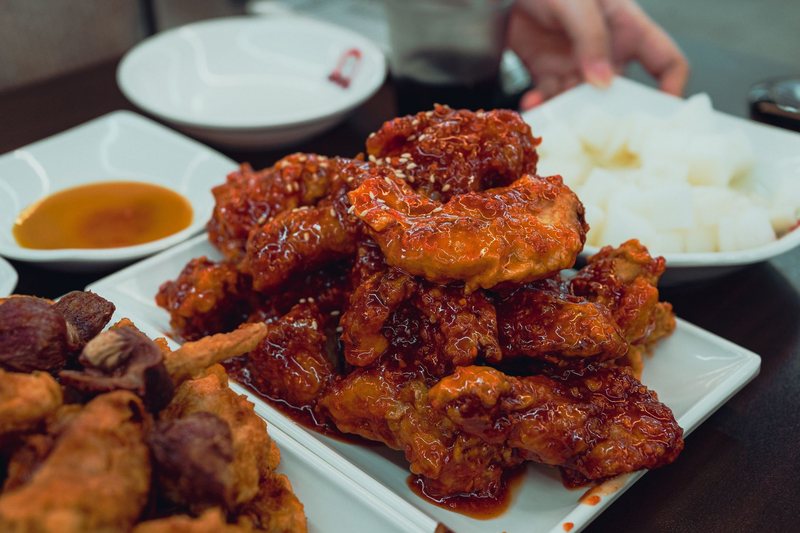
And the white cubes in the little tub? That is 치킨무 (chikin-mu, “chicken radish”), radish pickled in a sweet-sour brine. Foreigners ask about it constantly, and Koreans give the same answer: its cold, sour crunch cuts through the grease and resets your mouth for the next piece. It also packs neatly and needs no cooking, which suits a delivery box. Many people care enough to ask for extra.
How fried chicken met beer
Chimaek has no ancient roots. It is a story of modern Korea, told in a few steps:
- 1960s: Myeongdong Yeongyang Center in Seoul roasts whole chickens in electric ovens, a forerunner of today's chicken shops.
- 1971: Packaged cooking oil reaches the mass market, and frying chicken to sell becomes far easier, according to the Seoul Shinmun.
- 1977: Lim's Chicken opens at a Seoul department store and is widely counted as Korea's first fried chicken franchise. KFC follows in 1984.
- 1980s–90s: Parents carry a whole chicken home after work in a paper bag. As apartment complexes spread, the chicken starts arriving at the door in a paper box instead.
- 1997: After the Asian financial crisis, many laid-off workers in their 40s and 50s open chicken franchises with their lump-sum retirement money, as Korea JoongAng Daily recounts.
- 2002: Korea co-hosts the World Cup, crowds in red shirts watch the matches together, and chicken with beer becomes the snack of match night.
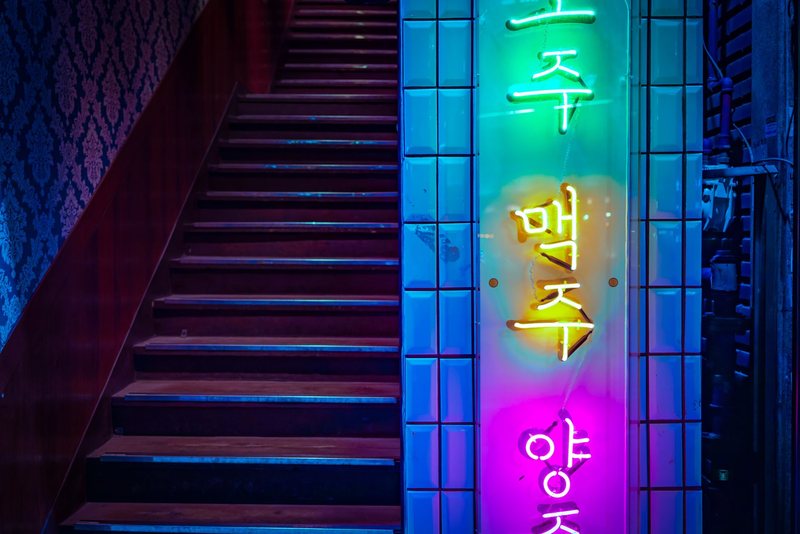
Why beer, and not soju? Koreans drink soju with plenty of dishes, but fried chicken grew up alongside draft beer, 생맥주 (saengmaekju), at the 호프집 (hopeu-jip), the casual beer pub where chicken is a standard order. Many Koreans explain the rest as balance: hot, salty chicken makes you thirsty, and a light, fizzy lager rinses it away. The love runs deep enough that people jokingly call fried chicken 치느님 (chineunim), a pun on chikin and haneunim, the Korean word for God. As of 2021, Korea's Fair Trade Commission counted nearly 30,000 fried chicken restaurants under more than 700 franchise brands, The Korea Times reported.
The K-drama line that took chimaek abroad
Outside Korea, chimaek owes much of its fame to one drama: My Love from the Star (별에서 온 그대, Byeoreseo On Geudae), which aired on SBS in 2013–14. Its heroine, the top star Cheon Song-yi played by Jun Ji-hyun, declares that a snowy day calls for chimaek. Korean newspapers quoted the line as 눈 오는 날에는 치맥인데 (nun oneun nareneun chimaeginde, roughly “Snowy days are for chimaek”).
The drama was a streaming sensation in China, and the line landed in the middle of an H7N9 bird-flu outbreak that had hurt chicken sales there. Demand for fried chicken jumped in big Chinese cities anyway, and some Korean-style chicken shops in Shanghai had lines of more than three hours, Sports Kyunghyang reported in February 2014. The Korea Times counted more than 3.7 million posts related to the Chinese term for chimaek. In 2021 the word itself entered the Oxford English Dictionary, as Korea JoongAng Daily noted.
A small correction to the legend: retellings abroad often call the scene a first-snow ritual, but the line Korean media quoted at the time was simply about snowy days. Any snow will do.
Delivery, the Han River and a festival in Daegu
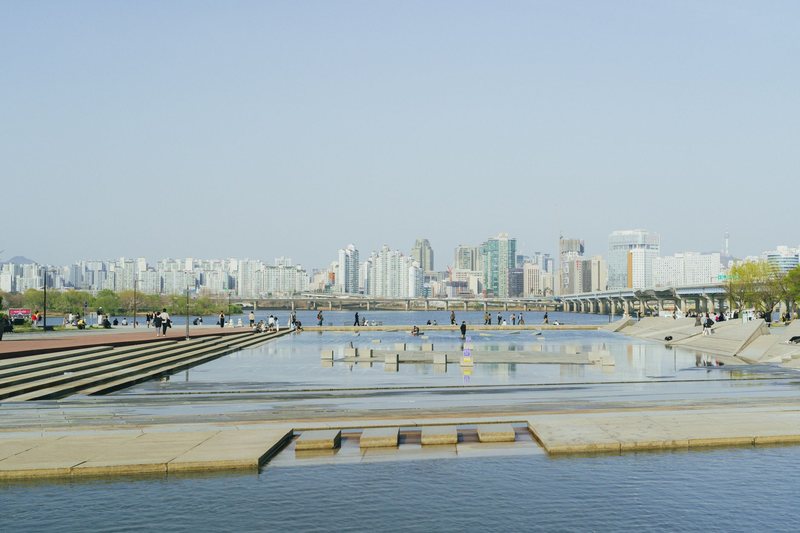
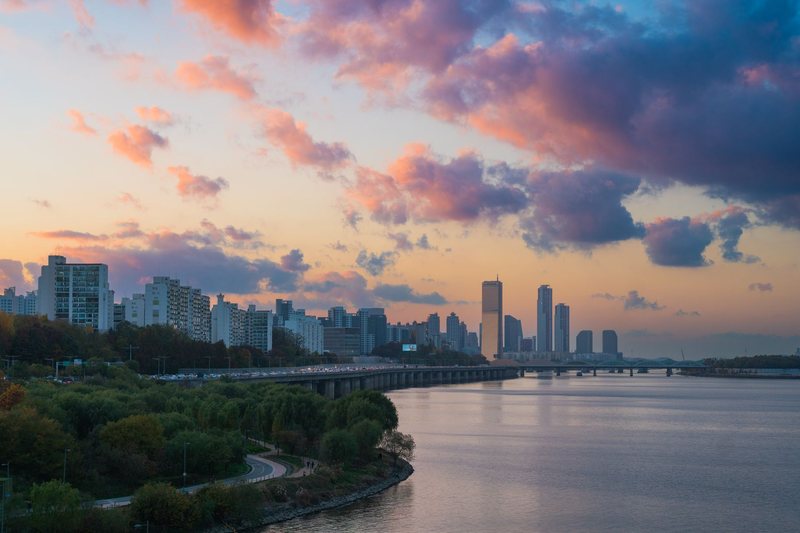
Chimaek rarely needs a restaurant. Fried chicken is one of Korea's classic 야식 (yasik, late-night snack) orders, delivered to apartments, offices and parks. In Seoul, the summer version is a mat on the grass at a Han River park, where riders meet customers at marked delivery zones. Our guide to Seoul's Han River parks explains how it works, even for visitors without a Korean phone number.
Then there is Daegu, which many Koreans call the hometown of Korean fried chicken. In the 1960s the city had the country's largest poultry farms, and several of the biggest chicken chains started there, as The Korea Times explains. Since 2013, Daegu has thrown chicken its own party: the Daegu Chimac Festival (대구치맥페스티벌), held in summer in and around Duryu Park, with chicken booths, beer and nightly concerts. The 2026 edition ran from July 1 to 5, with about 70 chicken booths and roughly 2,400 foreign visitors, around three times the year before, according to Nocut News. Organizers put 2025 attendance at about 1.15 million.
Your first chimaek night
- Order by the bird. 한 마리 (han mari, one whole chicken) is usually plenty for two, unless someone at the table is an irin ildak person.
- Order like a regular: 반반 무 많이요 (banban, mu maniyo), “half-half, extra radish.”
- Eat it hot. The crust softens as it sits, which is why Koreans open the box the moment it lands.
- No beer? No problem. Cola is a popular stand-in, and plenty of Koreans skip alcohol entirely. The chicken is the point.
- If you eat halal, note that most chicken shops in Korea are not halal-certified. The Korea Tourism Organization classifies Muslim-friendly restaurants, from halal-certified to pork-free, which is a good place to start.
- Pouring rules still apply. Drinking with Korean colleagues or older friends? Our guide to Korean drinking etiquette comes along with the chicken.
Quick answers
What does chimaek mean?
Chimaek (치맥) is short for chikin (fried chicken) and maekju (beer). It means fried chicken eaten with beer, usually shared with friends at a beer pub, at home by delivery or on a picnic.
Which K-drama made chimaek famous?
My Love from the Star (2013–14). The heroine's line about snowy days calling for chimaek set off a chicken-and-beer craze in China in early 2014.
Why do Koreans eat pickled radish with fried chicken?
The cold, sweet-sour cubes, called chikin-mu, cut the grease between bites. A small tub comes with almost every order.
Is Korean fried chicken spicy?
Huraideu is not spicy at all. Yangnyeom is sweet with a gentle kick, though some shops offer much hotter sauces, so ask if you are unsure.