On a warm evening at Yeouido Hangang Park, the longest line is often inside the convenience store. People wait their turn at a row of small cooking machines, then carry steaming bowls of instant noodles back to a mat on the grass as the bridges light up. This is 한강라면 (Hangang ramyeon, "Han River ramyeon"), and for many Seoulites it is the taste of a free evening.
So why do Koreans cook instant ramyeon at the Han River? Partly because it is easy: the park convenience stores sell the noodles and have machines that cook them for you in a few minutes. Mostly because of where you eat them. The Han River parks are Seoul's shared backyard, free and a subway ride from almost anywhere, and a simple bowl by the water has become one of the city's small rituals. K-dramas did the rest, carrying the scene to screens around the world.
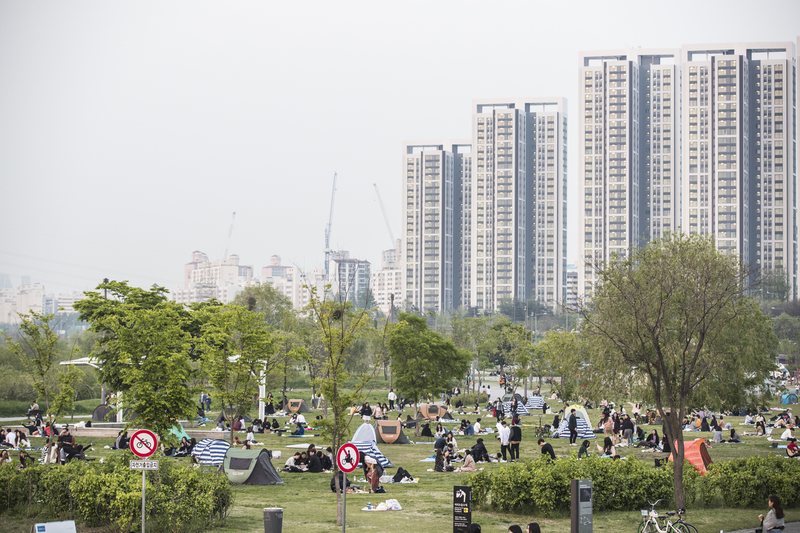
How the Han River ramyeon machine works
The machine is what surprises visitors most. Inside the store, you pick a packet of instant noodles and a disposable bowl made for the cooker. Drop in the noodles and the soup powder, set the bowl on the machine and press the button. It adds the water and boils everything on an induction plate, and a few minutes later dinner is ready.
According to Korea JoongAng Daily, each cooker combines a water purifier, a kettle and an induction stove, and one Korean manufacturer makes close to 95 percent of the country's instant-noodle cookers. The Han River version became famous enough that the machines are now exported.
Koreans have a joke that explains the appeal: 라면은 남이 끓여 준 게 제일 맛있다 (ramyeon-eun nami kkeuryeo jun ge jeil masitda), "ramyeon tastes best when someone else cooks it." At the river, a machine does the cooking, the breeze does the rest, and nobody has to wash the pot.
Korean insider tip: Koreans rarely eat the bowl on its own. From the same store, grab an egg or a slice of cheese to drop into the broth, plus a triangle kimbap (삼각김밥, samgak gimbap). Save the kimbap until the noodles are gone, then break the rice into the leftover soup. And after sunset in spring or autumn, the river wind turns cold fast, so bring a jacket.
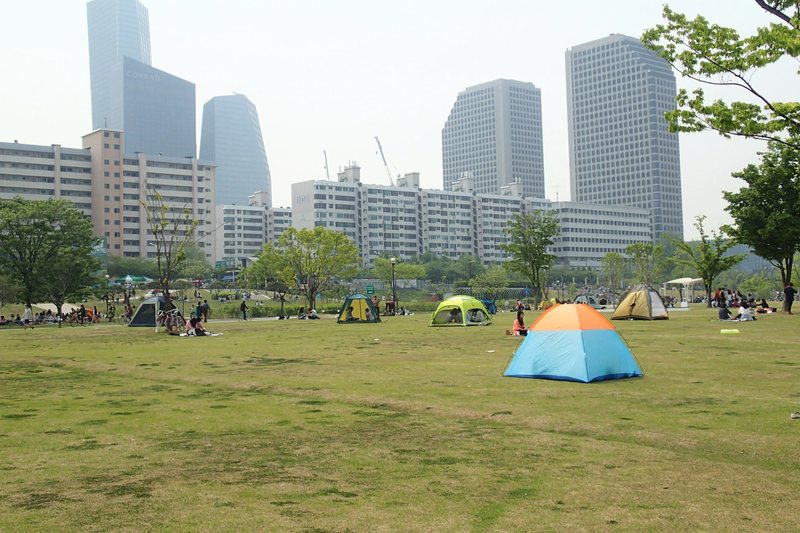
Seoul's backyard, one subway ride away
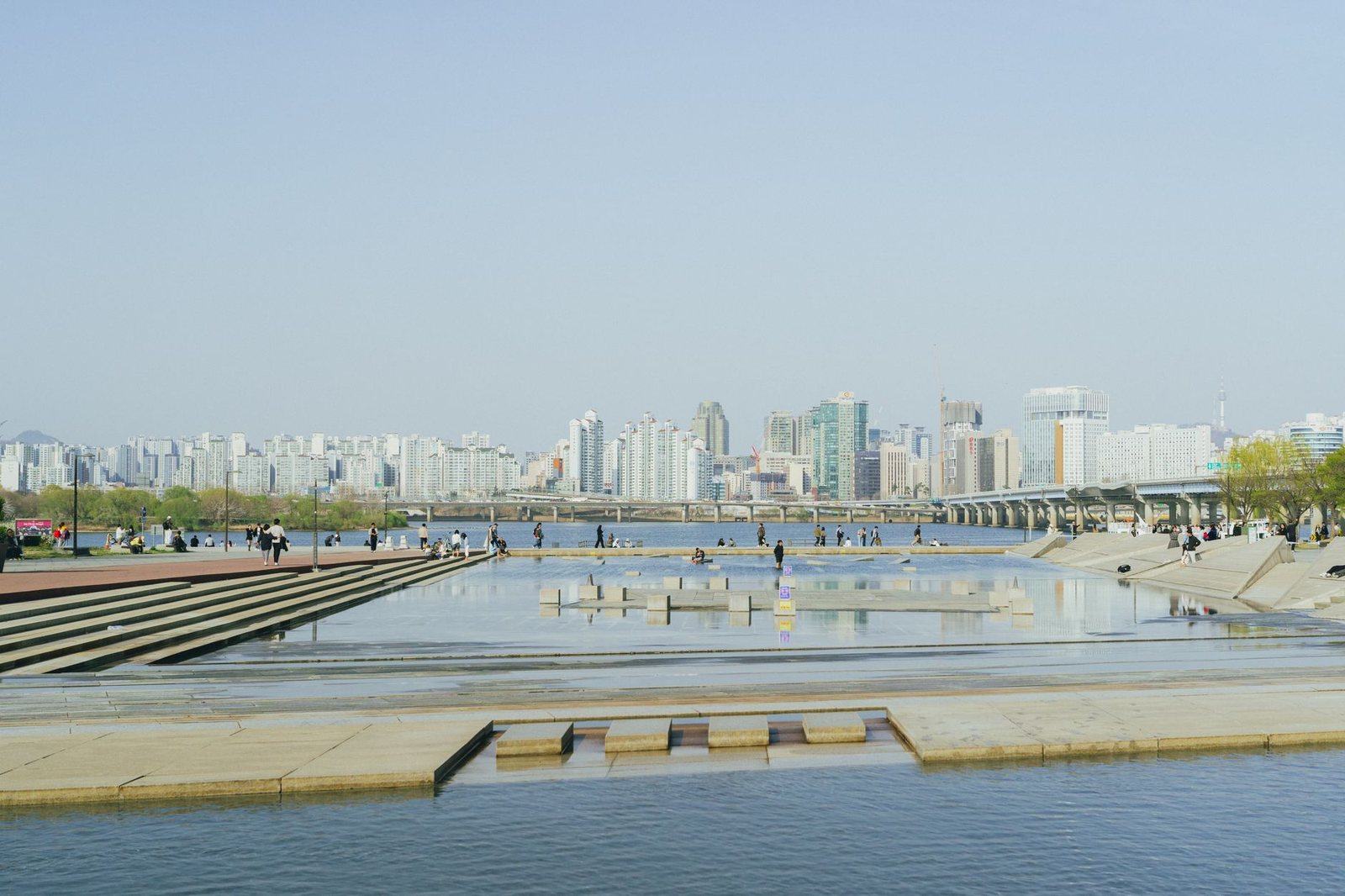
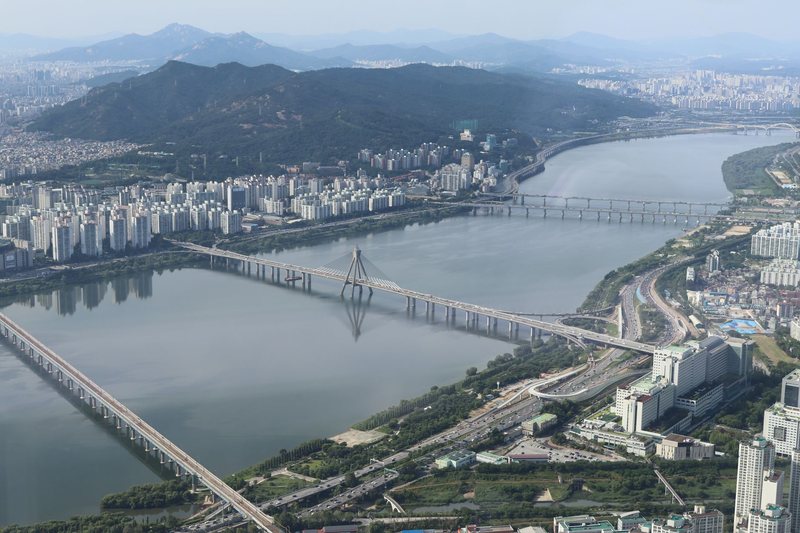
To understand the bowl, you have to understand the river. Many Seoulites live in apartments or small studios with no yard and little room for guests, especially young people who live alone. The Han River parks fill that gap. There are 11 of them along both banks, from Gangseo in the west to Gwangnaru in the east, with lawns, bike paths and convenience stores, open around the clock and free to enter.
They did not always look like this. After Seoul won the right to host the 1988 Olympics, a huge Han River development project reshaped the banks and created what was then called the Han River Citizens' Park, later renamed simply 한강공원 (Hangang Gongwon, Han River Park). Older Koreans still sometimes call the riverside 고수부지 (gosubuji, "floodplain"), a word from that era.
That history explains the mood. For many Koreans the river is the default plan: after work, after exams, on a first date, or when you just need air. "Let's go to the Han River" needs no further explanation. Seoul has even held a space-out competition by the water, one of the city's quiet answers to ppalli-ppalli culture, where the goal is to sit still and do nothing.
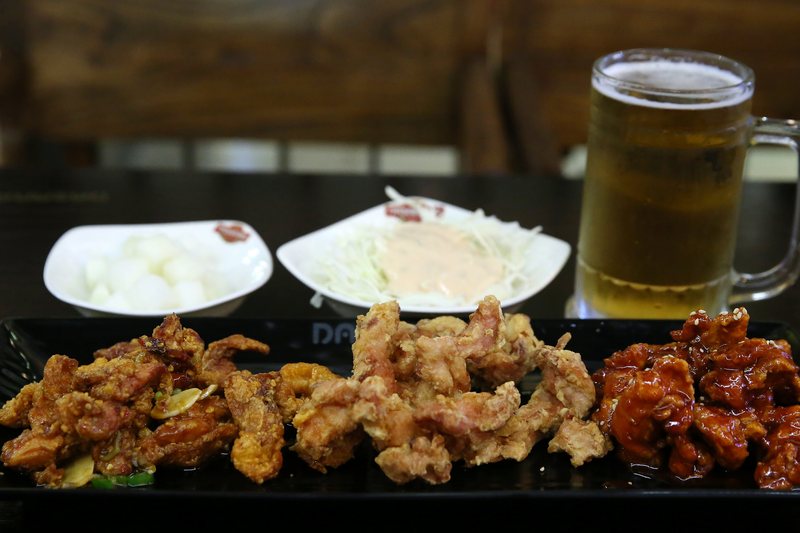
Chimaek, delivered to a meeting point in the grass
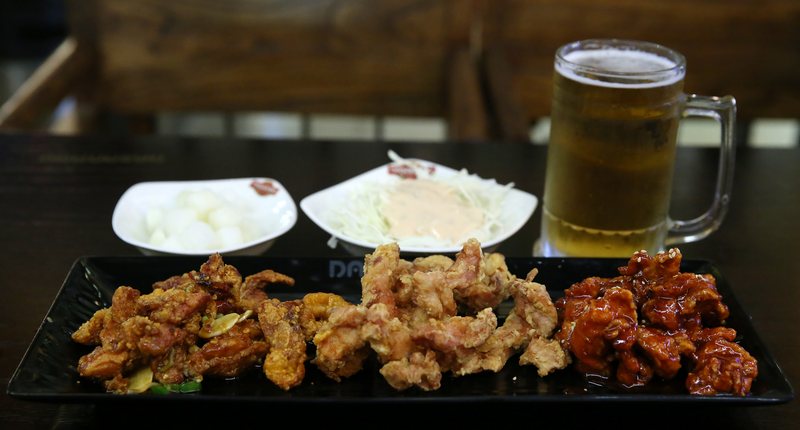
If ramyeon is the quick snack, 치맥 (chimaek, fried chicken and beer) is the feast. The 2014 drama My Love from the Star famously set off a chimaek craze in China, and the Han River is where Seoulites have theirs delivered. Lately some even order raw fish for a 회크닉 (hoekeunik, "sashimi picnic").
Here is the part visitors miss: riders do not wander the lawn looking for your mat. The parks have 배달존 (baedal jon, delivery zones), marked spots where riders and customers meet. You enter the zone as your address in a delivery app, then walk over when your order arrives. In September 2026, Seoul expanded the system to 17 zones across all 11 parks, according to the Seoul Metropolitan Government.
Ordering used to be tricky without a Korean phone number. In mid-2026, Seoul signed an agreement with the delivery app Baemin to help foreign visitors, and according to Herald Business, the app already lets users order without a Korean number and accepts overseas credit cards and Apple Pay with foreign cards.
And the beer? Since a 2021 change in national law, local governments can declare no-drinking zones, and Seoul has discussed allowing them along rivers and in city parks. As of this writing, the official Han River park rules do not ban drinking outright, but they do fine anyone who drunkenly harasses other people. The unwritten rule is simple: keep it calm, and follow any posted signs.
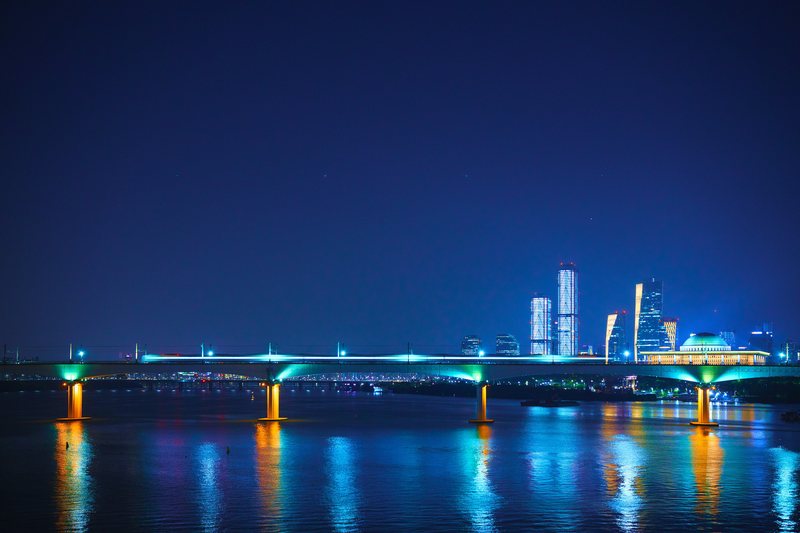
Why K-dramas keep coming back to the river
If the scene feels familiar, it is because Korean screens love it: a late-night talk on the riverbank, friends racing on bikes, a couple sharing convenience-store noodles as the bridge lights come on. In a 2024 interview with The Korea Herald, Joo Yong-tae, then head of Seoul's Future Hangang Project Headquarters, said that for the younger generation the river brings to mind chimaek and ramyeon, as seen in K-dramas and movies. Korea JoongAng Daily lists aespa's Karina among the stars who have enjoyed a Han River bowl.
One friendly warning from the same screen culture. In the 2001 film One Fine Spring Day (봄날은 간다), a late-night invitation to come in for ramyeon became one of the most quoted lines in Korean cinema, and 라면 먹고 갈래? (ramyeon meokgo gallae?, "Want to have some ramyeon before you go?") is still a well-known flirty joke. Inviting a friend for ramyeon at the Han River is perfectly innocent. Inviting someone up to your place for ramyeon at midnight may be heard very differently.
Bikes, fountains and fireworks
Seoul's public bikes, 따릉이 (Ttareungi), wait at rental stations near the parks, and visitors can buy a day pass without signing up, using an overseas credit card: 1,000 won for one hour, 2,000 won for two and 3,000 won for three, according to the official Seoul Bike site.
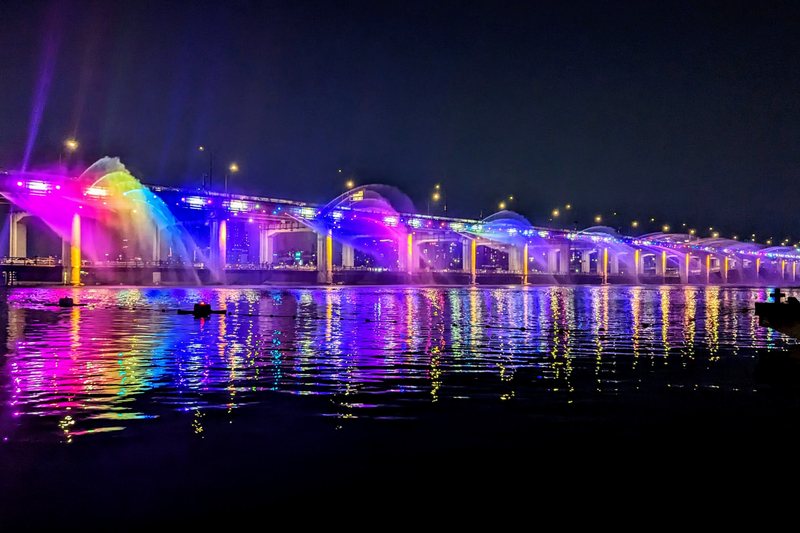
At Banpo Hangang Park, the Moonlight Rainbow Fountain sends lit-up jets of water off both sides of Banpo Bridge, set to music. It runs along 1,140 meters of the bridge and entered Guinness World Records in 2008 as the world's longest bridge fountain. The season runs from mid-March through October, with an extra late show from June to September, and the fountain stops for strong wind, rain or muddy water. Downstream at Yeouido, the Seoul International Fireworks Festival is one of the river's biggest nights; it is usually held in late September or early October, and in 2026 it moved up to September 5.
Exact subway exits, hours, fees and a taxi card for four of the most popular parks are in the Getting there guide at the end.
Before you spread your mat
- Time it. On warm weekends the machines get busy around sunset, so eat a little earlier or later.
- Leave the camping stove at home. Under the park rules, cooking or camping outside designated areas can bring a fine starting at 1 million won, which is why the store's machine is the way to cook.
- Tents follow rules. Small shade tents, about 2 by 2 meters, are allowed from March to November in designated zones only, with at least two sides open. They normally come down at 19:00 (March–May and September–November) or 20:00 (June–August); from September 1 to November 30, 2026, Seoul allows them until 22:00.
- Meet the rider at the delivery zone, not at your mat, and keep your phone handy.
- Clean up. Leaving picnic trash behind can mean a 100,000-won fine, so bag your bowl and chicken box and take them to the park's trash points.
Quick answers
Why do Koreans eat ramen at the Han River?
Because the park convenience stores sell instant noodles and have machines that cook them for you, and because the Han River parks are Seoul's free, shared backyard. K-dramas made the scene famous abroad.
Can foreigners order chicken delivery to the Han River?
Yes. Order to one of the park's delivery zones and meet the rider there. According to Herald Business, the Baemin app lets you order without a Korean phone number and accepts overseas cards.
Can you drink alcohol in Han River parks?
As of this writing, the park rules do not ban it outright, but drunken harassment of others is fined and Seoul has discussed no-drinking zones, so follow any posted signs.
Which Han River park is best for a first visit?
Yeouido is the classic picnic scene and the easiest to reach. Banpo is the pick for the rainbow fountain and night views, Ttukseom connects straight to a subway station, and Mangwon feels more local.
Getting there
Yeouido Hangang Park 여의도한강공원
- Subway
- Line 5, Yeouinaru Station, Exit 2 or 3 (about 1 min walk); or Line 9, National Assembly Station, Exit 1 (about 1 min walk)
- From Incheon Airport
- AREX all-stop train from Incheon Airport to Gongdeok Station, then Line 5 to Yeouinaru Station
- Hours
- Open 24 hours, year-round
- Admission
- Free
- Tip
- The classic picnic lawn, with ramyeon machines in the convenience stores and four delivery zones. The Seoul International Fireworks Festival is held here (September 5 in 2026)
Banpo Hangang Park 반포한강공원
- Subway
- Lines 3, 7 and 9, Express Bus Terminal Station, Exit 8-1 or 8-2 (about 15 min walk toward Banpo Bridge); or Line 9, Sinbanpo Station, Exit 1 (about 15 min walk)
- Bus
- 740 or 405 to the Banpo Hangang Park / Sebitseom stop
- From Incheon Airport
- AREX all-stop train from Incheon Airport to Gimpo Airport, then a Line 9 express train to Express Bus Terminal Station
- Hours
- Open 24 hours. Rainbow fountain (March 15–October): 20-min shows at 12:00, 19:30, 20:00, 20:30 and 21:00, plus 21:30 from June to September
- Admission
- Free
- Tip
- The fountain stops in winds of 7 m/s or more, when rain is forecast, or when the river is too muddy. October is the last month of the 2026 season
Ttukseom Hangang Park 뚝섬한강공원
- Subway
- Line 7, Jayang (Ttukseom Hangang Park) Station, Exit 2 or 3, connected straight to the park (about 1 min walk)
- From Incheon Airport
- AREX all-stop train from Incheon Airport to Hongik Univ. Station, Line 2 to Konkuk Univ. Station, then Line 7 one stop to Jayang
- Hours
- Open 24 hours, year-round
- Admission
- Free
- Tip
- Jayang Station used to be called Ttukseom Resort Station, and older guides still use that name. Don't mix it up with Ttukseom Station on Line 2
Mangwon Hangang Park 망원한강공원
- Subway
- Line 6, Mangwon Station, Exit 1, or Lines 2 and 6, Hapjeong Station, Exit 1; then bus Mapo 09 or Mapo 16
- Bus
- Get off at the Mangwon Hangang Park stop
- From Incheon Airport
- AREX all-stop train from Incheon Airport to Hongik Univ. Station, then Line 2 one stop to Hapjeong Station
- Hours
- Open 24 hours, year-round
- Admission
- Free
- Tip
- Shade tents are allowed under the north end of Seongsan Bridge and on the lawn beside Seoul Battleship Park
Checked on October 22, 2026; confirm on the official site before you go.