The Fish Bread With No Fish That Tells Koreans Winter Is Here
When the first cold wind blows, carts selling fish-shaped bread and syrup pancakes pop up across Korea. Here is why, and how Koreans hunt them down.
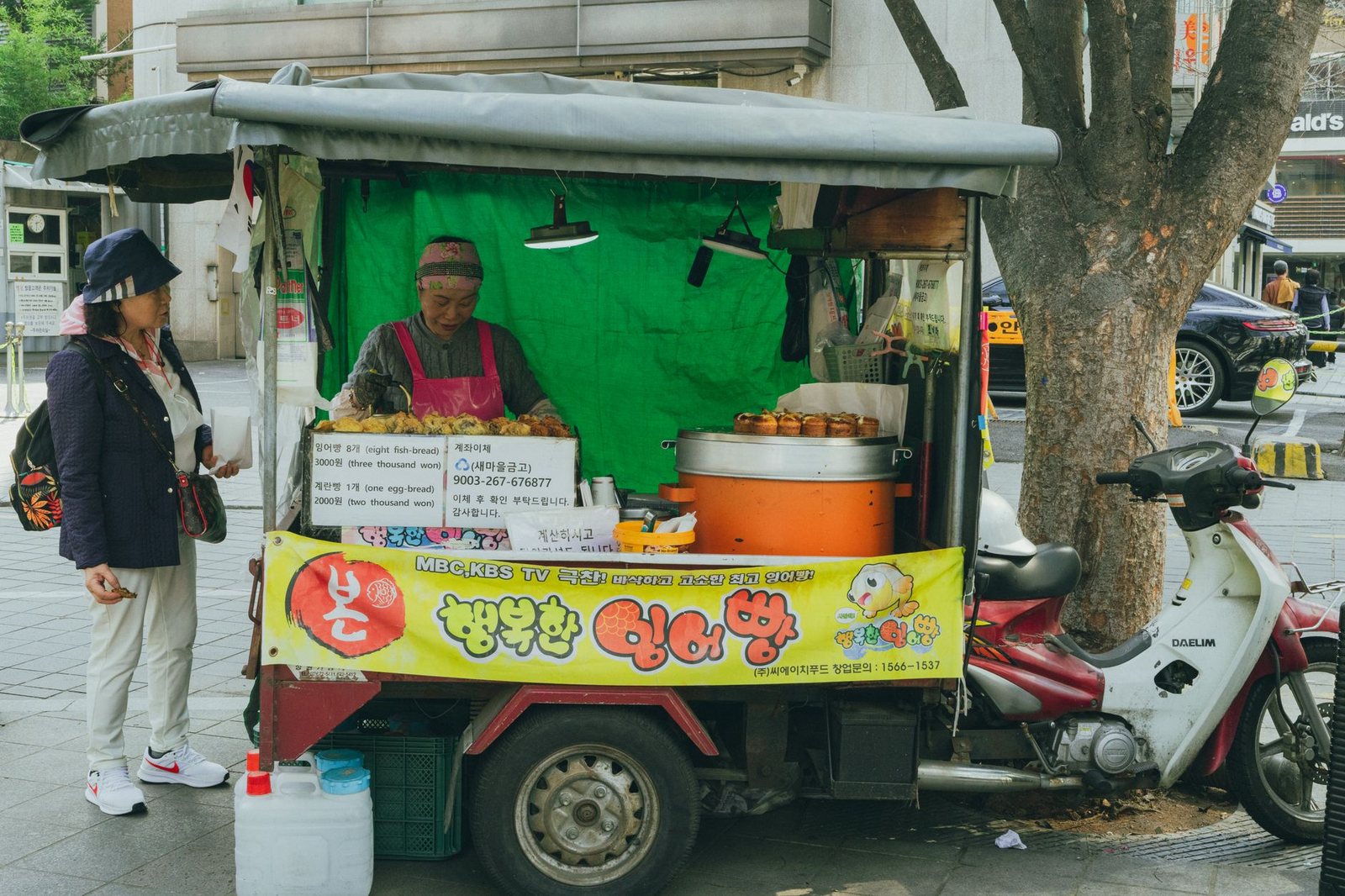
Sometime in October, Korean street corners start to smell different. A small cart appears near a subway exit, a row of iron molds begins to hiss, and the air fills with toasted batter and warm red bean. Before long, friends are passing on the good news: bungeoppang season is back.
붕어빵 (bungeoppang, “crucian carp bread”) is a fish-shaped pastry with no fish in it, just sweet red bean paste or custard. It shares the winter sidewalk with 호떡 (hotteok, a pancake with melted sugar inside), 계란빵 (gyeranppang, egg bread), roasted sweet potatoes and roasted chestnuts. They appear when it turns cold for a simple reason: they are hot, cheap and made to be eaten outdoors, with both hands wrapped around a warm paper bag. Many carts run only for the season, roughly October to March or early April, so their return is one of the ways Koreans know winter has arrived.
A fish bread with no fish
Bungeoppang belongs to a family Koreans call 풀빵 (pulppang): thin batter poured into a hot iron mold, a spoonful of red bean in the middle, more batter on top, then flipped until golden. According to the Encyclopedia of Korean Culture, these molds came from Japan in the 1930s, during the colonial period. The fish shape is widely traced to Japan's taiyaki, which is modeled on a sea bream, though the Korea JoongAng Daily notes that official records of exactly how it arrived are hard to find. In Korea the fish became a 붕어 (bungeo), a common freshwater carp. Change the mold and the name changes too: the flower-shaped version is 국화빵 (gukhwappang, “chrysanthemum bread”).
Cheap flour made it a street classic. Korea's climate was never kind to wheat, so flour dishes were once a treat. After the Korean War, a 1954 agreement brought in surplus American wheat, and in the 1960s, as the government urged people to eat more flour and mixed grains to save rice, pulppang became one of the cheapest snacks around.
Today the fillings are the argument. 팥붕 (patbung) is red bean, 슈붕 (syubung) is custard cream, and “patbung or syubung?” is a running debate in Korea, right next to whether you bite the head or the tail first. There is no right answer, which is exactly why nobody stops asking.
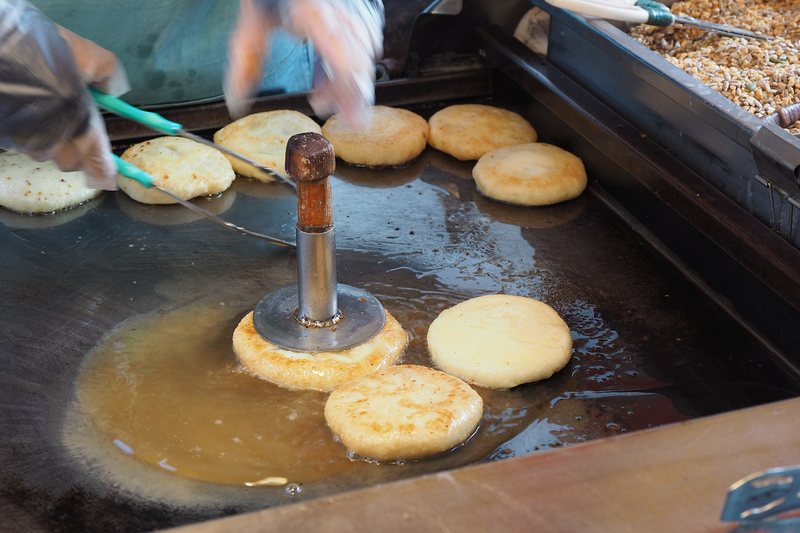
Hotteok: the pancake that came with Chinese merchants
Hotteok has a different family tree. The Standard Korean Language Dictionary simply notes that it came from China, and the Encyclopedia of Korean Culture fills in the story: it arrived with Chinese immigrants in the 1880s, after an 1882 trade agreement between Joseon and Qing China opened the way for Chinese merchants to settle. By October 1930 there were 1,139 Chinese-run hotteok shops across the country. The ho in the name is written with the character 胡, an old word for foreigners from the lands west and north of China.
Hotteok stayed popular into the 1960s, then faded in the 1970s, when steamed buns called 호빵 (hoppang) became a craze and many Chinese-run shops closed. The hotteok on the street today is a Korean adaptation: chewy dough wrapped around brown sugar, often with cinnamon and chopped nuts, pressed flat on an oiled griddle until the sugar melts into syrup. Busan goes further with 씨앗호떡 (ssiat-hotteok, “seed hotteok”), which the encyclopedia dates to the streets of Nampo-dong in the 1980s: the dough is fried, split open and stuffed with crushed peanuts, sunflower seeds and pumpkin seeds.
The warning Koreans give every first-timer: the syrup is far hotter than it looks. Hotteok has even entered everyday speech. When a place is loud and chaotic, Koreans say it is like 호떡집에 불난 것 같다 (hotteok-jibe bullan geot gatda), “like a hotteok shop on fire.”
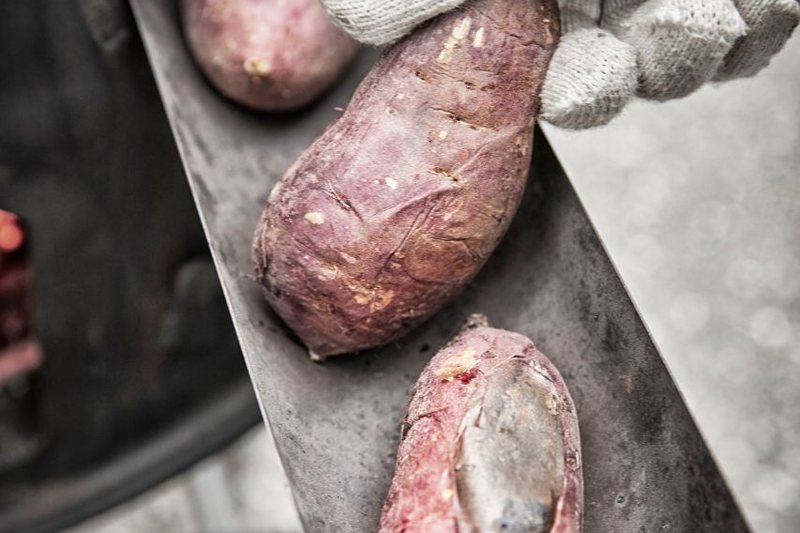
Egg bread, sweet potatoes and chestnuts
Gyeranppang is the youngest of the group: a small, sweet, slightly cakey loaf baked with a whole egg on top or inside. The Korea Times reports that it is said to have started in 1984 at a small shop near Inha University in Incheon, whose owner sold pulppang and wanted something for customers who did not eat red bean. In 2025, CNN put it on its list of 50 of the world's best breads.
The oldest winter smells come from fire. The Encyclopedia of Korean Culture describes sellers of 군밤 (gunbam, roasted chestnuts) on winter night streets as a scene that defines the season. Sweet potatoes reached Korea in 1763, when the envoy Jo Eom brought back sweet potatoes for planting from Tsushima on a mission to Japan, and 군고구마 (gungoguma, roasted sweet potatoes) were long roasted in drum-shaped ovens on the sidewalk. Those ovens are rarer now. Rising costs have pushed many sellers off the street, and these days roasted sweet potatoes often come from a machine at a supermarket entrance instead.
Living in “bungeoppang range”
Korean real estate listings love the word 역세권 (yeoksegwon), “within easy reach of a subway station.” Swap in the first syllable of bungeoppang and you get 붕세권 (bungsegwon): living close enough to a bungeoppang cart to grab a bag on the way home. It is said with a smile, and a little longing, because the carts keep getting harder to find.
Street stalls face complaints, fines and crackdowns, and costs keep rising. Seoul city figures cited by the magazine Weekly Kyunghyang showed street stalls in the capital falling from 7,718 in 2016 to 5,873 by September 2021. Many Koreans remember when 1,000 won bought three or four bungeoppang. In late 2025, the business daily Hankyung found many Seoul carts charging 1,000 won apiece, with domestic red bean wholesale prices more than 20 percent higher than a year earlier.
The apps that hunt for carts
So Koreans made maps. The best known is 가슴속 3천원 (Gaseumsok Samcheonwon, “3,000 won in your heart”), a cart-finder app that began as a side project by a small team of developers and designers. Its name comes from an online joke: in winter, always keep 3,000 won tucked close to your heart, because you never know when you will pass a cart. Users pin carts on a map, confirm them when they visit and note the menu and how each cart takes payment, and the app now covers hotteok, egg bread and other street snacks too.
The neighborhood marketplace app Karrot (당근, Danggeun) started a seasonal winter snack map in 2020, and in November 2024 turned it into a dedicated bungeoppang map where residents add stalls, opening hours and price ranges for their neighbors.
At the cart: cash, transfers and ordering
- Carry small bills. Not every cart takes cards, so cash, ideally 1,000-won notes, is the easiest way to pay.
- Look for an account number. Many vendors also take a bank transfer, 계좌이체 (gyejwa iche), to an account number or QR code posted on the cart. That needs a Korean bank account, so visitors are better off with cash.
- Send the right amount. In 2023, Korean media reported customers who “paid” 2,000 won by transfer but sent only 200 or 300 won, and some vendors went back to cash only. Check the number before you tap send.
- Order by filling and count. 팥 세 개 주세요 (Pat se gae juseyo) means “Three red bean ones, please.” Address the vendor as 사장님 (sajangnim), the polite word for an owner, just as you would at a stall in Gwangjang Market.
Quick answers
Why is bungeoppang called fish bread if there is no fish in it?
Because of its shape. It is baked in a mold shaped like a bungeo, a crucian carp. Inside there is only a sweet filling, traditionally red bean paste and today often custard.
Why are bungeoppang and hotteok sold only in winter?
They are hot, cheap snacks made to be eaten outdoors, so they sell best in the cold. Many carts run only for the season, roughly from October to March or early April.
What does bungsegwon mean in Korean?
붕세권 (bungsegwon) is slang for living near a bungeoppang cart. It plays on yeoksegwon, the real estate word for “near a subway station.”