At Gwangjang Market, Every Cook Is Somebody's “Auntie”
One word turns a stranger into family. Seoul's century-old Gwangjang Market, with its sizzling mung bean pancakes, is the best place to hear it.
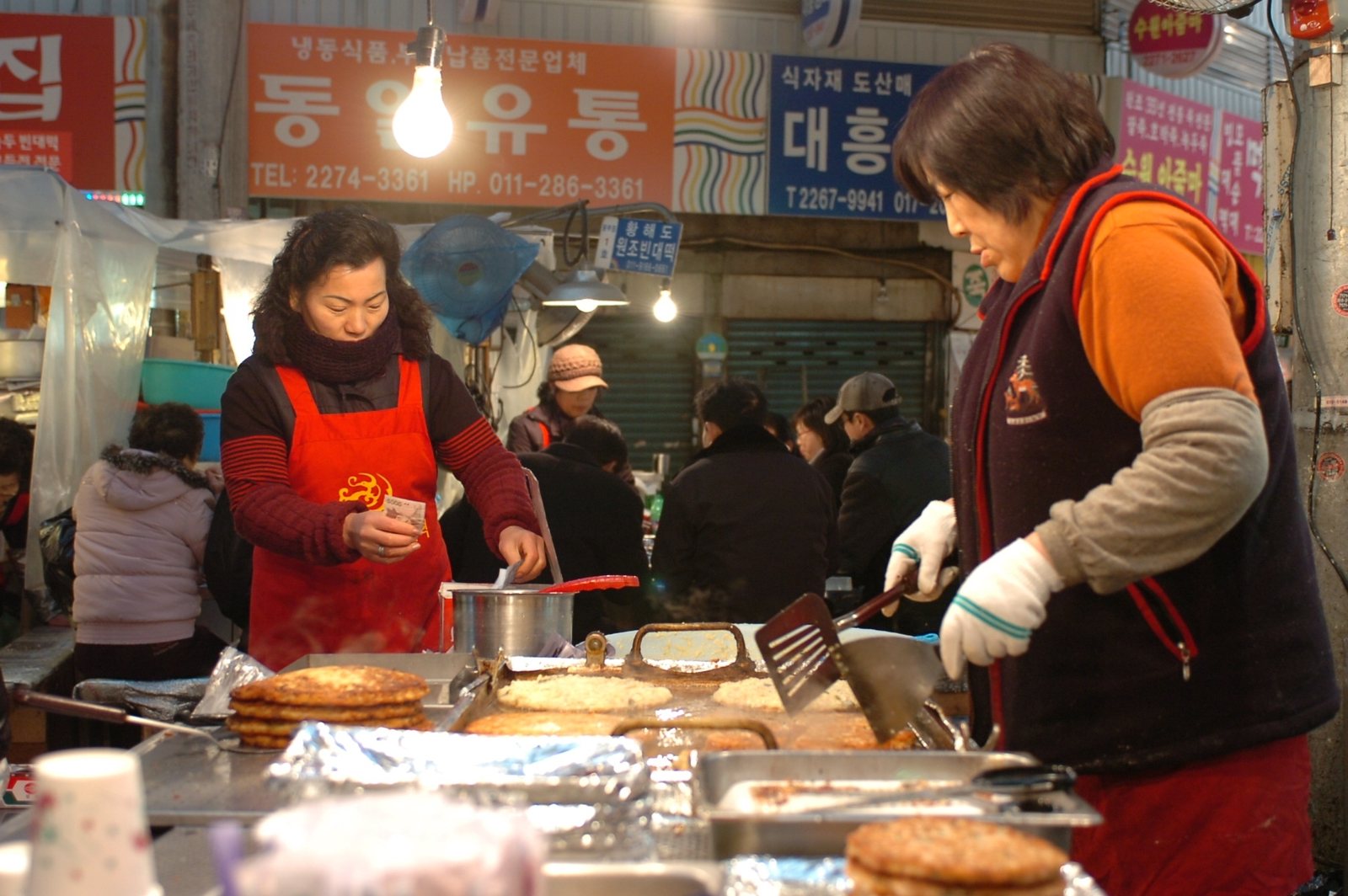
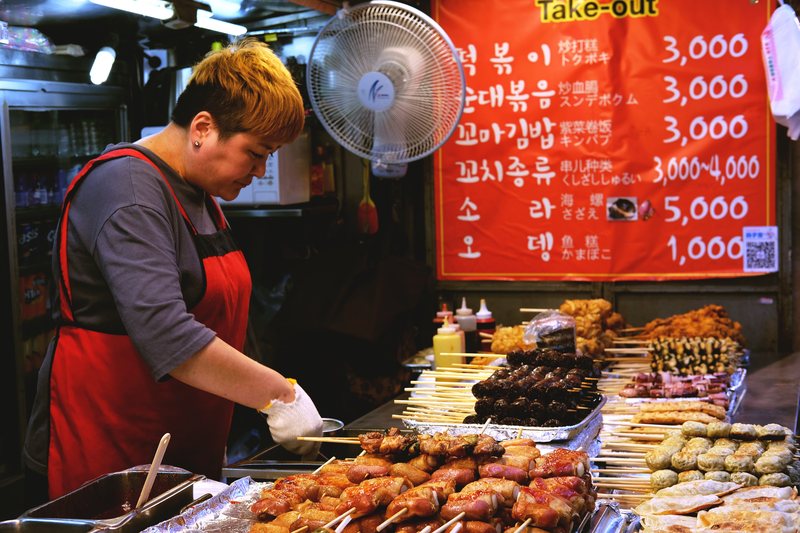
Stand by a bindaetteok stall in Gwangjang Market for a minute and listen. Oil hisses on the griddle, plates clatter, and every few seconds someone calls out to the woman flipping pancakes: 이모! (imo!). Imo means “aunt,” specifically your mother's sister. The people calling her are not her nephews and nieces. Most of them met her five minutes ago.
That single word says a lot about Korea. Korean has no neutral “sir” or “ma'am,” and the everyday words for “you” can sound cold, even rude, to a stranger. So when Koreans need to address someone who is neither family nor known by a title, they borrow a family word. A middle-aged woman serving food becomes imo, a younger one 언니 (eonni, “older sister”), a young man at work 삼촌 (samchon, “uncle”), and the owner 사장님 (sajangnim, “boss”). Seoul's Gwangjang Market is one of the best places to hear the whole family at work.
A language with no word for “ma'am”
Korean runs on titles, from Team Leader Kim to Teacher to Doctor. The trouble starts with someone who has no title you know and is not family. Writing in a 2018 journal of the National Institute of Korean Language, linguist Chae Wan observes that Korean society is unusually sensitive to titles and simply lacks a good word for a stranger without one. Family words step in to fill the gap: older brother, older sister, aunt, uncle, grandma, grandpa.
The habit is older than it looks. A Korean–French dictionary compiled by French Catholic missionaries and published in 1880 already noted that an old word for an aunt, 아자먼이 (ajameoni), was also used for women outside the family. There are neutral options, of course: 저기요 (jeogiyo, “excuse me”) and 여기요 (yeogiyo, “over here!”). In a 2024 language survey by the National Institute of Korean Language, these were the most common ways to call staff. They get the job done. Imo gets it done warmly.
Your instant family, explained
- 이모 (imo), “aunt”: literally your mother's sister. It goes to women who seem roughly middle-aged, especially those serving food. The speaker's own age does not matter, so a 60-year-old customer can happily call a 45-year-old cook imo.
- 언니 (eonni), “older sister”: what women call an older sister or friend, and what many customers call a female clerk, hairdresser or server who seems younger than “imo age.” A 1920 dictionary describes it as a child's word for an older sibling of the same sex, so boys once used it for their big brothers too.
- 삼촌 (samchon), “uncle”: chon counts degrees of kinship, and your father's brother is three steps away from you. At a shop or restaurant it is a friendly word for a male worker.
- 사장님 (sajangnim), “boss”: literally “company president,” and the standard polite way to address the owner of a shop or stall. In practice, many people use it for whoever is behind the counter.
Notice who is missing: 아줌마 (ajumma). It is the everyday word for a middle-aged woman, but said to her face it can sound blunt, which is exactly why regulars reach for imo. Koreans use the same trick with friends, as MARU explains in its guide to oppa, eonni, hyeong and nuna. And since every one of these words carries an age, it helps to know how age works in Korea.
Why the market is family territory
Gwangjang Market opened in 1905, as Japan was tightening its grip on Korea. Korean merchants pooled their money, formed a company and opened a market of their own at Baeogae, an old morning market in the area. It was first called Dongdaemun Market; the name Gwangjang is usually traced to two bridges over the Cheonggyecheon stream, Gwanggyo and Janggyo. The Korea Tourism Organization calls it the country's first permanent market, from a time when most markets opened only on set days. It was ruined in the Korean War and rebuilt, and it still sells silk, hanbok fabric and bedding alongside the food.
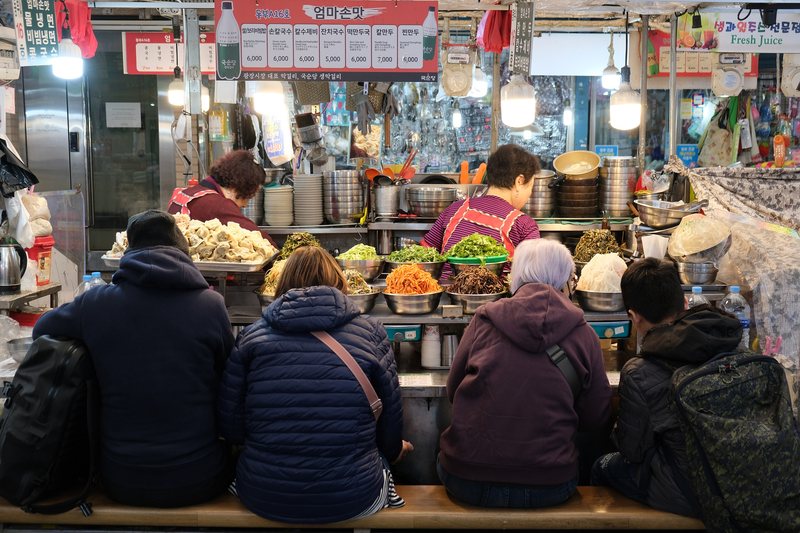
The stalls began by feeding the people who worked in the market, which is why the food is still, as the Korea Herald puts it, working-class fare: cheap and filling. You eat on a bench around the cook's counter, elbow to elbow with strangers. Regulars return to the same stall for years, and that is when imo stops being a figure of speech. A 2013 Korea JoongAng Daily piece noted that loyal customers of small eateries avoid “ajumma” and call the owners “mother” or “aunt,” out of real affection and, the writer suggested, perhaps in hope of an extra side dish. In Korea, feeding someone has always been a way of caring for them, the same instinct behind the greeting “Have you eaten?”
What to eat: the big three, plus noodles
- Bindaetteok (빈대떡): a mung bean pancake. Soaked mung beans are ground into batter, mixed with bean sprouts and other fillings, often pork or kimchi, and fried thick in plenty of oil until the edges crunch. It comes with a dip of soy sauce, vinegar and raw onion, and many people pair it with makgeolli, Korean rice wine.
- Mayak gimbap (마약김밥): mayak means “narcotic,” a joke about how hard these are to stop eating. They are finger-sized rolls with just a few fillings, such as carrot and pickled radish, wrapped in seaweed brushed with sesame oil and dipped in a sharp mustard sauce. And no, there is nothing illegal inside; Seoul's city news site notes that some foreign visitors have wondered.
- Yukhoe (육회): seasoned raw beef, a dish Koreans have eaten for centuries. Many shops in the market specialize in it, clustered in what locals call the yukhoe alley (육회 골목, yukhoe golmok), and some have appeared in the Michelin Guide. Try it plain, or as tangtangi, tossed with chopped raw octopus.
Then there is the Netflix effect. In 2019 the Seoul episode of Street Food: Asia was set at Gwangjang Market, showcasing old favorites from soy-marinated crab to hand-cut noodle soup, 칼국수 (kalguksu). Foreign visitors have been lining up for those noodles ever since.
The case against “imo”
For all its warmth, imo has critics. The National Institute of Korean Language's etiquette guide, Standard Language Etiquette, does not include it as a way to address people outside the family, and the Standard Korean Dictionary still gives only the family meaning. Some Korean columnists argue that the word lets customers skip a worker's name and role, and that its friendliness tends to flow one way, from the customer down. That is why plenty of Koreans, especially younger ones, stick to jeogiyo or sajangnim. Age matters too: call a woman in her twenties imo and she may hear “you look middle-aged.”
At the stall: ordering like a regular
- Pick your word. For a middle-aged woman at the griddle, imo is friendly and usually earns a smile. Otherwise, jeogiyo is never wrong, and sajangnim suits a shop owner.
- Read the board first. Most stalls post their prices, and some expect every person on the bench to order something.
- Carry some cash. Many shops and restaurants take cards, but some stalls have asked customers for cash or a bank transfer, so small bills help.
- Mind the clock. Food stalls stay open into the evening and on Sundays, when most fabric and hanbok shops are closed.
Fame has had a downside. Complaints about skimpy, overpriced plates made Korean headlines in 2023 and again in 2025, and in 2026 Seoul City and Jongno District sent undercover inspectors, both Korean and foreign, to check the stalls. Exact subway exits, hours and a taxi card are in the Getting there guide at the end.
Quick answers
What does imo mean in Korean?
이모 (imo) means your mother's sister. Koreans also use it as a warm way to call a middle-aged woman who is serving food, at a market stall or a casual restaurant.
Is it rude to call a waitress imo in Korea?
Usually not. At markets and casual eateries it sounds friendly when the woman is roughly middle-aged. With younger staff or in formal places, the neutral jeogiyo (“excuse me”) is safer, and some Koreans dislike imo altogether.
Do Gwangjang Market food stalls take cards?
Not always. Many shops and restaurants do, but some food stalls ask for cash or a bank transfer, so bring small bills.
Getting there
Gwangjang Market 광장시장
- Subway
- Line 1, Jongno 5-ga Station, Exit 8 (a few minutes' walk); or Lines 2 and 5, Euljiro 4-ga Station, Exit 4, then walk north across the Cheonggyecheon stream
- From Incheon Airport
- AREX to Seoul Station, then Line 1 to Jongno 5-ga Station
- Hours
- Shops 9:00–18:00, closed Sundays; food alley 9:00–23:00, open all year. Each stall keeps its own hours
- Admission
- Free to enter. Most food-stall dishes cost about 3,000–7,000 won; yukhoe plates cost more
- Tip
- Some stalls take only cash or bank transfer, so carry small bills and check posted prices. For help in English, call the 1330 Travel Hotline (+82-2-1330)
Checked on October 10, 2026. Hours and fees can change, so check the official site before you go. In Korea, Google Maps can’t give walking or driving directions — Naver Map or Kakao Map work best.