The King Who Built a Whole City for His Father
King Jeongjo moved his father's tomb to Suwon, then built a walled city there. Walk Hwaseong and you'll see why hyo still shapes Korean family life.
Picture a spring morning in 1795. In a freshly built palace hall in Suwon, a king raises a cup to his mother on her 60th birthday, with court music and one course after another. The city outside is barely finished. Its walls, its gates and the hall itself exist because of someone else: the king's father, who had died 33 years earlier in one of the darkest episodes in Korean royal history.
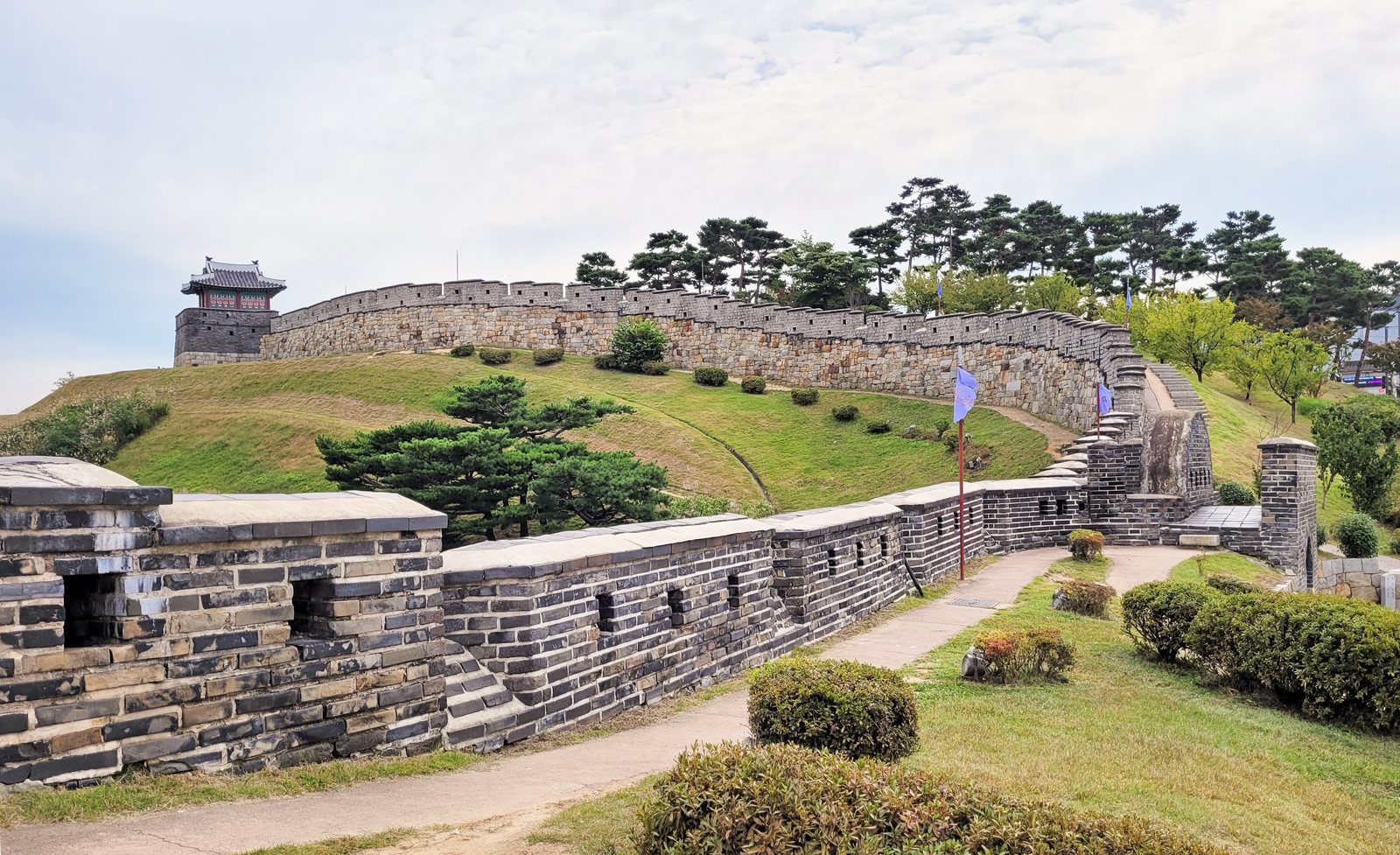
The king was Jeongjo (정조), and that city is today's 수원 화성 (Suwon Hwaseong, Hwaseong Fortress), a UNESCO World Heritage Site since 1997. Ask Koreans why it was built and many will answer with one word: 효 (hyo), filial piety, the love, respect and care children owe their parents. Jeongjo moved his father's tomb to Suwon, moved the whole town to make room, and wrapped the new town in 5.7 km of stone walls. That is why a day on this wall explains so much about Korean families, even now.
A father, a rice chest and one sentence
Jeongjo's father was Crown Prince Sado (사도세자), heir to King Yeongjo. Their relationship collapsed, and in 1762, on Yeongjo's orders, the prince was locked inside a wooden rice chest (뒤주, dwiju) and died there. Historians still debate why; the records point to the prince's illness, accusations made against him and the rivalries of the court. His son, the future Jeongjo, was a boy of about ten.
Fourteen years later, Jeongjo took the throne. On that day in 1776, he addressed his officials in words preserved in the Annals of the Joseon Dynasty: "I am the son of Crown Prince Sado." It was a bold thing to say. To keep the royal line tidy, his grandfather had officially made him the heir of another, earlier crown prince, and Jeongjo acknowledged that in the same speech. Still, nobody in the room could miss whose son he chose to be.
Moving a grave, then a whole town
In 1789, Jeongjo moved his father's tomb from Baebongsan in Yangju to Hwasan in Suwon, a site considered one of the most auspicious in the kingdom, and named it Hyeollyungwon. The old town of Suwon sat near Hwasan, so he moved it to the foot of Paldalsan mountain, where the city center is today. That same year a royal travel palace, 화성행궁 (Hwaseong Haenggung), went up there for the king's visits, and in 1790 he founded Yongjusa (용주사), a Buddhist temple near the tomb where prayers were offered for his father.
Then came the walls. Work began in January 1794 and was expected to take about ten years; it was finished in September 1796, in under three. Much of the credit goes to the scholar Jeong Yak-yong (정약용), who drew up the design and devised a pulley crane, the 거중기 (geojunggi), so heavy stones could be lifted with little effort. Workers were paid wages instead of simply being drafted, and the court wrote everything down, from workers' names to materials, costs, tools and daily progress, in the Hwaseong Seongyeok Uigwe, a royal record published in 1801. That obsessive paperwork paid off almost two centuries later. Parts of the fortress were damaged in the 20th century, including during the Korean War, and between 1975 and 1979 it was restored largely to its original look by following the book's drawings.
Hyo was not the only motive. Hwaseong was also meant to be a strong southern stronghold and a busy commercial city, a showcase for Jeongjo's reforms. But the reason Koreans remember first is the son.
Eight days with his mother
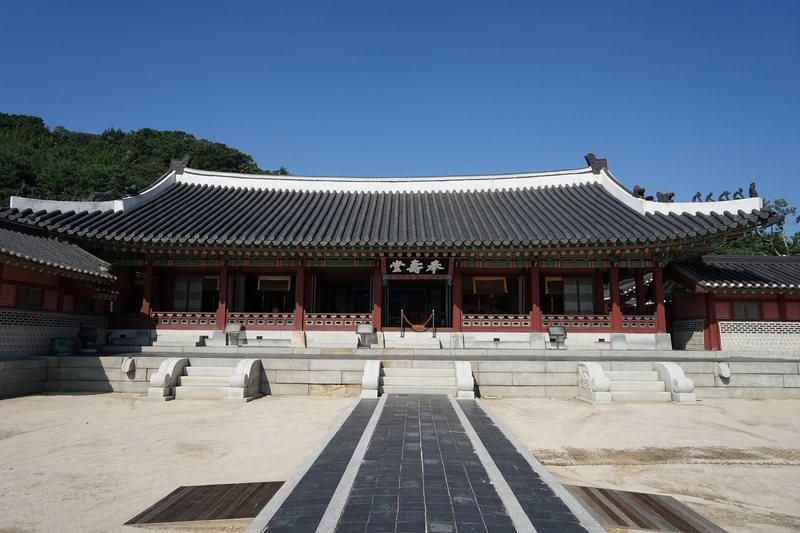
In 1795, Jeongjo's mother, Lady Hyegyeong (혜경궁 홍씨), turned 60, and so would his father have; the two were born in the same year. Jeongjo took her on an eight-day royal journey from Seoul to Suwon, visited his father's tomb with her and threw her birthday banquet in the travel palace. He renamed the hall 봉수당 (Bongsudang), roughly "the hall that offers wishes for a long life." Every detail of the trip went into an illustrated royal record, the Wonhaeng Eulmyo Jeongni Uigwe, part of the Joseon court protocol books on UNESCO's Memory of the World register.
Jeongjo died in 1800. He had long wished to rest near his father, and he does: his tomb, Geolleung, lies close to Sado's, now called Yungneung, in today's Hwaseong City just south of Suwon. In 1801, a shrine for Jeongjo's portrait, 화령전 (Hwaryeongjeon), was built beside the travel palace, so the son who honored his father is now honored in the same place.
Suwon retells the story every autumn at the Suwon Hwaseong Cultural Festival. In 2026, the 230th year since the walls were finished, the festival runs October 4–11 and opened with a re-creation of Jeongjo's royal procession, which marched through Janganmun, the north gate, to the palace.
What hyo looks like in Korea today
Hyo comes from Confucian teaching, which shaped the Joseon dynasty for five centuries, and it still runs through everyday life. Being good to your parents is 효도 (hyodo); a devoted son is a 효자 (hyoja), a devoted daughter a 효녀 (hyonyeo). Many Koreans start giving their parents 용돈 (yongdon, an allowance) once they earn a salary, call home often and travel back for Chuseok and Seollal. On Parents' Day, May 8, children pin red carnations on their parents, and a trip for mom and dad, known as 효도 관광 (hyodo gwangwang, a "filial trip"), is a classic gift.
There is even a law. A 2007 act to encourage and support filial piety (효행 장려 및 지원에 관한 법률) defines hyo as children faithfully supporting and caring for their parents, and it names October the Month of Filial Piety. Yes, that is this month.
Hyo is not always gentle. It can come with pressure, guilt and long years of caring for aging parents, and Koreans openly debate how much of it to keep. Yet even people who sigh at the word understand Jeongjo instantly. A king who reshaped a whole town to honor a father he lost as a child is, for many Koreans, the ultimate hyoja. The same value sits behind small things visitors notice, from the way age shapes how Koreans speak to each other to the birthday bowl of seaweed soup that is really a thank-you to mom.
Spending a day on the wall
The wall runs 5.7 km (5,744 m) around the old town, climbing over Paldalsan and passing four main gates. Walking it is free, since Suwon dropped its old 1,000-won ticket in 2022, and it never closes. Most people start at Paldalmun, the south gate, or Janganmun, the grand north gate; the stretch over Paldalsan is the steepest. Along the way:
- Hwaseong Haenggung: the travel palace, the largest of its kind in Korea, restored and reopened in 2003. Look for Bongsudang, the birthday-banquet hall, and Hwaryeongjeon next door. Visitors in hanbok get in free, just as at Seoul's royal palaces.
- Archery at Yeonmudae: near the east gate, you can try traditional Korean archery (국궁, gukgung) with a quick lesson and ten arrows.
- After dark: Banghwasuryujeong, an elegant corner watchtower above Yongyeon pond, is a favorite evening view, and the travel palace opens late on weekends from May to early November.
Station exits, bus numbers, hours, fees and a taxi card for the south gate, the palace and the archery field are in the Getting there guide at the end.
Quick answers
Why was Hwaseong Fortress built?
King Jeongjo built it between 1794 and 1796 after moving the tomb of his father, Crown Prince Sado, to Suwon. Filial piety (hyo) was at its heart, alongside defense and his plans for reform.
Is Suwon Hwaseong Fortress free?
Yes. Walking the wall is free and possible 24 hours a day. Hwaseong Haenggung palace charges adults 2,000 won, and entry is free if you wear hanbok.
What does hyo mean in Korean?
효 (hyo) means filial piety: the respect, gratitude and care children owe their parents. Putting it into practice is called 효도 (hyodo).
Getting there
Hwaseong Fortress (Paldalmun Gate) 수원화성 팔달문
- Subway
- Line 1 or Suin-Bundang Line to Suwon Station, then a city bus
- Bus
- To Paldalmun: from Suwon Station Exit 9 (Maesan Market stop), bus 2-2, 36, 39 or 400. To Janganmun (north gate): from Exit 7, bus 60, 7-1 or 7-2 to Jangan Park
- From Incheon Airport
- Airport bus 4100 to Suwon Station; or AREX to Seoul Station, then Line 1 to Suwon Station
- Hours
- Wall open 24 hours, every day; night walks allowed
- Admission
- Free
- Tip
- The full loop is 5.7 km, with a steep climb over Paldalsan. From Seoul, express bus 3000 from Gangnam Station stops at Paldalmun
Hwaseong Haenggung Palace 화성행궁
- Subway
- Line 1 or Suin-Bundang Line to Suwon Station, then a city bus
- Bus
- From Suwon Station Exit 4 (Novotel stop), bus 11 or 13; or from Exit 7 (AK Plaza stop), bus 60 or 7-2. Get off at Hwaseong Haenggung, then about 5 min on foot
- From Incheon Airport
- Airport bus 4100 to Suwon Station; or AREX to Seoul Station, then Line 1 to Suwon Station
- Hours
- 9:00–18:00 daily, last entry 17:00. Night opening Fri–Sun and public holidays until Nov 1, 2026: 18:00–21:30 (last entry 21:00)
- Admission
- Adults 2,000 won; youth and military 1,500; children 1,000 (Hwaryeongjeon included). Free in hanbok, for 65+ (with ID), children 6 and under, and on the last Wednesday of each month
- Tip
- Combined ticket with Suwon Hwaseong Museum and Suwon Museum: adults 4,000 won. From Seoul, express bus 1007 from Jamsil Station stops near the palace
Yeonmudae (traditional archery) 수원화성 연무대
- Subway
- Line 1 or Suin-Bundang Line to Suwon Station, then a city bus
- Bus
- From Suwon Station Exit 7, bus 60 or 7-2 to the Changnyongmun Yeonmudae stop
- From Incheon Airport
- Airport bus 4100 to Suwon Station; or AREX to Seoul Station, then Line 1 to Suwon Station
- Hours
- Archery 9:30–17:30 (Mar–Oct), 9:30–17:00 (Nov–Feb); sessions every 30 min, lunch break 12:00–13:00
- Admission
- 3,000 won for 10 arrows
- Tip
- Ages 7 and up; stopped in rain or snow. The Hwaseong Eocha tourist train also starts here (no service on Mondays)
Checked on October 5, 2026. Hours and fees can change, so check the official site before you go. In Korea, Google Maps can’t give walking or driving directions — Naver Map or Kakao Map work best.