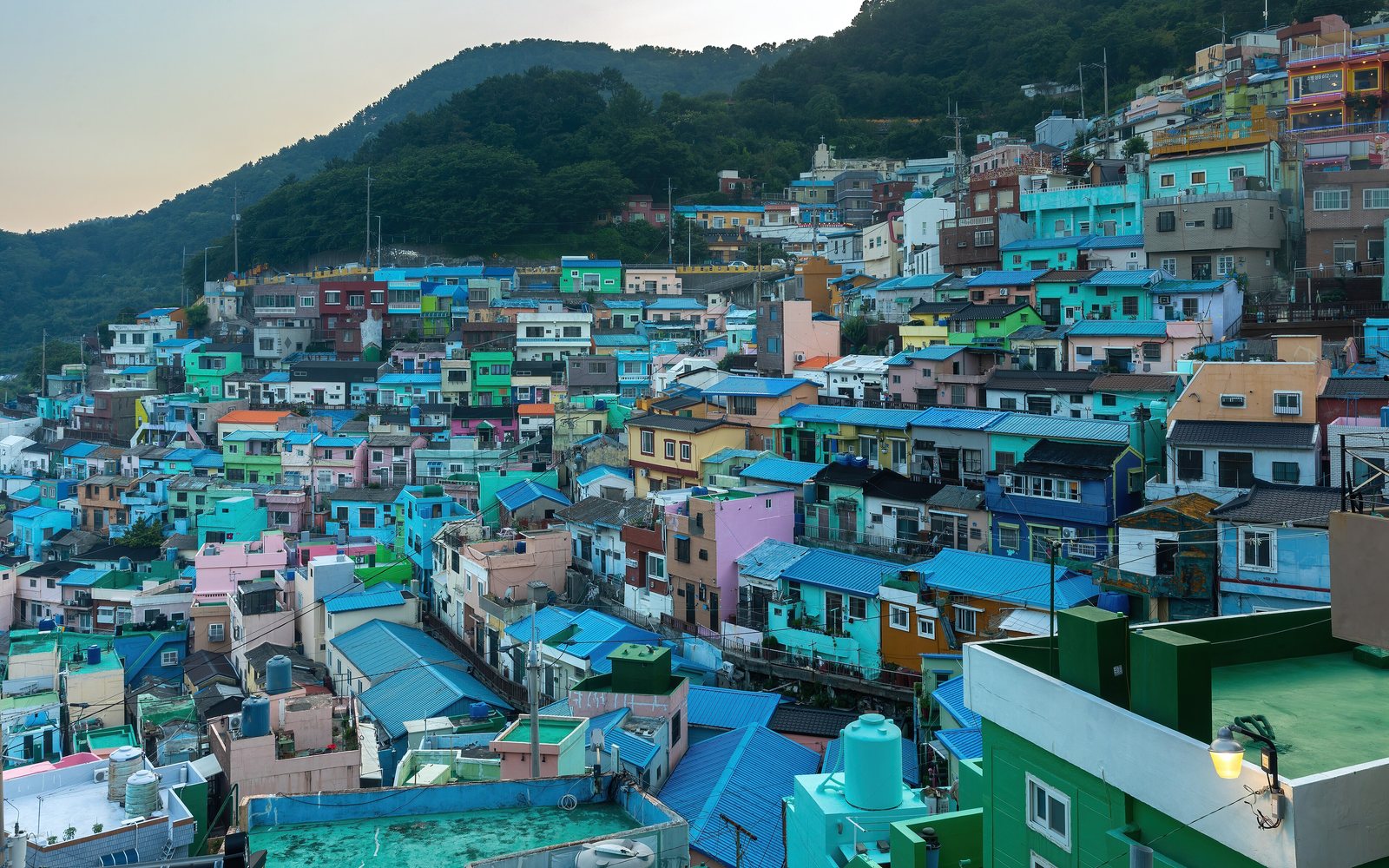
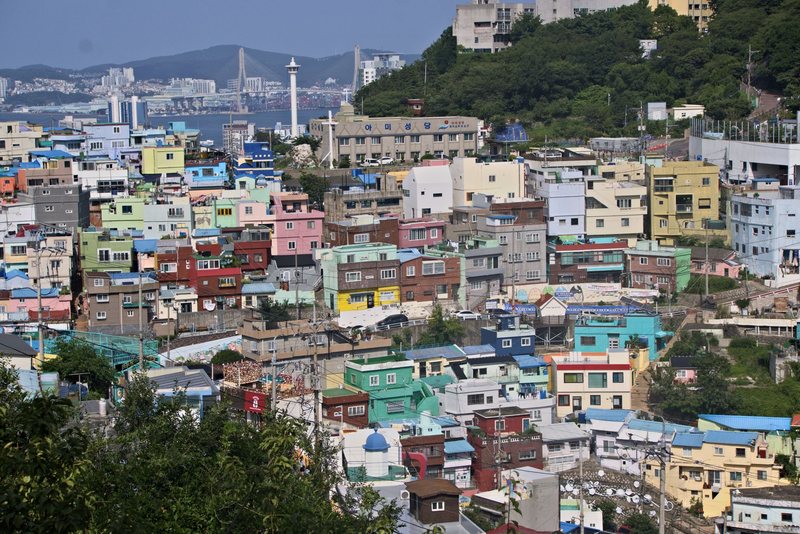
Busan's houses climb the hills because, during the Korean War, the hills were the only land left. Hundreds of thousands of refugees poured into the port city, the flat ground filled up, and families cleared the slopes and put up shacks wherever they could. 감천문화마을 (Gamcheon Munhwa Maeul, Gamcheon Culture Village), the pastel staircase of houses you have probably seen online, is what one of those slopes looks like seven decades later.
What the photos leave out is that this is still a neighborhood. Only about 1,500 people live here, and about 3.12 million visitors came in 2025, so many that the village now has official visiting hours. The murals are why people come. The reason the village exists is a harder story, and a better one.
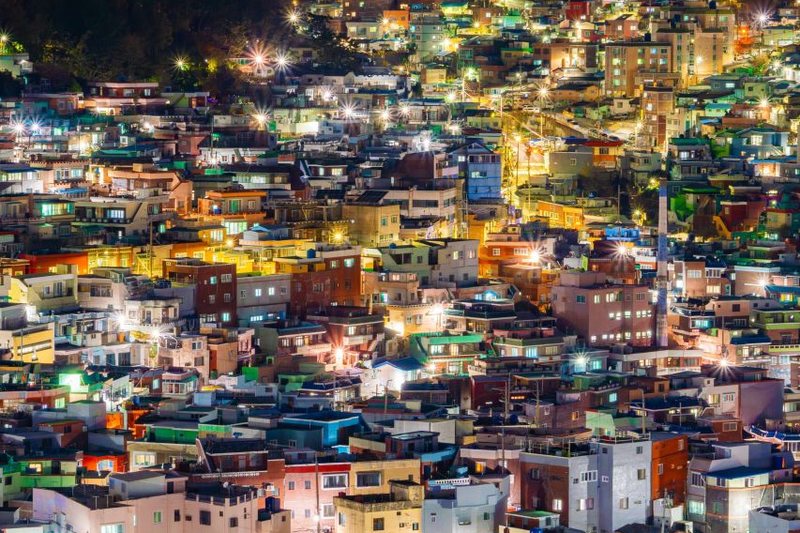
Why Busan's houses climb the hills
Busan sits at the southeastern end of the peninsula, the place farthest from the fighting, and it served as South Korea's wartime provisional capital. According to the Provisional Capital Memorial Hall, the city had about 300,000 people in 1945 and almost 840,000 by 1951. Rents soared, housing ran out, and many refugees had no choice but to clear the hillsides and build with planks and straw mats. Mountains cover about 70 percent of Busan, so up was the only direction left.
Two Korean words hold this history. 산복도로 (sanbok-doro, literally “mountain-belly road”) is a road running along the middle of a slope; Busan's first one opened in 1964 in Choryang-dong to link the hillside villages. 달동네 (daldongne, “moon neighborhood”) is the everyday word for a poor neighborhood perched up high, the kind of place with a fine view of the moon. It sounds romantic. It was never a compliment. In those hard years, even “Have you eaten?” was a real question.
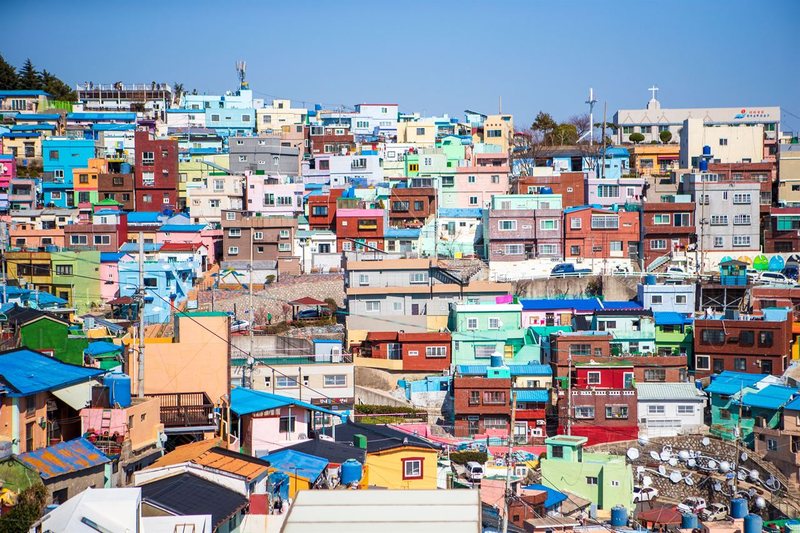
Gamcheon's twist: a village shaped by a religion
Most accounts stop at “refugees,” but Gamcheon has a second founding story. Saha District describes the village as a settlement formed in the 1950s by followers of 태극도 (Taegeukdo) together with war refugees. Taegeukdo is a new religion in the Jeungsan tradition, founded in 1921 by Jo Cheol-je (조철제). According to the Encyclopedia of Korean Culture, he moved its headquarters to Busan in 1948 and in 1955 resettled about 3,000 households, some 10,000 followers, in Gamcheon-dong. Before that, Gamcheon had been a cluster of 20 or so houses.
The first homes were corrugated iron, old planks and plywood, with stones on top to keep the roofs from blowing away. Yet the layout was no accident. The village's official site credits that 1950s community with Gamcheon's present shape: terraces stepping up the foot of Cheonmasan (천마산), arranged with care for the sunlight and view of the house behind. From the viewpoint, what looks like a cheerful jumble is really neighborly manners, built into a hillside.
How a poor hillside became “Busan's Machu Picchu”
Change came late. In 2011, Maeil Shinmun was still describing Gamcheon as a daldongne of tiny, tightly packed houses where people used wells and shared toilets. But the art had already arrived. In 2009, the Ministry of Culture, Sports and Tourism launched a project called Dreaming of Busan Machu Picchu, hiring artists to paint murals and add 10 pieces of street art. A second phase transformed six houses and six alleys under the name 미로미로 (Miro Miro). It is a pun: written 美路迷路, it means both “beautiful road” and “maze.” Anyone who has lost the main road in Gamcheon's alleys will agree with both halves. The nicknames followed: Korea's Machu Picchu for the terraces climbing the mountain, Korea's Santorini for the pastel walls above the sea.
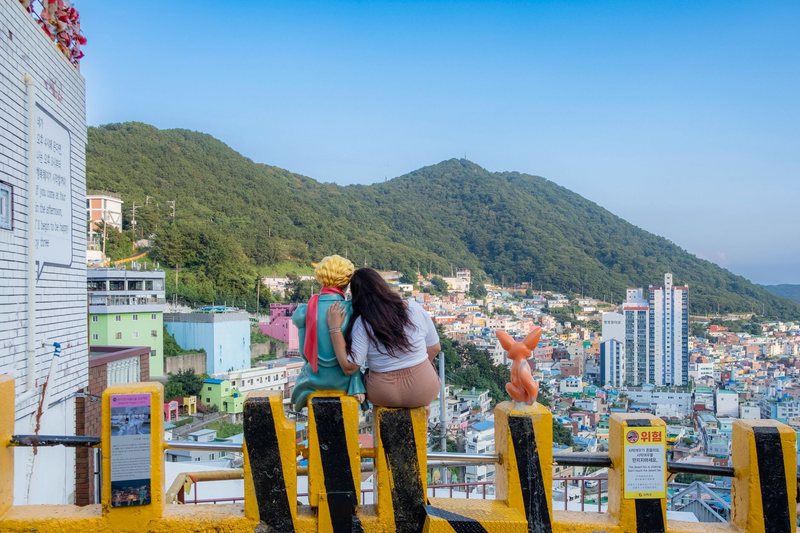
The star of the art is a small statue. The Little Prince and the Desert Fox, by Na In-ju, sits on a guard wall at the edge of the road, looking out over the rooftops, and Visit Busan calls the photo spot the highlight of the walk. Expect a queue. Even the district's notice about the new rules stars a cartoon Little Prince and fox.
When 25,000 visitors became 3 million
The art worked almost too well. Visitors rose from about 25,000 in 2011 to 3.08 million in 2019 and about 3.12 million in 2025, and Saha District says more than 80 percent are foreigners. Residents went the other way. District figures reported by JoongAng Ilbo show 3,161 people in 2010 and 1,558 in 2023, more than half of them 65 or older. In 2022 that came to 1,122 visitors for every resident. Neighbors complained of noise, trash, traffic jams, parking and lost privacy.
Charging admission came up twice: a plan was dropped in 2016, and a 2025 review rejected it too. Instead, Saha District designated the village a special management area on August 1, 2026, the third in Korea after Bukchon in Seoul and Yeoncheon. The district's notice sets out the main measures:
- Residential zone: tourists may enter only between 9:00 and 18:00.
- Gamnae 2-ro: from 9:00 to 18:00, tourist vehicles, taxis included, are barred from about 1 km of this road, starting at the information center entrance. Fines begin January 1, 2028, after a guidance period.
- Groups: parties of 10 or more must buy the official map. This rule already applies.
- Large buses: advance reservation is required.
The notice gives January 1, 2027 as the effective date, and a pilot has been running since August. Days after it began, Busan Ilbo found staff at the entrance blowing whistles to turn back taxis and vans, and reported that after 18:00 patrols remind tourists not to shout or litter. Walking the village is still free.
How to visit someone else's neighborhood
Treat Gamcheon like a friend's street and you will be fine. Exact subway exits, hours, fees and a taxi card are in the Getting there guide at the end.
Korean insider tip: Plan the ride the way Koreans do, on KakaoMap or Naver Map; the village's own website points visitors to KakaoMap for directions. Type the Korean name, 감천문화마을, and the app will show the village bus routes and live arrival times from Toseong Station Exit 6 or Jagalchi Station Exit 1. A T-money card from Seoul works on Busan's buses and subway, so you do not need a new card. And leave the car behind: the official site says parking is short.
- Do come early on a weekday if you can. Busan Ilbo counts around 10,000 visitors a day, and the village buses get packed. You may also get a free lesson in the Busan accent on board.
- Do buy the stamp map, 2,000 won at the information center. Individuals do not have to, but it is a small contribution to the village's upkeep, and the district's stamp route takes about 1 hour 20 minutes.
- Do stay quiet and carry your trash out. Visit Busan's etiquette note asks for exactly that, because this is a residential area.
- Don't aim your camera through windows or open doors, or borrow someone's doorstep as a backdrop. The district now lists invasion of privacy among the behaviors it will manage. If a resident would be in your shot, ask first: 사진 찍어도 될까요? (sajin jjigeodo doelkkayo?, “May I take a photo?”).
- Don't fly a drone. The village's site carries a “no drones” notice, and Visit Busan repeats it.
- Don't call a taxi to pick you up on Gamnae 2-ro. Yellow signs at the entrance say no taxi calls.
Quick answers
Is Gamcheon Culture Village free to enter?
Yes. There is no admission fee. The stamp map costs 2,000 won and is optional for individuals, but groups of 10 or more must buy one.
Do people still live in Gamcheon Culture Village?
Yes. About 1,500 people live here, many of them elderly. Those are real homes behind the painted walls, which is why the village now has visiting hours.
Can you visit Gamcheon Culture Village at night?
Not the residential alleys. Tourists may enter that zone only from 9:00 to 18:00, and the information center closes by then too, so plan a daytime visit.
How long do you need at Gamcheon Culture Village?
Saha District suggests 40 minutes for a round trip along the main road and about 1 hour 20 minutes for the stamp route. Add time for the Little Prince queue.
Getting there
Gamcheon Culture Village 감천문화마을
- Subway
- Line 1, Toseong Station, Exit 6 (Pusan National University Hospital), then a village bus. Or Jagalchi Station, Exit 1 (Chungmu Market stop)
- Bus
- Village bus Seo-gu 2, Seo-gu 2-2 or Saha 1-1 from either station to Gamjeong Elementary School, then about 5 min on foot. City bus 61 also serves the village
- From Incheon Airport
- Busan-Gimhae Light Rail to Sasang, Line 2 to Seomyeon, then Line 1 to Toseong
- Hours
- Residential zone open to tourists 9:00–18:00. Information center 9:00–18:00, open all year (Visit Busan lists 9:00–17:00 for Nov–Feb)
- Admission
- Free. Stamp map 2,000 won at the information center (required for groups of 10 or more)
- Tip
- From 9:00 to 18:00, tourist vehicles, taxis included, are barred from about 1 km of Gamnae 2-ro, starting at the information center entrance. Parking is scarce, so come by village bus
Checked on November 5, 2026; confirm on the official site before you go.