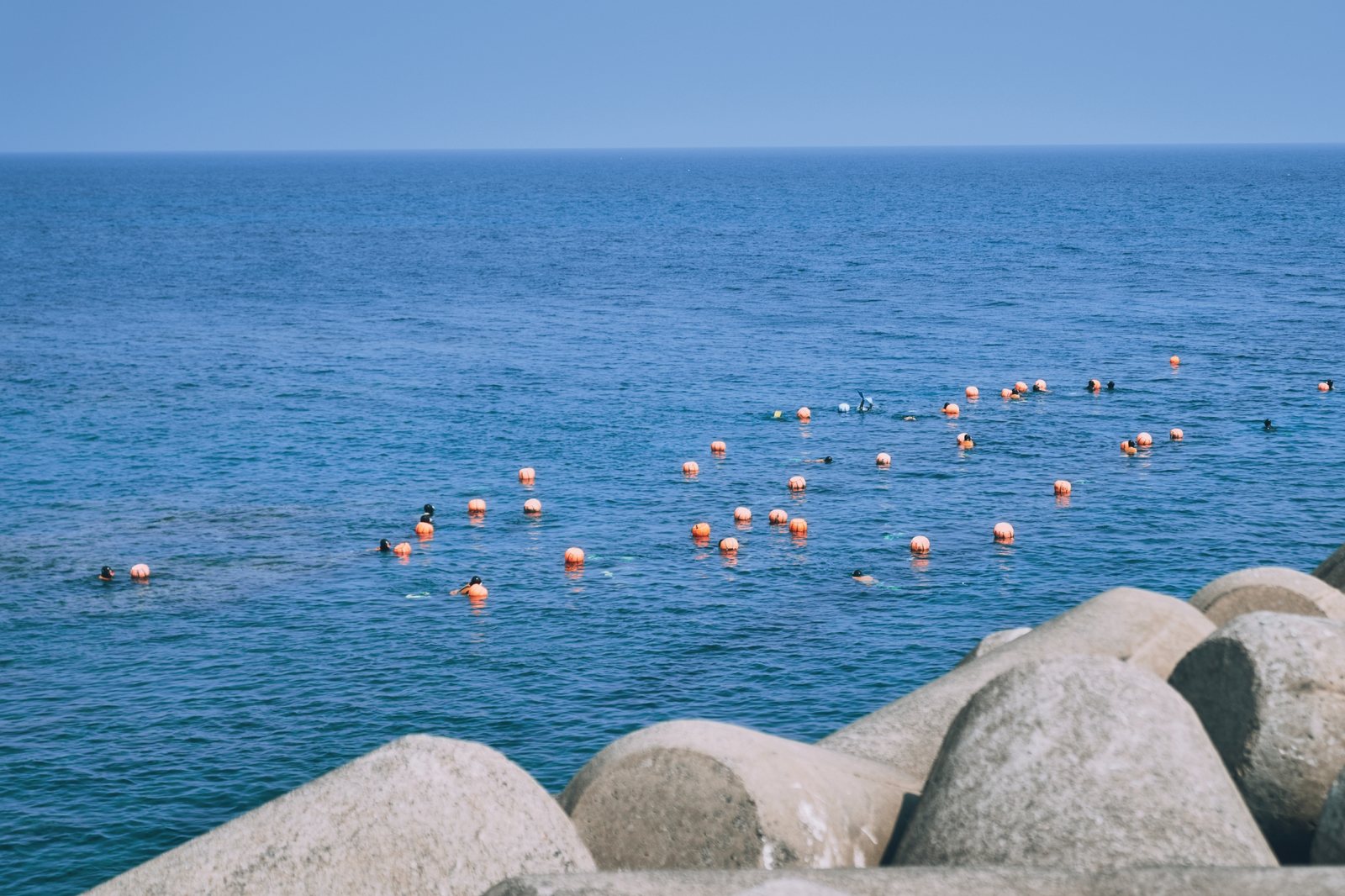
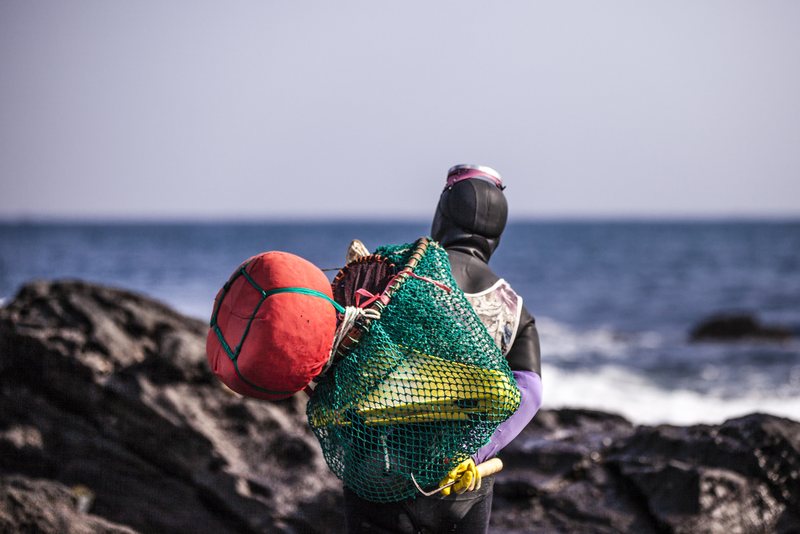
On a calm morning on Jeju's northeast coast, the water off a village harbor fills with small orange balls. They bob, slip behind a swell, bob again. Every minute or so a head in a black rubber hood comes up beside one of them, and a long, thin whistle carries over the waves: hoo-i. Koreans know that sound by name. It is the 숨비소리 (sumbisori), the breath a 해녀 (haenyeo, woman diver) lets out when she surfaces, and the orange balls are 테왁 (tewak), the floats she rests on between dives. There is no boat of air tanks waiting nearby, and there never is. This scene still plays out on Jeju's east coast, from the villages around the Jeju Haenyeo Museum in Gujwa-eup to the water below Seongsan Ilchulbong.
So where can you see haenyeo divers in Jeju? The museum is the place to start, because it tells their story from the middle of a stretch of working diving villages. At the foot of Seongsan Ilchulbong, the crater on Jeju's eastern tip, divers from the local fishing village give a short demonstration dive, usually in the early afternoon when the sea allows. And on almost any quiet stretch of rural coast on a calm day, you may simply see them at work. As for the missing tanks, the whole way of life is built on one breath. A diver takes only what she can reach and carry in a minute or two, and that limit, kept by the women themselves, works as a natural brake on overharvesting the village sea.
One breath, one float, one fire
Diving for food off Jeju is far older than any museum. The National Archives of Korea points to a Goryeo-dynasty record from 1105 that banned divers from working naked, and to Joseon-era male divers called 포작 (pojak), who gathered abalone as tribute for the royal court while women gathered seaweed. Over the centuries, the sea became women's work. Girls traditionally learned to swim and duck under the waves at seven or eight, began diving in earnest in their mid-teens, and were thought to reach their peak around forty.
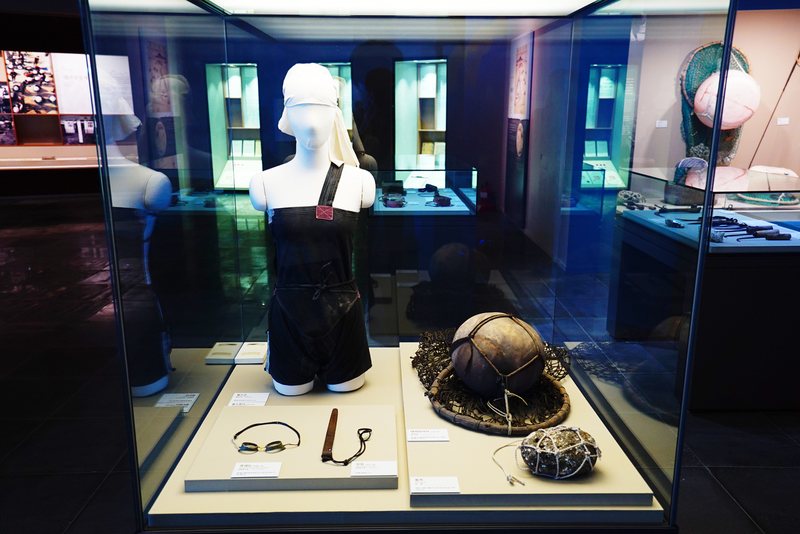
The tools are simple. The tewak keeps a diver afloat while she catches her breath and carries a net bag, the 망사리 (mangsari), for the catch. A long iron bar, the 빗창 (bitchang), pries abalone off the rock. Divers once worked in cotton suits called 물옷 (mul-ot), and goggles only arrived in the 1950s; today it is rubber wetsuits. UNESCO describes dives of about 10 meters, around a minute each, for up to seven hours a day and some 90 days a year, bringing up abalone and sea urchins (Jeju even has a sea urchin version of birthday seaweed soup). The strongest divers, the archives note, can reach 20 meters and stay down for more than two minutes.
Skill sets the order of things. Every diver belongs to one of three ranks, 하군 (hagun), 중군 (junggun) and 상군 (sanggun), and the sanggun, the most experienced, guide the rest. Much of that guiding happened at the 불턱 (bulteok), a sheltered circle of stacked stones on the shore where a fire was lit. According to the Jeju Haenyeo Museum, this was where women changed, warmed up between dives, passed on what they knew about the sea and made decisions together. Villages once had three or four each, and about seventy survive, even though modern changing rooms went up around 1985. Many communities also hold the 잠수굿 (jamsugut), a ritual asking the goddess of the sea for safety and a full catch.
The work carried Jeju women far from home, too. Islanders were barred from leaving Jeju for about two centuries from 1629, and after that ban was lifted in the 19th century, haenyeo began traveling for seasonal diving, first to Busan and Ulsan, then right around the Korean coast and on to Japan, Vladivostok, Dalian and Qingdao. In January 1932, haenyeo around Gujwa, Seongsan and Udo rose up against colonial exploitation under Japanese rule. The museum calls it Korea's largest anti-Japanese movement by women, and a 12-meter monument to it stands on the museum grounds.
Rules written on the water
This is the part most visitors miss. The sea off a Jeju village is not open water. It is a village fishing ground, and the right to harvest it belongs to the local fishery cooperative, which in practice means the women who dive there. They decide together when a harvest opens and what may be taken. UNESCO points to exactly this in its listing: methods that are kind to the environment, and a community that manages its own fishing.
Seen from inside that system, the one-breath way of working stops looking like stubborn tradition. A tank would let a diver stay down until a reef was bare, and the reef belongs to the whole village, including the divers who will need it next year. Holding your breath is a quota you cannot cheat: nobody takes more than her lungs allow, and the strongest simply go deeper, leaving the shallows to others. It is also why haenyeo have long resented recreational divers who arrive with air tanks and spearguns, whom many see as raiding their field.
The same sense of fairness decides who dives where. Many villages keep a calm, shallow patch near the shore as 할망바당 (halmang badang, "grandmother's sea"), where only the oldest divers work, so they can keep earning without facing deep water. Some also set aside a 학교바당 (hakgyo badang, "school sea"), whose harvest helped pay for the village school. UNESCO also credits haenyeo culture with raising women's standing in their communities.
Where to see haenyeo divers in Jeju, without getting in their way
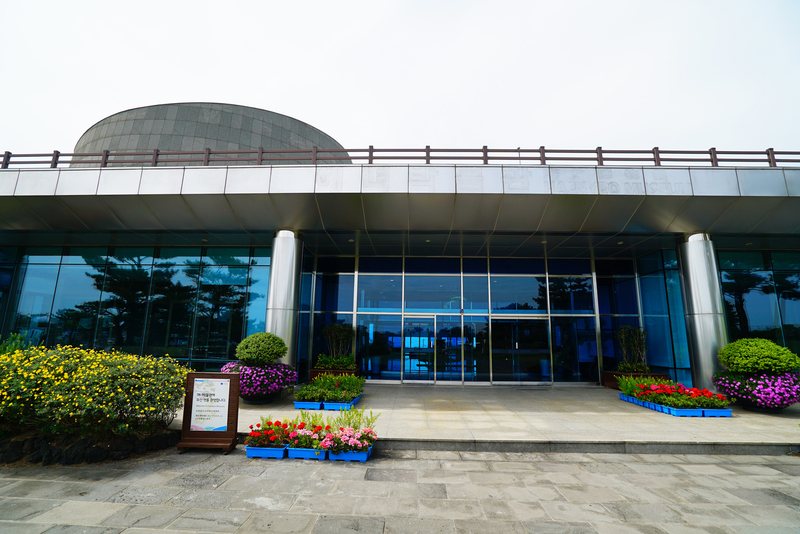
The Jeju Haenyeo Museum opened in 2006 in Gujwa-eup, part of the area where the 1932 protest took place, and its halls cover the divers' work, their gear and village life. Entry is 1,100 won for adults visiting from outside Jeju, according to the museum's admission page, and free for children 12 and under and visitors 65 and over. It closes on Mondays. Guided tours run in Korean only and must be booked three days ahead, and from March to November the museum hosts a monthly "bulteok talk show" with working haenyeo, also in Korean. Interest is rising: the museum drew 114,845 visitors from January to August 2026, with foreign visitors up 70.9 percent on the same months of 2025, Korea JoongAng Daily reported. The museum also marks out the Sumbisori-gil (숨비소리길), a 5.6-kilometer coastal walk that passes several old bulteok.
To watch divers in the water, head to Seongsan. Below the crater, haenyeo of the Seongsan fishing village give a short show: an introduction, a dive, the catch held up for photos, then a chance to buy and taste what just came out of the sea. It is free, but the sea decides whether it happens, so don't build a whole day around it. Everywhere else, sightings come down to luck: a calm morning, a quiet harbor and a line of orange floats. Watch from the shore, and remember that this is a workplace, not a stage.
Korean insider tip: Those orange balls off a harbor are tewak, so keep kayaks, paddleboards and snorkels well clear; a diver may surface right beside you. Don't pocket conch or sea urchins from the rocks either. That shallow sea is the haenyeo's field, and taking from it can get you fined. To taste their catch legally, look for a harbor shack signed 해녀의 집 (haenyeo-ui jip, "haenyeo's house"), often run by the village fishing cooperative.
Bus routes, opening hours, the full fee table and a taxi card for the museum are in the Getting there guide at the end.
The last sanggun
The numbers explain the urgency. Jeju had 14,143 haenyeo in 1970. When UNESCO added the culture of Jeju haenyeo to its Representative List of the Intangible Cultural Heritage of Humanity in 2016, there were 4,005, and Korea named it national intangible heritage the following year. By the end of 2025 the count was 2,371, and 63 percent were 70 or older, according to the same Korea JoongAng Daily report. In 2023, only six of Jeju's haenyeo were under 30, Seoul Shinmun reported from provincial figures.
Why so few young divers? The work is hard on the body and carries a real risk of accidents. The sea is also giving less: climate change and 갯녹음 (gaennogeum), the "whitening" that turns seaweed beds into bare rock, have thinned out conch, abalone and seaweed. And becoming a haenyeo is not a weekend course. A newcomer has typically trained for 86 hours at a haenyeo school such as Hansupul or Beophwan, then interned with a village fishing cooperative for at least a year and paid fees to join before diving as a full member. A village sea is shared property, and joining it means being accepted by the women who already work it.
Jeju people call these women 삼춘 (samchun), a Jeju word for any respected elder neighbor, man or woman, and the affection in it is real. For Koreans today, the haenyeo stand for Jeju itself and for a kind of strength many of us grew up hearing about: unsentimental, unglamorous, the person who goes out into winter water because the family needs it. The UNESCO listing made that official, but the real test is quieter. Every time a sanggun in her seventies shows a newcomer where the abalone hide, and every time a village keeps the grandmother's sea for divers who can no longer go deep, the old bargain is renewed: take one breath's worth, and leave the rest for tomorrow. If you hear a sumbisori carrying across the water, that is the sound of the bargain being kept.
Getting there
Jeju Haenyeo Museum 해녀박물관
- Subway
- No subway on Jeju Island; take the bus (see Bus)
- Bus
- From Jeju Bus Terminal: bus 260 to the Haenyeo Museum (해녀박물관) stop, about 60 min; or bus 201 to Haenyeo Museum Entrance (해녀박물관 입구), about 80 min, then a 5-min walk
- From Incheon Airport
- Express bus 101 from Jeju Airport toward Seongsan/Seogwipo to Sehwa Transfer Stop (세화환승정류장), about 70 min, then a 10-min walk; about 60 min by car
- Hours
- 09:00–18:00 (tickets sold until 17:00); closed Mondays (if Monday is a public holiday, the next non-holiday instead), Jan 1, Seollal and Chuseok
- Admission
- Adults (25–64) from outside Jeju 1,100 won; ages 13–24 and military 500 won; 12 and under and 65+ free
- Tip
- Guided tours are in Korean only and must be booked 3 days ahead. A monthly bulteok talk show with working haenyeo runs March–November (in Korean).
Checked on November 14, 2026; confirm on the official site before you go.