Walk into a restroom in a Seoul office building after lunch and you may well see the same small ritual at the mirrors: a round compact clicks open, a puff presses into it, and a few quick pats land on the nose and cheeks. The compact is a 쿠션 (kusyeon), a cushion, and the ritual has its own name: 수정 화장 (sujeong hwajang, touch-up makeup).
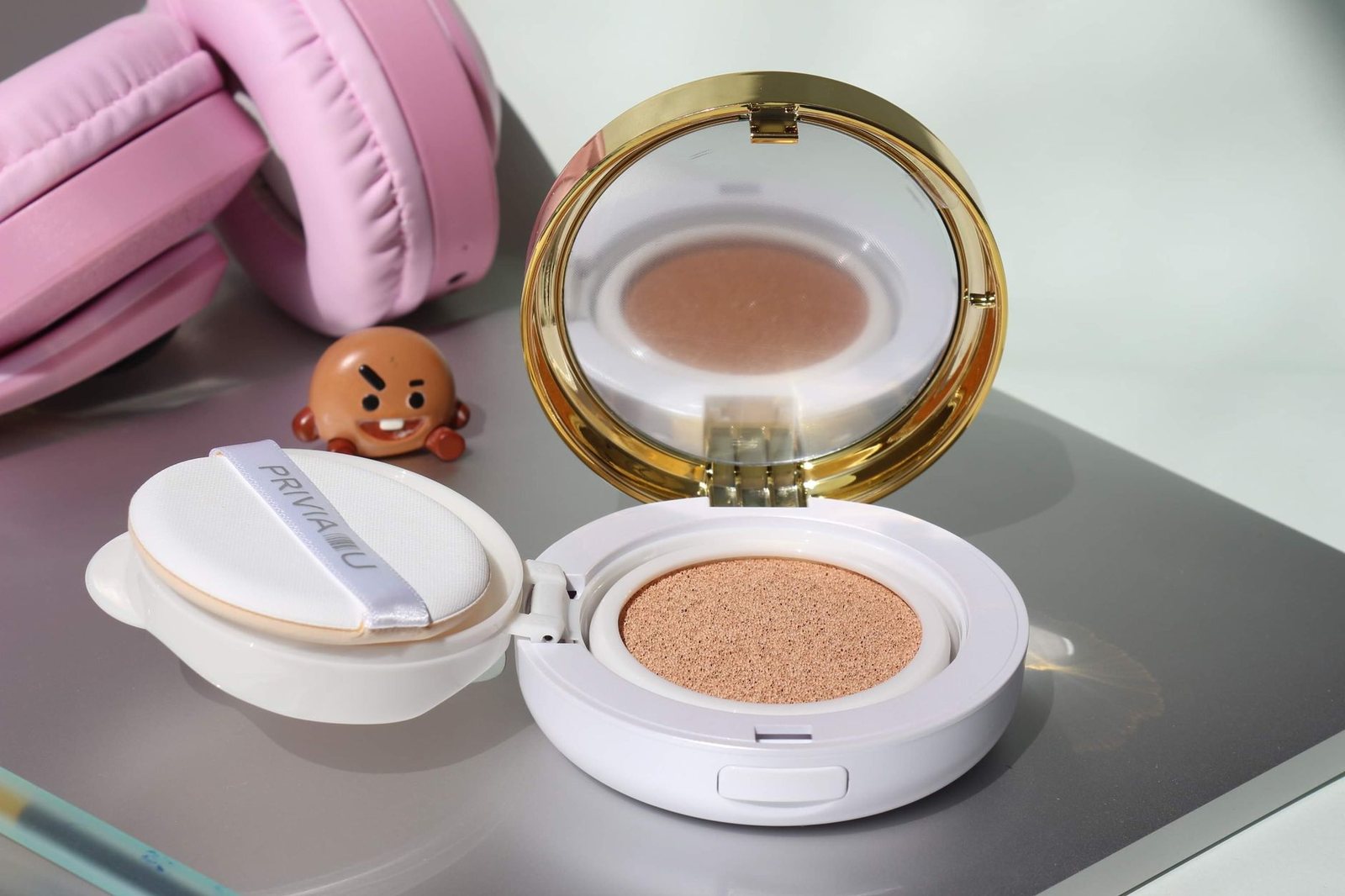
So what is a cushion foundation, and why do so many Koreans carry one? It is liquid foundation, often with sun protection added, soaked into a sponge and sealed in a compact with a puff. You press, pat, shut the lid and go: no bottle, no brush, no foundation on your fingers. In a TNS Korea survey of 800 Korean women, reported by The Korea Times in 2016, 75% had used a cushion and 55% used nothing else for their base makeup. Three in four said it cut the time they spent on base makeup and touch-ups.
It started with a parking stamp
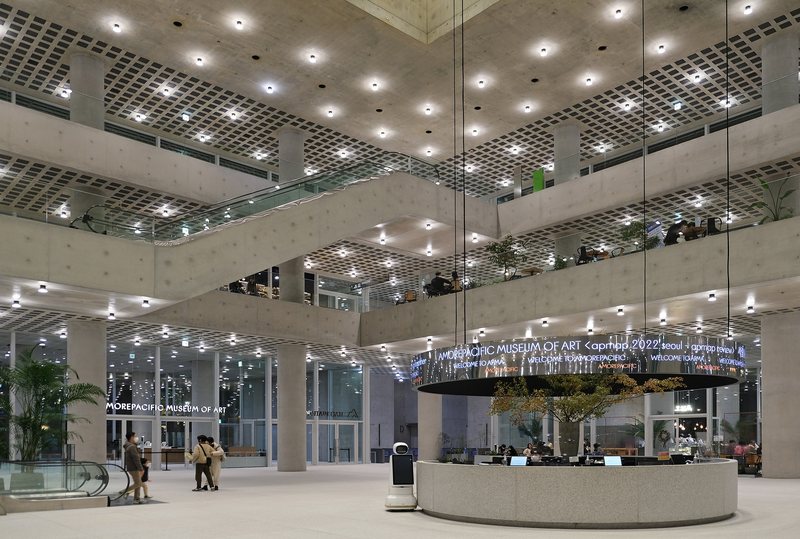
The cushion is a Korean invention with a very unglamorous muse. Researchers at Amorepacific, the company behind IOPE, Laneige and Sulwhasoo, were struck by the stamp used on parking tickets: it left a clean, even mark, and the ink never leaked. Could sunscreen work the same way? Their answer, launched in 2008 as the IOPE Air Cushion, was a stamp-style sunblock: liquid held in a polyurethane foam sponge, in a compact with a puff for touch-ups anywhere. Getting that sponge right took 3,600 experiments, according to The Korea Times.
Foundation versions followed, and the format took off. In November 2016, Amorepacific said it had sold more than 100 million cushions worldwide, including over 33 million in 2015 alone, or more than one every second. Koreans call it simply 쿠션 or 쿠션팩트 (kusyeon paekteu), since 팩트 is the everyday word for a makeup compact.
Why every brand seems to have one
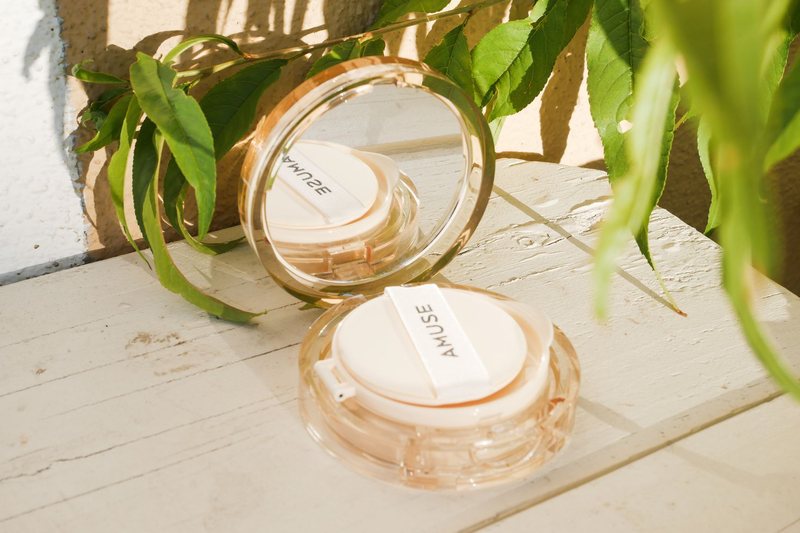
If a Korean beauty shelf looks like a wall of near-identical round compacts, part of the reason is a court case. Amorepacific patented its core idea in Korea in 2011: a cosmetic held in urethane foam soaked with product. In 2015, Cosmax, a major contract manufacturer, and five other Korean beauty companies challenged it. The Patent Court found the patent lacked inventiveness, and on May 31, 2018, the Supreme Court turned down Amorepacific's appeal, Korea JoongAng Daily reported. Amorepacific said it still held more than 400 cushion-related patents worldwide, and global names such as Chanel, Yves Saint Laurent and L'Oréal already sold cushions of their own. Today the cushion is less a product than a format, like lipstick.
21 or 23? How Koreans name their shade
Ask a Korean which cushion they use and the answer often comes with a number: 21호 (21-ho) or 23호 (23-ho). Korean base makeup is labeled by 호 (ho, number), and the higher the number, the darker the shade. For years, many Korean foundations came out in just those two shades, the daily JoongAng Ilbo noted in 2018.
Of the two, 21 had an almost mythical status. Vogue Korea wrote in 2016 about a "21 myth": a preference for a bright, fair-looking base, even one lighter than the wearer's skin. The same article cited a 2015 measurement by LG H&H's color lab: the skin tone found most often among Korean women converted to about 23, covering 43% of the customers measured, and 90% had yellow undertones. By 2018, JoongAng Ilbo reported that the myth was crumbling: one international brand said 7 of its 20 shades now sold steadily in Korea, where one or two light shades once dominated.
Readers abroad often had the opposite problem: Korean cushions did not go dark enough. After a Canadian beauty creator said in 2023 that even the darkest shade of TirTir's Mask Fit Red Cushion was too light for her, the brand developed more than 20 deeper shades; the cushion now comes in 40 shades worldwide and 45 in Korea, The Korea Herald reported in January 2026. Ranges still vary widely by brand, so check the full line before you fall for a compact.
Korean insider tip: Look at the letter after the number, too. Many Korean cushions are labeled like 21N or 21C: N means a neutral base, C a cool, pinkish one. Then watch for 다크닝 (dakeuning, darkening), the Korean beauty word for base makeup that turns duller and darker a few hours after you put it on, as it mixes with skin oil. Oily skin? Wear a tester out of the shop and look again later before buying.
How Koreans actually use a cushion
The technique goes back to that parking stamp: press, don't swipe. Touch the puff lightly to the sponge once, then pat from the center of the face outward. Start thin and add a second layer only where you need it, such as around the nose; press too hard and it turns cakey. Oily skin? A matte or semi-matte cushion with a little powder on the T-zone is a common choice, while dry skin usually prefers dewy ones.
The rest of the day is what the compact was made for. Many people blot shine first with 기름종이 (gireumjongi, oil-blotting paper), then pat on a little product where needed. When the sponge runs dry, keep the case: cushions in Korea are commonly sold with a 리필 (ripil), a spare filled pan that clicks into the same compact.
IOPE still sells the Air Cushion. On Amoremall, Amorepacific's own online store, the Air Cushion 5.5th-generation Cover (15g, SPF50) was listed at 28,000 won on Nov. 5, 2026, and its refill alone at 22,000 won, both marked 15% off that day (Amoremall; refill).
Two habits are worth copying. First, don't rely on the SPF on the lid. Korea's Ministry of Food and Drug Safety says cushion- and stick-type sun products may not block enough with a single application and should be applied several times (Korea.kr, May 2024). So many Koreans put on sunscreen first and treat the cushion's SPF as a bonus; our story on Korean sunscreen explains why. Second, look after the puff. It sits damp in a closed case, so Korean health outlets commonly suggest washing it about once a week and letting it dry fully. ELLE Korea's rule in September 2026: if a puff has cracked, changed color or no longer picks up foundation evenly, replace it. And never share one.
If you buy a cushion in Korea
- Ask by number. Staff know 21 and 23 at once, and the phrase below helps. Test on your jawline, not the back of your hand, ideally in daylight.
- Read rankings as sales charts. The Olive Young Awards are a year-end sales tally, not a jury prize: the 2025 edition analyzed about 180 million purchases from July 2024 to June 2025 and named 166 products in 40 categories, CJ Olive Young said on Nov. 28, 2025. LG H&H, for one, said its VDL Cover Stain High Cover Cushion was named a "Rising Star" in the trend category. A best-seller shows what Koreans bought, not which shade matches you.
- Tax refund. Non-Korean visitors staying under six months can reclaim VAT on purchases of 15,000 won or more per receipt. At stores with an immediate refund, show your passport at the register: each payment must be under 1,000,000 won, and the trip total no more than 5,000,000 won. Keep goods unopened and leave Korea within three months (VisitKorea).
- Global membership. Olive Young Global's app and points are for its online mall only, not for Olive Young stores in Korea.
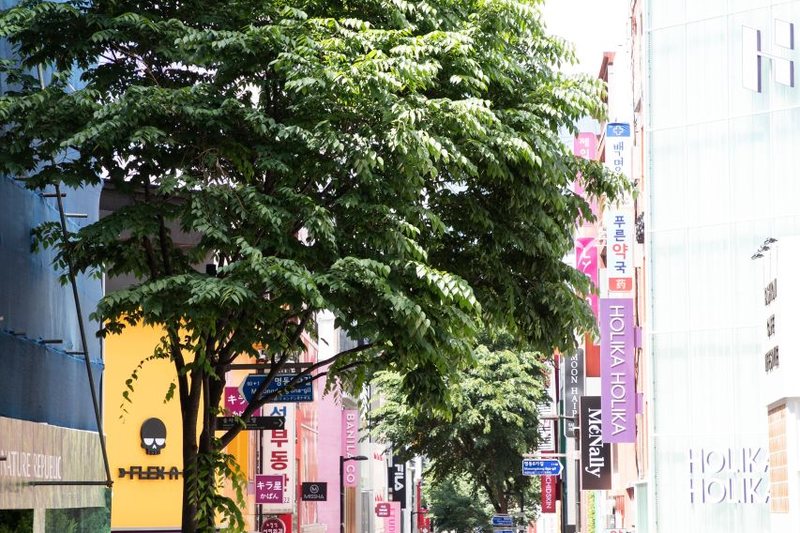
- Myeongdong. Olive Young's Central Myeongdong Town, opened in March 2026, has about 1,000 brands over three floors.
- In the US. Olive Young launched a U.S.-only online store on May 29, 2026, alongside its first U.S. store, in Pasadena, California.
Our Olive Young guide covers the sale calendar, and if you order from abroad, our guide to spotting fake K-beauty shows what Koreans check on the box. Then do what Koreans do: keep the cushion in your bag, not on the bathroom shelf.

Quick answers
Is a cushion the same as foundation?
It is foundation in a different package: liquid foundation soaked into a sponge inside a compact and patted on with a puff. Most cushions go on in thinner, lighter layers than bottled foundation and are made for touch-ups during the day.
Is the SPF in a cushion enough sun protection?
Not by itself. Korea's Ministry of Food and Drug Safety says cushion-type sun products may not protect enough with a single application. Most Koreans apply sunscreen first and the cushion on top.
Why are Korean cushion shades so light?
For years, Korean base makeup was made mainly for the home market, and many products launched in just two shades, 21 and 23. Ranges are widening: TirTir's cushion now comes in 40 shades worldwide.