Over 5 Million Trays a Day: Why Korea's School Lunch Looks So Good
Free for students, planned by a teacher whose subject is food, and served on the same steel tray nationwide. Here is how geupsik really works.
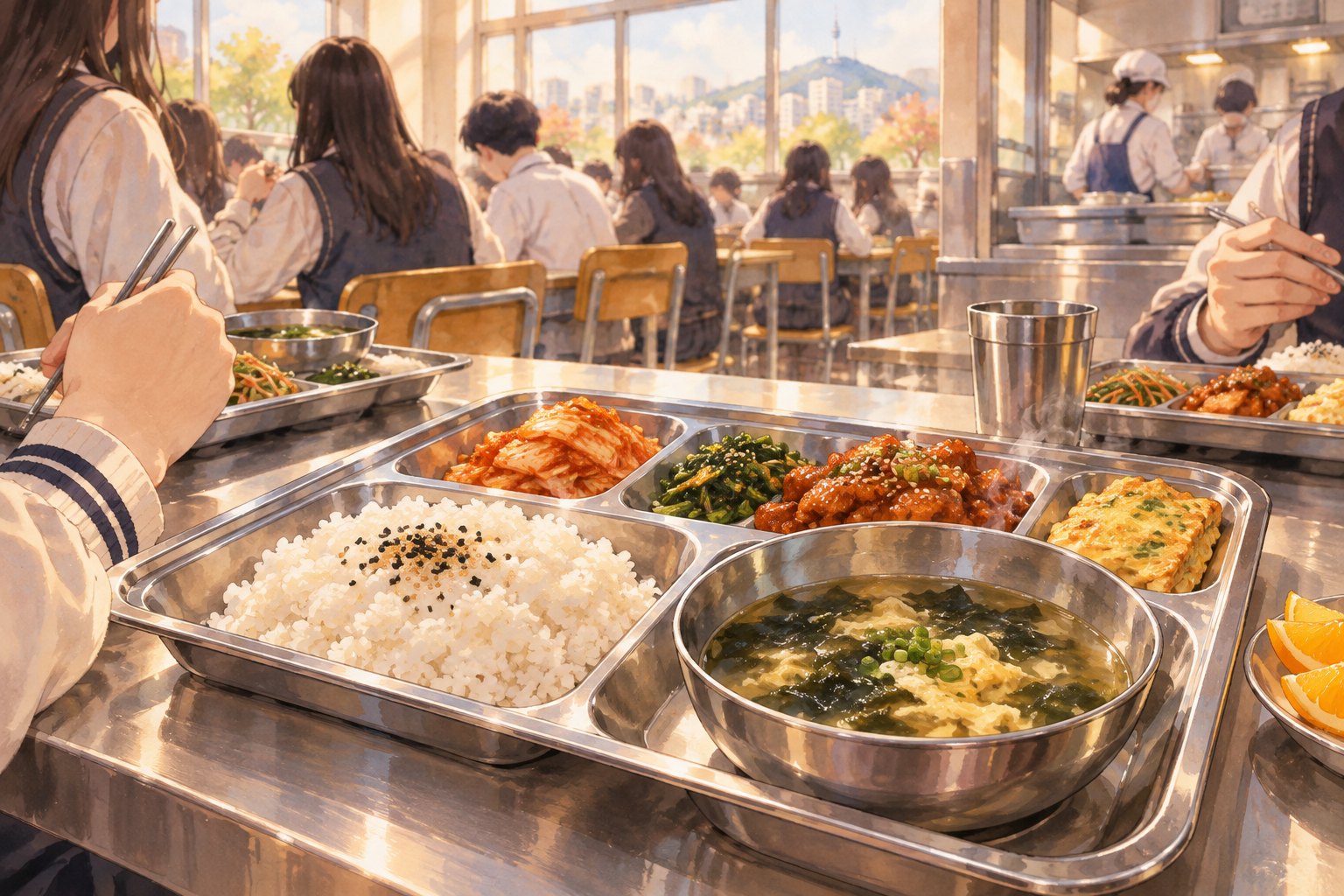
Around noon in a Korean school, a bell rings and a line forms. Each student picks up a stainless steel tray, a spoon and metal chopsticks, then moves past the kitchen staff: a scoop of rice, a ladle of soup, kimchi, two or three side dishes, maybe a piece of fruit. Photos of trays like this go viral abroad again and again, usually with the same reaction: "This is a school lunch?" In Korea it is simply 급식 (geupsik, school meal), and almost every student eats it on every school day.
So why does it look like a restaurant set meal? Three things work together. The tray is built like a Korean home meal, with rice and soup at the center. By law, the menu is planned by a nutrition professional, usually a certified teacher whose subject is food, and most of it is cooked that morning in the school's own kitchen. And for students it is free: since 2021, every elementary, middle and high school in Korea has served lunch at no charge.
Is school lunch really free in Korea?
Yes, for students. Ministry of Education data from February 2021 showed free lunch at all 11,903 elementary, middle, high and special schools in the country. A Ministry of Education and Korean Educational Development Institute report published in March 2026 counts 12,047 schools serving an average of 5.17 million students a day, or 99.9% of all students (as reported by the Korean Education Newspaper). The packed lunchbox has all but disappeared from the school day.
The public pays the bill. Most of the money comes from the 17 regional offices of education, with local governments covering much of the rest, and the national school meal budget reached about 8.26 trillion won in 2024. There is a legal twist many Koreans don't know: the School Meals Act still says that, in principle, families pay for the ingredients. The same law lets national and local governments pay that share instead, and today they do it for every student.
So what does one tray cost? Each region sets its own budget. In North Chungcheong Province, the provincial office of education fixed its 2026 base food cost for each student's free lunch at 3,735 won in elementary schools, 4,429 won in middle schools and 4,736 won in high schools, about 5.6% more than the year before. That base figure covers ingredients only, before extra local money for eco-friendly and non-GMO food, and the office pays kitchen staff and running costs on top.
Two limits surprise people. The free meal is lunch on school days; some high schools also serve dinner to students who stay for evening study, and that meal is usually paid for separately. Teachers eat the same food, but they are not part of the student program, so they normally pay for their own meals.
The teacher whose subject is lunch
School meals in Korea began in 1953 as relief food after the Korean War, and the School Meals Act dates from 1981. Its stated purpose goes beyond filling stomachs: it speaks of better school meals, students' healthy growth in body and mind, and improving how the whole country eats. Article 7 requires every school with a meal kitchen to have a licensed cook and a nutrition teacher, 영양교사 (yeongyang gyosa).
The nutrition teacher, a post created by a 2003 revision of the law, is a certified teacher whose job is the menu. They plan the month's meals, choose and inspect ingredients, oversee kitchen hygiene and teach students about food. The 2026 ministry report counts 7,255 nutrition teachers and 4,095 dietitians in schools, working with more than 61,000 cooks and kitchen assistants.
They cannot put just anything on the tray. The law says school meals must use a variety of foods that meet children's nutritional needs and help them build good eating habits, and its enforcement rules give menu planners a short checklist: carry on Korea's traditional food culture; mix grains, vegetables, fruit, fish, meat, beans and dairy; go easy on salt, fat, sugar and additives; use natural, seasonal foods where possible; and vary the cooking methods. The cooking happens on site, too: in 2021, about 98% of schools ran their own kitchens instead of outsourcing.
What goes on the steel tray
Across the country, the standard lunch is served on a stainless steel tray with five or six sections, according to Korea's Ministry of Culture, Sports and Tourism. A typical day looks like this:
- Rice, often 잡곡밥 (japgok-bap, rice cooked with mixed grains), in one of the two big wells at the bottom.
- Soup or stew in the other big well, just as rice and soup sit side by side on a Korean home table.
- Kimchi, made from cabbage, radish or cucumber, almost every day.
- Two or three banchan (side dishes), usually one with meat, fish, tofu or eggs and one or two vegetable dishes.
- Something extra on many days: fruit, yogurt, juice, a cookie or, on a lucky day, ice cream.
Steel is practical: it survives years of hot washing and sterilizing, and it matches the metal spoon and flat metal chopsticks Koreans use at home. To get more trays back empty, many schools hold a "clean plate" Wednesday and save a favorite such as pork cutlet, fried rice, pasta or bibimbap for that day. Some regional offices of education also encourage vegetarian meals one to four times a month.
Why the whole school eats at the same time
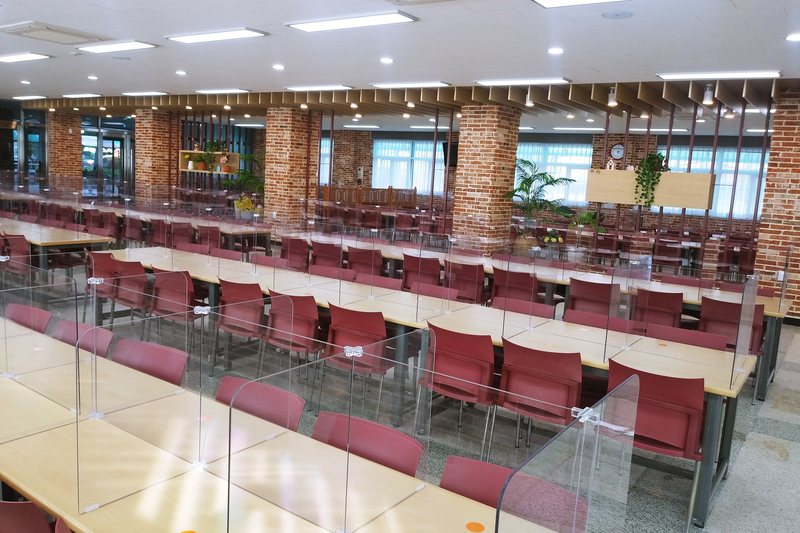
Anyone who has watched a Korean school drama has seen it: lunch is a school-wide event that runs like clockwork. It is a fixed slot in the timetable, as fixed as math class. One kitchen cooks for hundreds of students at once, so the food is timed to come out hot at a set hour. When the dining hall cannot seat everyone, students go in by grade, one group after another; schools without a proper dining hall send the food to classrooms on carts.
There is a quieter reason, too. In a country where "Have you eaten?" works as a greeting, lunch is treated as part of school, not a break from it. By rule, the weekly menu, with allergens marked, hangs in the cafeteria and every classroom, and the monthly menu goes home to families and onto the school website. Allergens usually appear as small numbers after each dish, each standing for an ingredient such as eggs, milk or wheat. No wonder 오늘 급식 뭐야? ("What's for lunch today?") is one of the most-asked questions in any Korean school. Elementary teachers usually eat with their class, and when students finish, they scrape leftovers into bins, stack their trays and often thank the kitchen staff on the way out.
Korean insider tip: If you have a food allergy and will be eating geupsik, for example as an English teacher at a Korean school, learn the menu numbers before day one. They come from one official list of 19 allergens: 1 is eggs, 2 milk, 5 soybeans, 6 wheat, 10 pork, 15 chicken and 16 beef. So a dish marked 1, 5 and 6 contains egg, soy and wheat. Keep the school's monthly 식단표 (sikdanpyo, menu sheet) on your phone and you can plan your week.
What the viral photos don't show
- Not every day is a feast. The trays that go viral are often from special days. A high school in Paju once served every student a whole lobster, and it became famous precisely because it was unusual. Most days mean rice, soup, kimchi and a couple of side dishes.
- Free is not effortless. The budget pays for ingredients, kitchens and tens of thousands of workers, and in 2026 The Korea Herald reported chronic staff shortages in school kitchens, where the work is hot and physically hard.
From lunch tray to slang: geupsik-che
Because nearly every student eats it, geupsik also became an online nickname for school-age kids, and 급식체 (geupsik-che, "school-lunch style") is what Koreans call teenage slang. It reportedly spread from around 2015 and became widely known after a 2017 SNL Korea sketch parodied it. The classic example is 인정? 어 인정 (injeong? eo, injeong), "Agree? Yeah, agree," where the speaker asks and answers in one breath. Use it lightly: the nickname is tied to a harsher insult for teenagers, so calling someone "geupsik" is not a compliment.
Quick answers
Are school lunches free in Korea?
Yes, for students. Since 2021, every elementary, middle and high school in Korea has served free lunch on school days, paid for mainly by regional offices of education and local governments. School dinners and teachers' meals are usually paid for separately.
Do Korean students bring their own lunch?
Almost never. Ministry of Education data show 99.9% of students eat the school meal, so homemade lunchboxes mostly appear on field trips.
What does geupsik mean?
급식 (geupsik) means a meal provided to a group, and in everyday Korean it almost always means school lunch. Online it is also slang for school-age kids, which is where 급식체 (teen slang) gets its name.