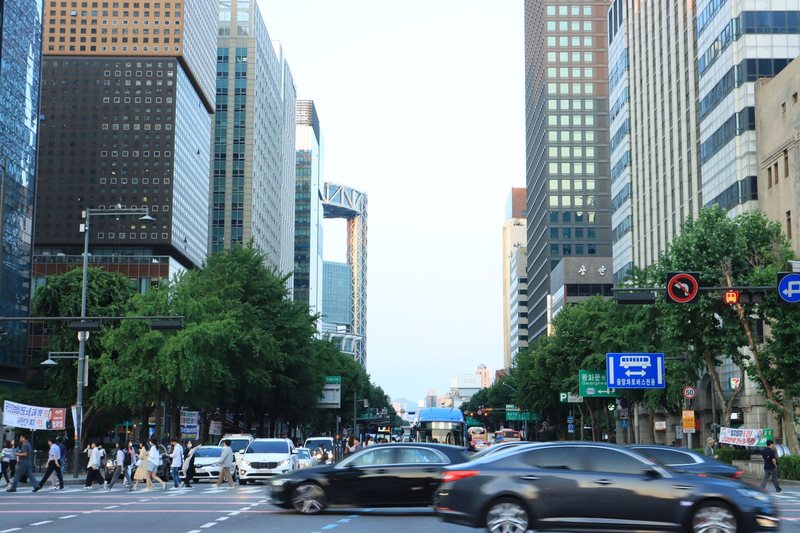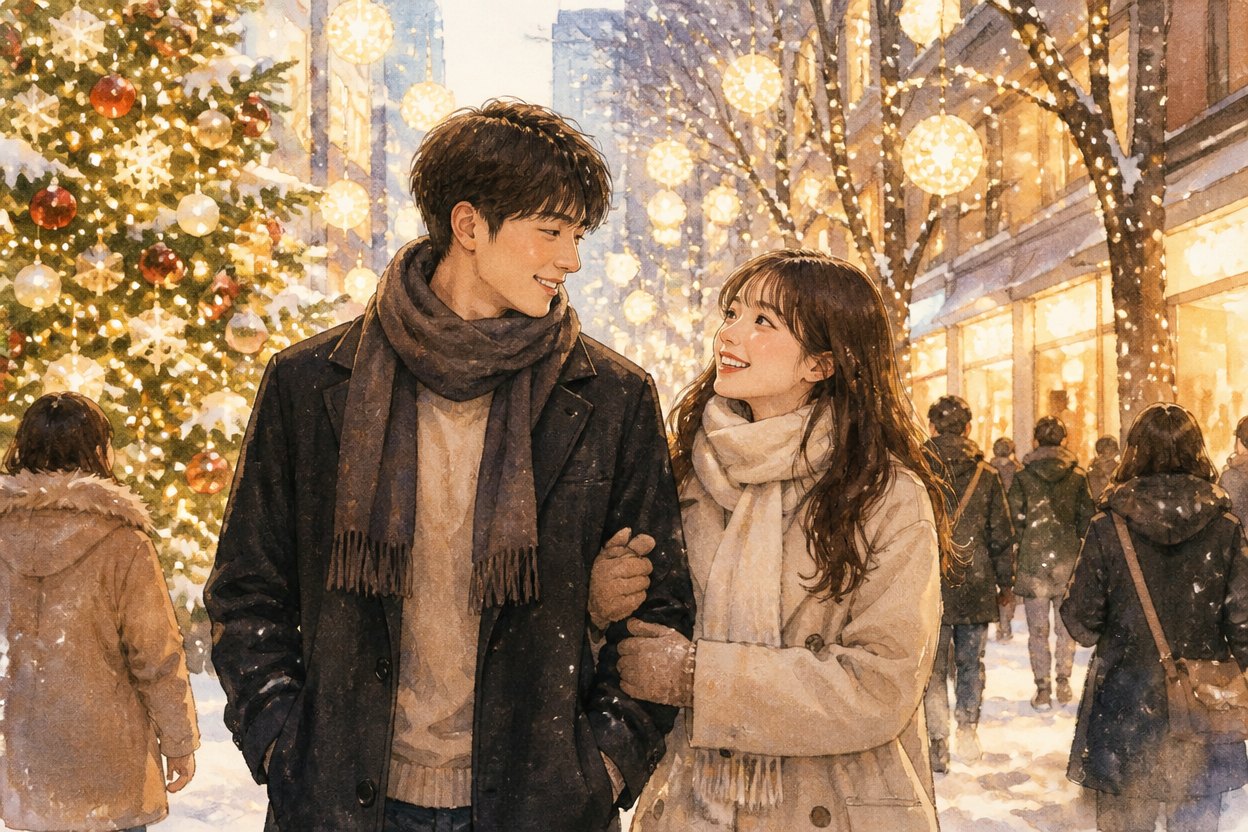
On the evening of December 24, Seoul runs on a different clock. Bakeries have queues out the door, and people leave carrying white cake boxes by the ribbon. Popular restaurants have been fully booked since the middle of the month. Around the light displays downtown, the crowds come mostly in twos, phones raised for the same photo under the same tree, while somewhere across town a group chat of single friends settles on fried chicken and a movie they have all seen before. It looks a lot like Valentine's Day, only colder.
So why is Christmas a couples' holiday in Korea? Christmas Day is a national public holiday here, but it never became the family holiday it is in much of the West, because Korea already has two of those: 설날 (Seollal, Lunar New Year) and 추석 (Chuseok, the autumn harvest holiday), when families travel home and gather around the ancestral table. Christmas arrived later, as a largely secular import, and history handed it to the young: for decades, Christmas Eve was one of the few nights of the year without a curfew. Add a dating culture that loves anniversaries, and you get what a Korea JoongAng Daily explainer called “Valentine's Day, with Santa.” It is a common pattern, not a rule. Plenty of Koreans spend the day at church, with their children, with friends or at work.
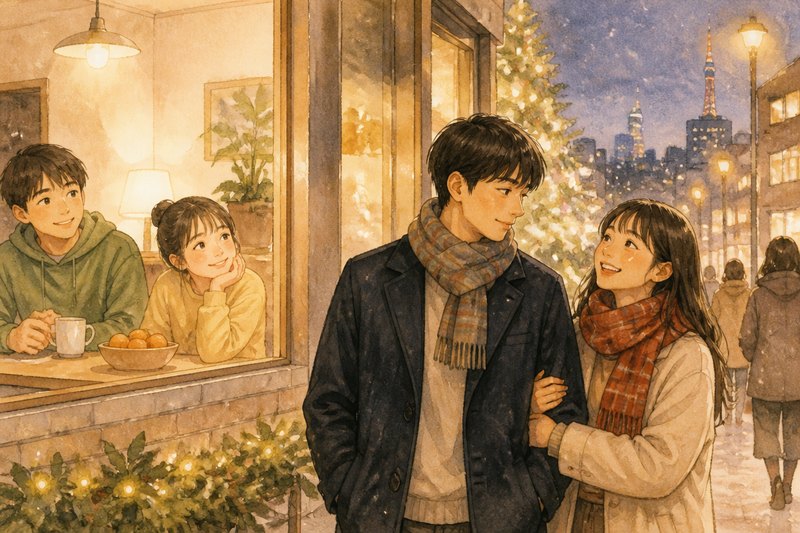
A borrowed holiday and one free night
Christmas came to Korea with Christian missionaries in the late 19th century. Local reports cited by the Korea JoongAng Daily credit the American missionary Mary F. Scranton with the country's first Christmas tree in 1886, and a year later students at Pai Chai School received Christmas stockings, which is how many Koreans first heard of Santa Claus. The day became an official holiday under the American military government of 1945 to 1948, and the new Korean government kept it: a 1949 presidential decree on public holidays listed December 25 as the “Day of Christ's Birth.” Officially it is 기독탄신일 (Gidok Tansinil); most people just say 크리스마스 (keuriseumaseu) or 성탄절 (Seongtanjeol). Christmas Eve, by contrast, is an ordinary working day. In 2026, December 25 falls on a Friday, so many people get a three-day weekend.
Yet Korea never became a mostly Christian country. In the 2015 census by Statistics Korea, Protestant and Catholic Christians together made up a little over a quarter of the population, and 56.1 percent said they had no religion at all. For most households, December 25 came with no inherited ritual and no ancestors to honor. It was a day off with lights, free to become whatever people made of it.
What people made of it, at first, was a night out. From 1945 Korea lived under a nighttime curfew that, as The Korea Herald recounts, went nationwide in 1954, ran from midnight to 4 a.m. after 1961 and was not lifted until January 5, 1982. On a few holidays, Christmas Eve among them, the curfew was suspended, and people poured into the streets. The Korea Times describes Christmas Eves of the 1960s that turned into nights of dancing, shouting and drinking, and notes that in 1970 some 100,000 people crowded into the entertainment districts of Mugyo-dong and Myeong-dong. Christian groups held candlelight prayer services and worried that the holiday was losing its solemnity. For a generation, December 24 meant permission to stay out late, and that is the kind of night couples remember.
From street party to date night
When the curfew ended in 1982, the big night out outlived it and, over the following decades, settled into the dating calendar. Part of the reason is timing. Seollal and Chuseok are three-day holidays full of family duties, while Christmas is a single day with nothing required of anyone. As a professor at Busan Presbyterian University told the Korea JoongAng Daily, it also falls during the school vacation, after the college entrance exam and around the first snow, a season Koreans link with wrapping up the year. A winter day off with no relatives to visit was made for two.
Korean dating culture did the rest. Couples here often count the days from the moment they start going out and celebrate milestones such as the 100th day, and the year is dotted with couple holidays, from Valentine's Day and White Day to Pepero Day on November 11. Christmas slid neatly onto the end of that list. Online, a playful custom that appeared in the 2010s even calls September 17 고백데이 (Gobaek Day, “Confession Day”): start dating that day, count it as day one, and your 100th day lands exactly on December 25.
You can see the result in the bookings. In December 2024, the Korea JoongAng Daily found well-known Seoul restaurants full for the 24th and 25th by mid-month, and hotels with rooms left charging at least double for a Christmas Eve stay. Bakeries feel it too. December is usually the year's biggest month for cake, with sales two to three times higher than in other months, the Seoul Shinmun reported, and some bakeries sell their showpiece cakes by advance order only. In recent years a cake piled with fresh winter strawberries has become the signature Christmas cake, Digital Daily noted in 2024, and as more Koreans live alone, YTN reported that the best-selling cakes have been getting smaller.
Korean insider tip: The big night is Christmas Eve, not Christmas Day. For a dinner date on the 24th, book in late November or early December, since popular places are often full by mid-month, and pre-order your cake rather than joining the queues on the day. Christmas Day is the quieter one: government offices and banks close, but many shops, cafés and restaurants open as usual, so it works well for a relaxed day with friends.
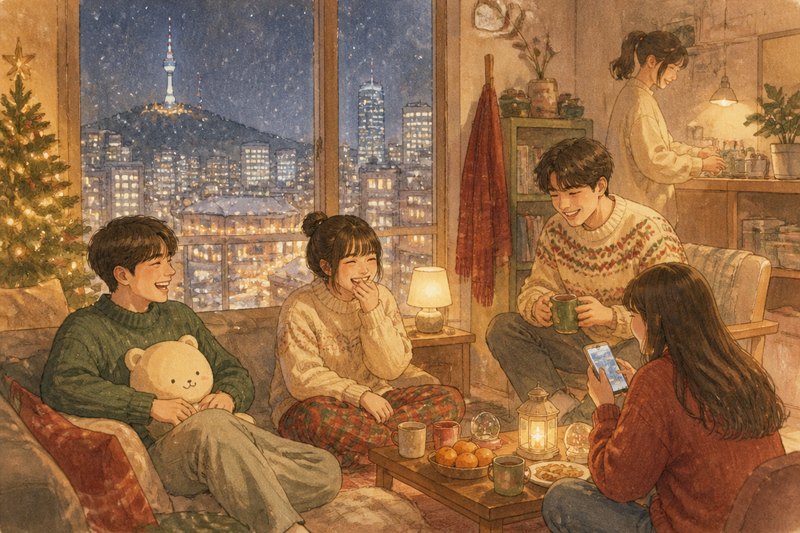
Christmas solo, and the jokes that keep it warm
If Christmas belongs to couples, the people without one need a sense of humor, and Korea has built a whole comic tradition around being a 크리스마스 솔로 (keuriseumaseu sollo, “Christmas solo”). Singles trade tongue-in-cheek slogans like 솔로천국 커플지옥 (sollo cheonguk keopeul jiok, “singles' heaven, couples' hell”), and the best-loved joke comes from television. Because Home Alone has been a holiday staple on Korean cable for years, single people like to announce that they will be spending Christmas with Kevin, the boy left behind in the film. So when someone asks 크리스마스에 뭐 해? (“What are you doing for Christmas?”), “with Kevin” is a ready-made answer.
In 2012 the joke went public. An idea floated on Facebook invited singles to a mass Christmas Eve blind date nicknamed 솔로대첩 (Sollo Daecheop, roughly “the Great Battle of the Singles”), and Al Jazeera reported that more than 20,000 people signed up. On the afternoon of December 24, in sub-zero cold, about 3,500 people gathered at Yeouido Park in Seoul by police estimate, according to a Yonhap report carried by the Seoul Shinmun. The plan was simple: when phone alarms rang at 3:24 p.m., men and women would walk toward each other. In practice, men outnumbered women by about seven to three, very few couples came out of it, and the event fizzled. Earnest, crowded and a little absurd, it was a very Korean Christmas story.
The jokes sit on top of a real shift. Many young Koreans today are single by circumstance or by choice, for reasons that have as much to do with long working hours and the cost of marriage as with romance, as we explore in why young Koreans are dating less. For them, Christmas is often a long day off with friends, a film on their own or an extra shift at work. No one is obliged to pair up, whatever the shop windows suggest.
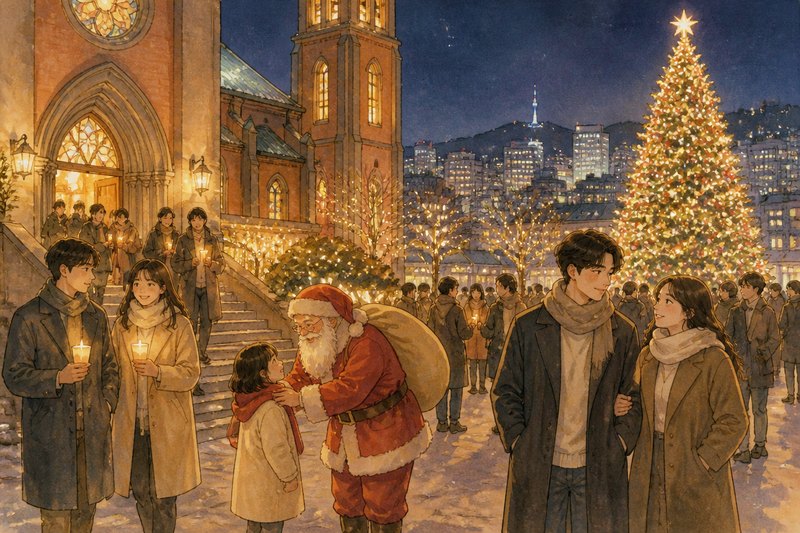
Night Mass, Grandpa Santa and a square full of lights
None of this means Korean Christmas has no family side. For Christians it remains one of the most important days of the year. Churches fill for Christmas services, Sunday school classes rehearse choir performances, and Catholics crowd into churches such as Myeongdong Cathedral for the Christmas Eve night Mass. Families with small children keep a cozier version at home, with a little tree, a cake after dinner and presents from 산타 할아버지 (Santa harabeoji, “Grandpa Santa”), who, according to the Korean lyrics of “Santa Claus Is Coming to Town,” brings nothing to children who cry. Even the Jogye Order, Korea's largest Buddhist order, has lit a hanji-paper Christmas tree lantern at Jogye Temple for more than a dozen years, the Korea JoongAng Daily reports.
The city, meanwhile, makes Christmas something anyone can share. For the 2026 Seoul Winter Festival, Gwanghwamun Square hosts the Gwanghwamun Market from December 11, 2026 to January 10, 2027. Now in its fifth year, it fills the square with a giant tree, stalls and photo zones under the theme “Santa Village Where Time Stands Still,” with free admission, according to VisitSeoul. The city has also scheduled a riverside Christmas market at Ttukseom Hangang Park from December 24 to 27. Exact subway exits, hours and a taxi card for Gwanghwamun are in the Getting there guide at the end.
Stand in that square on Christmas Eve and the whole story is there at once. There are couples, of course, taking turns under the tree. There are also parents lifting toddlers toward the lights, friends who skipped the dating question altogether, churchgoers heading home and visitors wondering why everyone is carrying a cake box. Because Korea never inherited Christmas as a family ritual, each generation has been free to decide what it means. For the curfew generation it was one night of freedom; for their children it became the year's great date night. Today it is turning into something wider: a winter evening that belongs to whoever you choose to spend it with, yourself included.
Getting there
Gwanghwamun Square (2026 Gwanghwamun Market) 광화문광장
- Subway
- Line 5, Gwanghwamun Station, Exit 7 or the Haechi Madang underground passage; Line 3, Gyeongbokgung Station, Exit 6. VisitSeoul lists Line 5 Exit 9 as closest to the market
- Hours
- The square is open 24 hours. Gwanghwamun Market: Dec 11, 2026–Jan 10, 2027, Sun–Thu 17:30–22:00, Fri–Sat 17:30–22:30
- Admission
- Free admission to the Gwanghwamun Market
- Tip
- The 2026 theme is “Santa Village Where Time Stands Still.” The Seoul Winter Festival opening ceremony is held on the square on Dec 12 at 18:00
Checked on November 28, 2026; confirm on the official site before you go.