Koreans Knew 'APT.' Before the World Did: It's a Drinking Game
Behind Rosé and Bruno Mars' global hit is a hand-stacking game Koreans know from drinking tables. Here's how it's played, and why Korea laughed.

At a Korean drinking table, it is easy to tell when a game is about to start. Someone chants a friend's name, the whole table answers in rhythm, and it all ends in a shout: game start! So when Rosé's “APT.” opened with 채영이가 좋아하는 랜덤 게임 (Chaeyeong-iga joahaneun raendeom geim, “Chae-young's favorite random game”), Koreans did not need a translation. Chae-young is Rosé's Korean name, Park Chae-young, and that line is exactly how a round kicks off when friends drink together.
The song is named after the game that follows. 아파트 (apateu) is the Korean word for “apartment,” and it is also a simple hand-stacking drinking game, a long-time favorite at Korean university gatherings. In a statement released through her agency, The Black Label, Rosé called it her favorite Korean drinking game, one she plays with friends back home because it is simple and breaks the ice. One night in the studio she taught it to her crew. Everyone loved the chant, she suggested turning it into a song, and once Bruno Mars joined the track, the rest was history.
How to play apateu
All you need is a circle of friends. According to the Korea Herald and the Korea Times, a round goes like this:
- Everyone chants “apateu, apateu,” usually swinging their hands in a crisscross across the circle.
- When the chant ends, all players pile their hands into one tower in the center. Each hand is one floor of the apartment building.
- The person who started the round calls out a number: the 7th floor, say.
- The lowest hand slides out and goes on top, then the next, while everyone counts the floors out loud.
- Whoever puts their hand on top when the count reaches that number loses, and takes a sip or, in many groups, a small forfeit.
No skill is involved, just rhythm, noise and the suspense of watching your hand climb toward the fatal floor. That is why it works so well as an icebreaker.
The name fits Korea perfectly. In Korean cities, the apartment block is the default home; the Korea Herald noted that 51.9 percent of Koreans lived in apartments by 2022. A game that turns your hands into a high-rise is a very Korean joke.

Why Koreans burst out laughing
For fans abroad, “APT.” was a catchy new pop song. For many Koreans, it was the sound of a packed bar on a Friday night, suddenly coming out of radios and streaming charts around the world. The Korean magazine Hankyung Business pointed out that the game is so ordinary in Korea that local listeners were simply bewildered to hear it in a global hit.
There was a generational twist, too: one university student told the Korea Herald that people who bring up drinking games now seem old-fashioned. So part of the laughter was pure surprise at a slightly dated campus ritual becoming, almost overnight, the coolest song on the planet.
Older Koreans heard another echo. In 1982, the singer Yoon Soo-il released a rock hit of his own called 아파트, a song the Korea Times describes as an indirect comment on the apartment boom in Seoul's Gangnam area at the time. In an interview with Yonhap, Yoon said he was grateful to Rosé and Bruno Mars for “reconstructing” his song. The word he used was 재건축 (jaegeonchuk), the term Koreans use for tearing down an aging apartment complex and building it again, a pun that made Korean readers smile.

From a studio game to the world's biggest single
“APT.” was released on October 18, 2024, ahead of Rosé's first solo studio album, rosie. What followed, on the record:
- Global charts: it debuted at No. 1 on the Billboard Global 200 and spent 12 weeks on top. On Billboard's Global Excl. U.S. chart it logged 19 weeks at No. 1, a record at the time; in January 2026, Billboard reported that HUNTR/X's “Golden,” from KPop Demon Hunters, had passed it.
- United States: it climbed to No. 3 on the Billboard Hot 100 in early 2025, the highest position for a female K-pop artist up to then, the Korea Herald reported.
- YouTube: the official video passed one billion views in early 2025, about three and a half months after release.
- The year's biggest song: IFPI, the global recording industry body, named it the biggest-selling global single of 2025, with 2.06 billion units. It was the first time an artist from outside North America or Europe topped that chart, and the first winner with non-English lyrics.
- Awards: Song of the Year at the 2025 MTV Video Music Awards, a first for a K-pop act; three Grammy nominations, including Record and Song of the Year (Rosé and Bruno Mars opened the February 2026 ceremony with the song, though it did not win); and International Song of the Year at the 2026 BRIT Awards, which Korean media reported as the first BRIT for a K-pop artist.
Not bad for a game that usually ends with someone taking a sip.
A drinking game older than any apartment
Korea's drinking games did not start in college bars. In 1975, archaeologists excavating Wolji, the pond of a royal palace in Gyeongju, the old capital of the Silla kingdom, found a small 14-sided oak die known as 주령구 (juryeonggu). According to the National Institute of Korean History, it was used to hand out forfeits at banquets of the Silla elite, and each face carries a four-character command, such as “drink three cups in one go” or “sing alone and drink alone.” The original was lost in an accident during conservation; a replica is on display at Gyeongju National Museum.
Today's tables have classics of their own. The Korea Times and the Korea Herald list a few long-running favorites:
- 눈치 게임 (nunchi geim): players call out numbers in order, one at a time, with no fixed turns. Say a number at the same moment as someone else, or be the last one left, and you lose. It runs entirely on nunchi, the Korean art of reading the room.
- 삼육구 (samyukgu, “3-6-9”): the circle counts up, but any number containing a 3, 6 or 9 has to be replaced by a clap.
- 지하철 게임 (jihacheol geim, the subway game): pick a Seoul subway line and take turns naming its stations. Freeze or repeat one, and you are out.

Playing it the Korean way, responsibly
In Korea, the legal age to buy alcohol is 19, and it is counted by birth year: everyone becomes eligible on January 1 of the year they turn 19 (our guide to how age works in Korea explains why). Apateu itself needs no alcohol: it works just as well with soft drinks and silly forfeits.
The old habit of pressuring everyone to drink is fading, too. In a 2024 survey of 475 college students cited by the Korea Herald, 29.9 percent said the person they most wanted to avoid at a gathering was someone who keeps pushing drinks on others, and 26.5 percent named the person who only cares about drinking games. If you do drink with Korean friends, a few table manners go a long way; we explain them in how to drink with elders in Korea. And saying no is always fine.
If you go to a K-pop concert
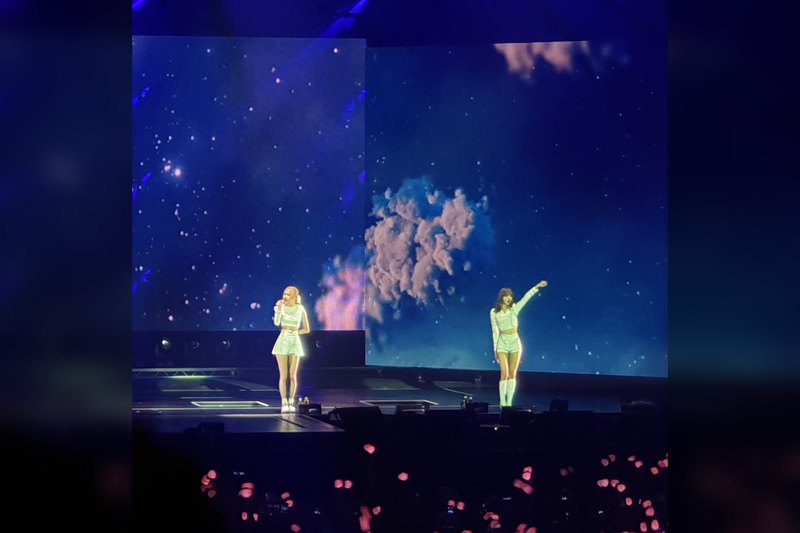
- Learn the first line. 채영이가 좋아하는 랜덤 게임, 랜덤 게임, 게임 스타트! is short, and singing a Korean line back to an artist is the heart of 떼창 (ttechang), a whole crowd singing as one voice. We saw it happen in Rio during K-pop's first night at Rock in Rio.
- Sing the hook. “Apateu, apateu” is built for call-and-response. You do not need to speak Korean to join in.
- Buy tickets only from official sellers. Big K-pop shows sell out fast, and resale scams follow.
Quick answers
What does “APT.” mean in Rosé's song?
“Apartment,” 아파트 (apateu) in Korean, the name of a drinking game in which players stack their hands like floors of a building.
How do you play the APT. game?
Stack everyone's hands, call a floor, then move hands from bottom to top while counting; whoever's hand lands on top at that number loses.
What is the legal drinking age in Korea?
19, counted by birth year: you can buy alcohol from January 1 of the year you turn 19.