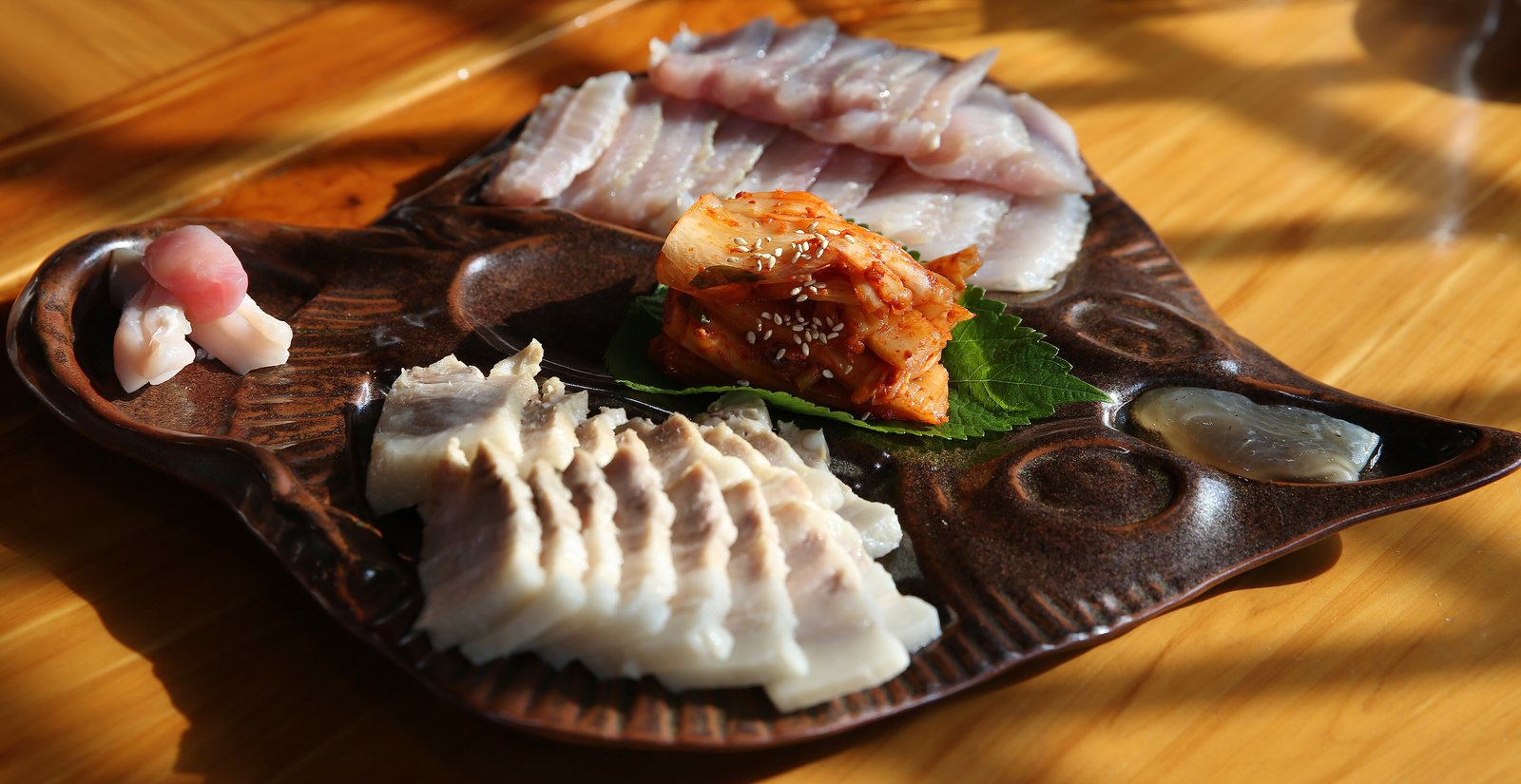
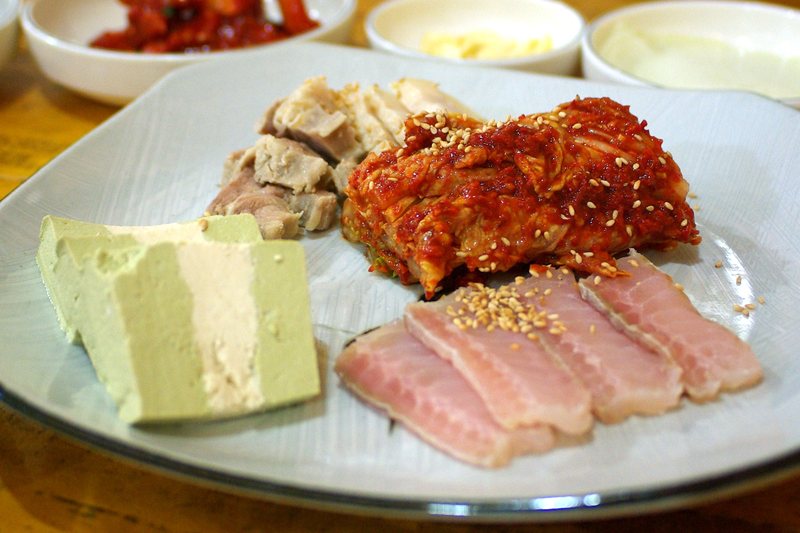
In a restaurant by the old docks of Yeongsanpo, the plate arrives before anyone is quite ready for it. Thin, rose-pink slices of skate are fanned out beside boiled pork and a pile of sour, long-aged kimchi, with a kettle of makgeolli close behind. Someone at the table folds all three into one bite and nods at the first-timer to do the same. Then comes the moment every Korean who has watched it before knows by heart: a breath in through the nose, a sharp sting that climbs straight to the eyes, and the whole table laughing, kindly. This is 홍어 (hongeo), fermented skate, the dish foreigners online have nicknamed "fish in piss." And if you want to know where to try hongeo in Korea, this riverside corner of Naju is where Koreans themselves will send you.
Yeongsanpo is an old river port in Naju, the city behind the second syllable of Jeolla's name in the country's southwest. Naju city counts about 30 restaurants specializing in hongeo around the old docks in Yeongsan-dong, and the Korea Tourism Organization's listing puts the figure at more than 40 once wholesalers are included. What they serve is skate left to ferment until the urea stored in its own flesh breaks down into ammonia. That is the smell, and for its fans it is the whole point. The nickname gets the smell right and the biology wrong.
A fish that carries its own chemistry
Skates, like their relatives the sharks and rays, handle life in salt water in an unusual way. Instead of steadily losing water to the sea around them, they keep their body fluids loaded with urea. A 2022 paper in Frontiers in Physiology explains that these high urea levels keep the fish's body fluids as concentrated as seawater, or slightly more, so the animal avoids dehydration, and that the kidneys of rays and skates are especially good at reclaiming urea instead of letting it go. Skate muscle also holds a compound called trimethylamine oxide, or TMAO.
After the catch, that internal store becomes the recipe. During fermentation the urea is converted into ammonia and the TMAO into trimethylamine, the compound behind a classic fishy smell. A 2020 study of mottled skate in the Journal of Microbiology and Biotechnology followed the flesh turning steadily alkaline, from a near-neutral pH of about 7.1 to above 9.3 within twenty days, while the mix of bacteria narrowed and Pseudomonas, a group that commonly spoils fish, fell from about 11 percent of the community to under 1 percent. A 2021 study in Food Bioscience measured the same climb in ammonia and trimethylamine and credited microbes with building hongeo's distinctive flavor. Koreans have long put it more simply: the ammonia is why a fermented skate does not go bad the way other fish do.
This is where many English articles go astray. They claim that skates have no kidneys or bladder and "urinate through their skin," or that uric acid is the culprit. Neither the physiology nor the fermentation research backs that up. Skates have kidneys, and the source of the smell is urea held in their own tissues, broken down after the catch. Koreans, for their part, do not describe good hongeo as spoiled. The verb is 삭히다 (sakida), to let something ferment and mellow, and the dish is 삭힌 홍어 (sakin hongeo), skate that has been given time.
Fifteen days up the river
Why would anyone leave a fish to do this? Naju's answer is a journey. According to the Encyclopedia of Korean Culture, raids by Japanese pirates led to the people of Heuksando, an island group far off the southwest coast, being moved en masse in 1363 to Nampo, today's Yeongsanpo, on the lower Yeongsan River, leaving the islands empty. Local tradition adds that the newcomers came from Yeongsan-do, a small island off Heuksando, and that the new port took its name from them. Some tellings describe families fleeing the raids; others, like a 2010 Weekly Kyunghyang feature, describe a forced evacuation ordered by the Goryeo court, which emptied islands it could not defend.
The skate, the story goes, came with them. The islanders kept fishing the waters they knew and carried the catch back under sail, across the sea and up the river. Naju city's tourism page says the skate traveled for about a week and fermented naturally on the way; JoongAng Ilbo, retelling the local account in May 2026, puts the trip at about fifteen days. Other fish spoiled on the voyage, the tale continues, while the skate arrived pungent but perfectly edible. Nobody recorded who first dared to eat it, as a 2011 Maeil Shinmun column on the dish admits. The earliest solid witness comes later. In 1814 the scholar Jeong Yak-jeon, exiled to Heuksando, wrote in his fish guide Jasan eobo that people in the towns near Naju liked their skate fermented, and that tastes differed from region to region, as Seoul Shinmun quotes him.
More than six centuries separate 1363 from today, which is where the "600-year tradition" in Naju's festival publicity comes from. It is best read as what it is: a local tradition with a recorded relocation behind it, not a documented first meal. Yeongsanpo grew into a busy river port, until river development in the 1970s and an estuary dam closed the passage to the sea and the boats stopped coming. The skate did not stop. By then Yeongsanpo was where hongeo was aged, sold and sent onward, and it kept that role even as the fish itself changed. Skate from Heuksando is now scarce and costly, with a whole fish retailing for about 250,000 to 350,000 won, JoongAng Ilbo reported, and imported skate, from Chile and Argentina among other places, fills many plates.
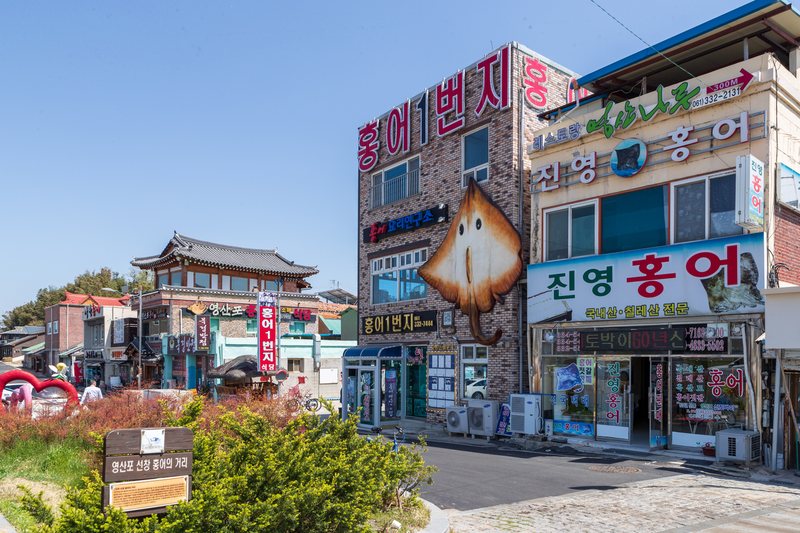
Where to try hongeo in Korea: the street by the old docks
Today the hongeo street sits a short walk from the old Yeongsanpo lighthouse and the riverbank where the boats once tied up. Restaurants serve the fish in the ways Naju city lists: sliced raw, spicy, steamed or boiled. The classic order is 홍어삼합 (hongeo samhap, "hongeo three together"): fermented skate, boiled pork and kimchi in a single bite. The fatty pork softens the sting, and the sour kimchi, often deeply aged kimchi of the kind families make at kimjang, cuts through both. Many tables add makgeolli, a pairing common enough to have its own name, 홍탁 (hongtak), from hongeo plus takju, an older word for the cloudy rice wine. A full set meal can run on to 홍어무침 (hongeo-muchim), a cold, tangy skate salad, then pancakes, steamed and fried skate, and 홍어앳국 (hongeo-aetguk), a soup of skate innards in soybean-paste broth that Naju's tourism page calls a dish you can only try in Naju.
Korean insider tip: Eat from cold to hot. Heat makes fermented skate's aroma stronger, which is why a hongeo set meal in Naju starts with chilled plates. Begin with the tangy 홍어무침 (hongeo-muchim) and samhap, and leave the steamed and fried skate for last; the fried pieces come at the end for a reason. Also know your region: Naju prefers its skate deeply fermented, while Mokpo, at the river's mouth, is known for a lighter touch.
The street is at its busiest in late May, when Naju holds the Yeongsanpo Hongeo and Hanwoo Festival in the riverside park nearby. The 22nd edition ran May 22 to 24, 2026, and drew about 150,000 visitors over three days, up from about 135,000 the year before, according to Naju city figures reported by Electronic Times. The 2027 dates had not been announced when we checked. Bus directions from KTX Naju Station, a taxi card and map links are in the Getting there guide at the end.
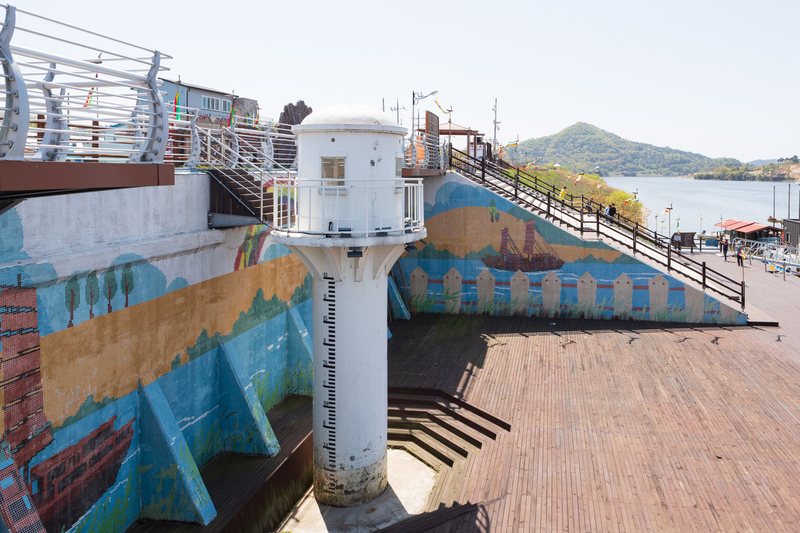
A town that kept its smell
In Jeolla, hongeo has never been only a dare. It is feast food. A saying often repeated in the region holds that a party table without hongeo leaves the guests with nothing to eat, and many families still set it out for celebrations and on holiday ancestral-rite tables. When a friend from the southwest slides the plate toward you, the question is less whether you will like it than whether you will share it. One bite is a perfectly good answer.
For Yeongsanpo, the smell has become a future as well as a past. The town lost its status as an eup, a town in its own right, when it was folded into Naju's urban neighborhoods in 1981, and its population has since shrunk from the 26,000s to around 8,000, JoongAng Ilbo reported. In 2026, after the National Assembly amended the Local Autonomy Act, Naju began merging Yeongsanpo's three neighborhoods, Yeonggang-dong, Yeongsan-dong and Ichang-dong, back into Yeongsanpo-eup, aiming to open the new town office in January 2027 once national approval comes through, WikiTree reported after a residents' hearing in September. One headline summed it up in a phrase: thanks to hongeo, Yeongsanpo is coming back.
That is the quiet logic of hongeo in Korea today. A dish born from a long, slow boat ride now keeps a river town on the map decades after the boats stopped, and a smell that makes newcomers' eyes water is the thing its people are proudest to serve. Koreans who love it rarely try to convince you. They pour the makgeolli, wrap a piece in kimchi, and wait to see whether you will reach for a second bite.
Getting there
Yeongsanpo Hongeo Street (Naju) 영산포 홍어거리
- Subway
- No subway in Naju; take the KTX to Naju Station, then a city bus (see Bus)
- Bus
- From KTX Naju Station (나주역), city bus Express 01 (급행01) runs to its last stop, Yeongsanpo Terminal (영산포터미널). From the terminal, walk past Yeongsanpo Girls' Middle School, the Ichang-dong Center and Yeongsanpo Post Office, then go straight about 300 m
- Hours
- Set by each restaurant; there are no shared opening hours or closing day
- Tip
- The Yeongsanpo Hongeo and Hanwoo Festival is held on the riverside in late May (May 22–24 in 2026). Tourist information: Naju-eupseong Tourist Information Center, +82-61-331-6941
Checked on November 24, 2026; confirm on the official site before you go.