On a weekend afternoon in Seoul, a group of friends squeezes into one of the self-service photo booths that now dot Korea's shopping streets. The countdown beeps, everyone grins, and a strip of four frames drops out of the slot. Look closely and every face shares one small detail: a soft, crescent-shaped ridge sitting right under the lower lashes, as if the eyes kept smiling after the flash. Koreans call it 애교살 (aegyo-sal), and much of everyday Korean eye makeup is built around it.
So what is aegyo-sal makeup? It is the craft of drawing or boosting that little puff so it shows even when you are not smiling. It usually takes two things: a matte brown a couple of shades darker than your skin, blended as a soft shadow along the bottom edge of the puff, and a touch of shimmer on top to make it look plump. Vogue Korea, in a July 2026 feature, places the real thing about 1 to 2 millimeters below the lower lash line and notes that it stands out more when you laugh. The goal is not to look tired. It is to look as if you are about to smile.
What aegyo-sal makeup is really drawing: a smile
The name says a lot. 애교 (aegyo) is the Korean word for cute, charming behavior: the sing-song voice, the playful pout, the way a younger sister stretches out “oppaaa” when she wants a favor. 살 (sal) simply means flesh. So aegyo-sal is, roughly, “charm flesh,” and Koreans say it fondly. In careful print you will also see 애굣살, with an extra ㅅ marking the hard “ss” that Koreans actually pronounce: aegyo-ssal.
It is prized because it belongs to a smile. According to Vogue Korea, aegyo-sal is not simply fat. It comes mostly from the lower-lid part of the orbicularis oculi, the ring of muscle you blink with, which in some people is naturally a little thicker. A real smile tightens that muscle and the band pops up, so a face that carries it at rest looks warm and approachable, as if it has just heard good news. The magazine also likens it to the soft fullness around a newborn's eyes, which is why Koreans tie it to 동안 (dong-an), a “baby face” that looks younger than its years. A Korean plastic surgeon writing for the health site Kormedi in June 2025 noted that the preference is especially strong in Korea, where looking youthful counts for a lot.
So is it natural or makeup? Both. Some people are born with a clear one, others barely have it, and with age, under-eye fat that pushes forward can hide the band that was there. Koreans draw a firm line between the puff they want and the puffiness they don't: 다크서클 (dakeu-seokeul, dark circles) and 눈밑지방 (nunmit-jibang, under-eye fat) belong to a tired face, aegyo-sal to a happy one. The real thing hugs the lashes and moves with your expression; eye bags sit lower and stay put. For most people, makeup fills the gap. Some get filler instead, and Korean health news was already writing about 애교 필러 (aegyo filler) back in 2012.
One flat stroke, one soft flush
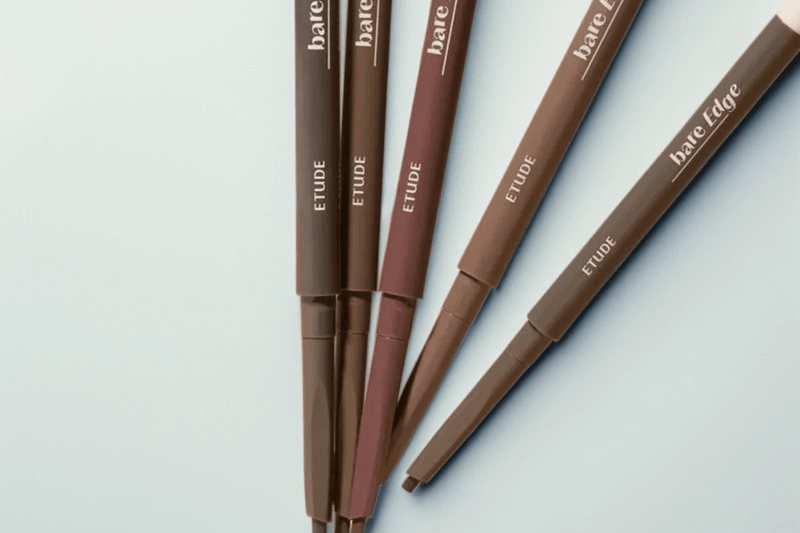
Aegyo-sal rarely travels alone. Vogue Korea dates its rise to the center of Korean beauty to the early 2010s, and it came as part of a whole soft, young-looking face that fans abroad now copy from K-dramas and idol stages. Start with the brows. 일자 눈썹 (ilja nunsseop) means “straight-line brows,” after 一, the character for “one,” a single flat stroke. Instead of a high arch, the brow runs almost level, in a shade close to the hair. In a 2012 tutorial for the Korean women's magazine Lady Kyunghyang, a makeup artist called it the brow of the moment for an innocent, youthful face and shared the method: trim away the peak of the arch, then draw a level line with a pencil close to your hair color. A high arch reads as sharp; a straight brow reads as gentle, the same mood as the puff below the eyes. Brow fashions have wandered since, yet in May 2026 the Korea Herald was still describing a fresh, natural trend with brows drawn straight, hair by hair.
Then the lips. 그라데이션 립 (geuradeisyeon rip, gradient lip) puts the deepest color in the middle of the mouth and lets it fade toward the edges, so the lips look flushed rather than outlined. Many Koreans do it with a lip tint dabbed on the inner lips and blurred outward with a fingertip. Under it all sits the quietest part and the hardest: skin that looks like your own on a very good day. Koreans call base makeup 피부 화장 (pibu hwajang, “skin makeup”), and the aim is thin, even and lit from within, which is exactly the job the cushion compact was invented for. Put together, the face says one thing: young, soft, friendly.
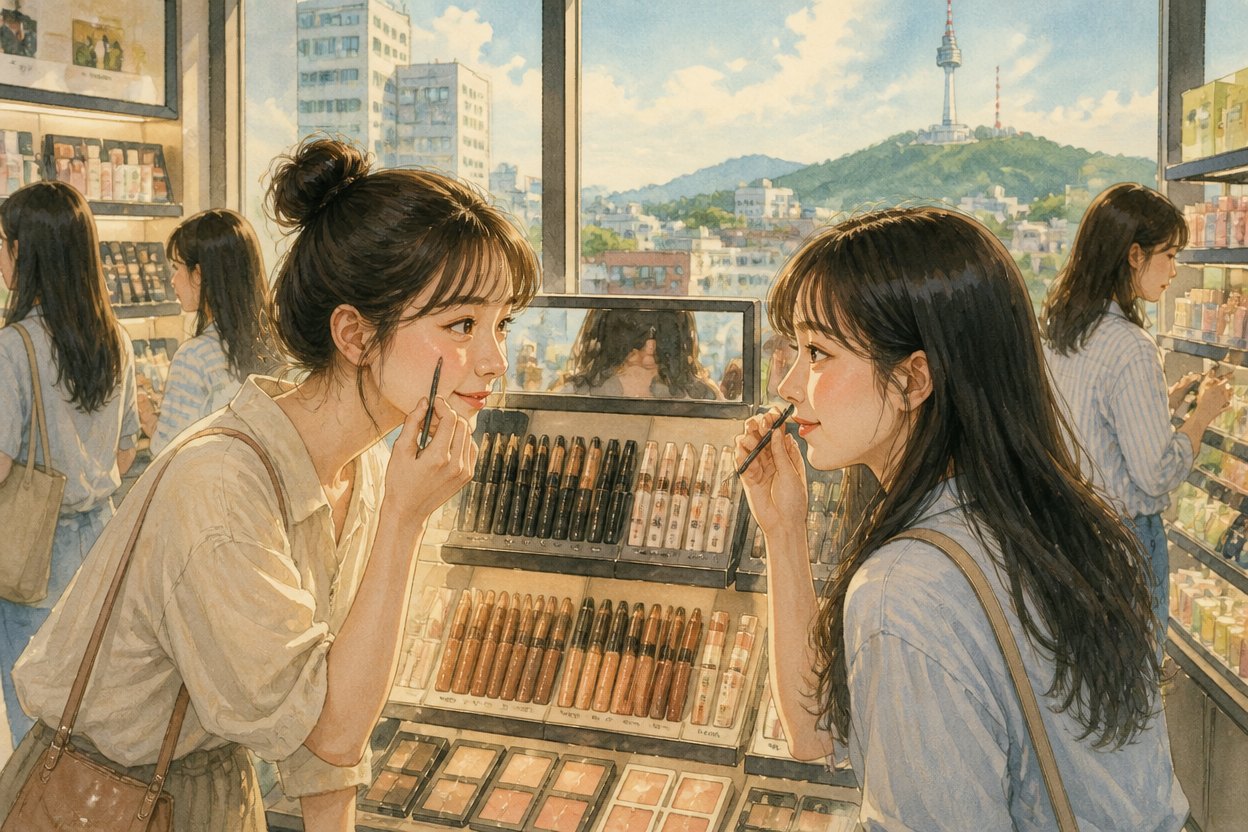
Koreans mostly learn all this by watching and testing. Korean beauty YouTube is full of close-up tutorials, and idols now post makeup clips on their groups' official channels. Then there are the drugstores: in chains like Olive Young, testers sit open on the shelves, and it is an ordinary sight to see students and office workers swatching brown shadows on the backs of their hands, hunting for one that looks like a shadow and not a bruise. The basic recipe, as Vogue Korea lays it out, is a matte brown about two shades darker than your skin, or a light brown eyeliner, blended under the puff, then a shimmery highlighter on top, with the rest of the eye makeup kept light.
Korean insider tip: Find your own line before you draw one. Smile into a mirror and press a fingertip lightly under the outer corner of your eye; the small roll that rises is your aegyo-sal. Shade only along its lower edge, close to the lashes, and blend until no line is visible. If friends start asking whether you slept badly, you went too dark or too low. And in Korean, praise someone's 애교살, never their 눈밑지방 (under-eye fat).
Not the same face as Douyin makeup
Online, Korean makeup is often confused with Douyin makeup, named after Douyin, China's counterpart to TikTok. The mix-up is easy to understand. Both come from East Asia, both spread through short videos, and both care about the space under the eyes; the feature even has its own names across the region, 涙袋 (namida-bukuro, “tear bag”) in Japanese and 卧蚕 (wòcán, “sleeping silkworm”) in Chinese. But the two looks start from different ideas.
Douyin makeup leans into drama. Describing it in May 2026, the Korea Herald pointed to detailed, almost cartoon-like lashes, plenty of glitter and a blurred lip line, with highlighter and sparkle pulling focus to points all over the face. It is built to glow on camera, and doing it well is a real skill. Everyday Korean makeup heads the other way: a thin base, soft browns, and aegyo-sal so subtle that people notice a cheerful face rather than a technique. One look is designed to be seen; the other is designed to look like you, just well rested.
The influence runs both ways. Wonhee of the girl group ILLIT posted a Douyin-style makeup short on the group's official YouTube channel earlier this year, the same report noted, and in March 2026 Allure Korea described 왕홍 (wanghong, Chinese influencer-style) makeup-and-costume photo shoots in Shanghai as a hot experience for young Korean travelers. The neighbors have been studying each other's faces for centuries. Until January 29, 2027, the Coreana Cosmetic Museum in Seoul's Gangnam district is running a free exhibition on exactly that, 《三國三美: 한중일 화장문화》, roughly “Three countries, three beauties: makeup culture of Korea, China and Japan,” with about 80 objects ranging from a Goryeo-dynasty bronze mirror to 19th- and 20th-century cosmetic boxes and hair ornaments. Exact subway stations, hours and a taxi card are in the Getting there guide at the end.
A face that looks ready to smile
Beauty trends turn over fast in Korea. Brows go thin and then straight again, and this year's buzzwords already include mori and Douyin. Aegyo-sal has outlasted most of them, and the reason goes back to that photo booth. Koreans talk a lot about 인상 (insang), the impression a face gives before anyone speaks, and saying someone's 인상이 좋다 (insang-i jota, “has a good face”) is real praise with little to do with glamour. It means you look kind and easy to approach, the sort of person a stranger would stop to ask for directions.
Aegyo-sal is that idea drawn in brown and shimmer: a face set, ever so slightly, to the moment just before a laugh. As Vogue Korea's July feature put it, nobody is chasing a permanent grin, only a way toward looking lovable. It is the same reason one of the warmest compliments in Korea is about your 눈웃음 (nunuseum, eye smile), and why a student practicing at a drugstore mirror and an office worker touching up before a meeting reach for the same little highlighter. In a country that reads faces closely, a soft puff under the eyes is a way of saying “nice to see you” before you have said a word.
Getting there
Coreana Cosmetic Museum (in the space*c building, Gangnam) 코리아나화장박물관
- Subway
- Line 3, Apgujeong Station, or Suin-Bundang Line, Apgujeong Rodeo Station (the nearest stations listed by Visit Gangnam)
- Hours
- Current exhibition: Mon–Fri 10:30–18:00; closed Sat, Sun and public holidays. Visit Gangnam lists Tue–Fri 11:00–17:00, so call +82-2-547-9177 before you go
- Admission
- Free for the 三國三美 exhibition (Sep 10, 2026 – Jan 29, 2027)
- Tip
- The 三國三美 exhibition is on the 6th floor: about 80 objects comparing Korean, Chinese and Japanese makeup culture, including a Goryeo-dynasty bronze mirror
Checked on November 28, 2026; confirm on the official site before you go.